 Back
BackCellular Respiration - General Biology
 01:53
01:53
Terms in this set (20)
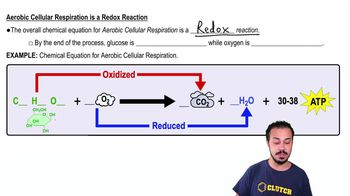
Cellular respiration is the process by which cells convert glucose and oxygen into energy (ATP), carbon dioxide, and water.
To produce ATP, the energy currency of the cell, by breaking down glucose.
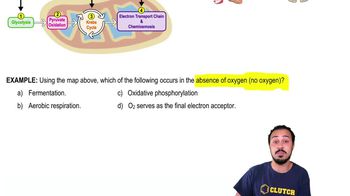
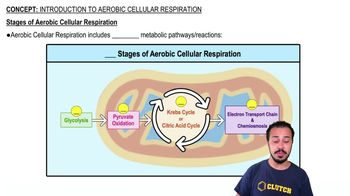
Glycolysis, Citric Acid Cycle (Krebs Cycle), and Electron Transport Chain.
In the cytoplasm of the cell.
Input: 1 glucose molecule; Output: 2 pyruvate molecules, 2 ATP, and 2 NADH.
Pyruvate enters the mitochondria and is converted to acetyl-CoA to enter the Citric Acid Cycle.
In the mitochondrial matrix.
6 NADH, 2 FADH2, 2 ATP, and 4 CO2 molecules.
They carry high-energy electrons to the Electron Transport Chain for ATP production.
In the inner mitochondrial membrane.
Oxygen, which combines with electrons and protons to form water.
Through oxidative phosphorylation, where the proton gradient drives ATP synthase to make ATP.
Approximately \(30-32\) ATP molecules.
Cellular respiration that occurs without oxygen, producing less ATP and often resulting in fermentation products.
A process that regenerates NAD+ from NADH allowing glycolysis to continue in the absence of oxygen.
Alcoholic fermentation and lactic acid fermentation.
ATP provides energy for cellular processes such as muscle contraction, active transport, and biosynthesis.
Oxygen acts as the final electron acceptor, allowing the Electron Transport Chain to function and produce ATP efficiently.
They are released as carbon dioxide (CO2) during the Citric Acid Cycle.
Electrons moving through the Electron Transport Chain pump protons into the intermembrane space, creating a gradient.