Skip to main content
General Biology
My Course
Learn
Exam Prep
AI Tutor
Study Guides
Textbook Solutions
Flashcards
Explore
Try the app
My Course
Learn
Exam Prep
AI Tutor
Study Guides
Textbook Solutions
Flashcards
Explore
Try the app
Back
Cellular Respiration Overview - General Biology
You can tap to flip the card.
What are the starting and ending molecules of cellular respiration?
You can tap to flip the card.
👆
What are the starting and ending molecules of cellular respiration?
Cellular respiration starts with
glucose and oxygen
and ends with
water (H2O), carbon dioxide (CO2), and energy
.
Track progress
Control buttons has been changed to "navigation" mode.
1/10
Recommended videos
01:53
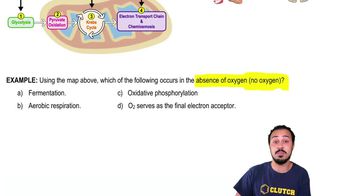
Introduction to Cellular Respiration Example 2
20145
views
234
rank
04:18
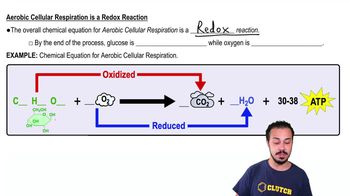
Aerobic Cellular Respiration is a Redox Reaction
31201
views
477
rank
02:31
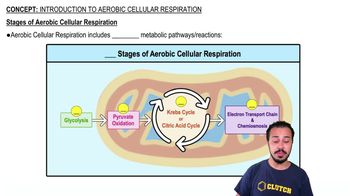
Stages of Aerobic Cellular Respiration
23787
views
362
rank
1
comments
Terms in this set (10)
Hide definitions
What are the starting and ending molecules of cellular respiration?
Cellular respiration starts with
glucose and oxygen
and ends with
water (H2O), carbon dioxide (CO2), and energy
.
What is the main purpose of glycolysis in cellular respiration?
Glycolysis converts sugar into
pyruvate, energy, water
, and electron carriers
NADH
.
What are the products of pyruvate oxidation?
Pyruvate oxidation produces
enzyme CoA, NADH, and CO2
, and this happens twice per glucose molecule.
What happens during the citric acid cycle?
The citric acid cycle uses enzymes and ADP to produce
CO2, electrons for NADH and FADH2, and two ATP molecules
.
What is the role of oxidative phosphorylation in cellular respiration?
Oxidative phosphorylation uses the
electron transport chain (ETC), proton motive force, and ATP synthase
to produce
32 ATP
.
How many ATP molecules are produced in total by cellular respiration?
Cellular respiration produces a total of
32 ATP molecules
.
Which stage of cellular respiration produces water as a product?
Water is produced during
oxidative phosphorylation
when oxygen accepts electrons.
What electron carriers are generated during glycolysis and the citric acid cycle?
Electron carriers
NADH
are produced in glycolysis and both
NADH and FADH2
are produced in the citric acid cycle.
How many times does pyruvate oxidation occur per glucose molecule?
Pyruvate oxidation occurs
two times
per glucose molecule because glucose splits into two pyruvate molecules.
What is the function of Coenzyme A (CoA) in cellular respiration?
Coenzyme A binds to pyruvate during
pyruvate oxidation
to form acetyl-CoA, which enters the citric acid cycle.
 BackBack
 01:53