Water has polar covalent bonds where electrons spend more time near oxygen than hydrogen, creating partial charges and an uneven charge distribution.
What causes hydrogen bonding between water molecules?
The polarity of water molecules allows the partial positive hydrogen atoms to be attracted to the partial negative oxygen atoms of neighboring molecules.
Name the four emergent properties of water important for life.
Cohesion, moderation of temperature, expansion upon freezing, and versatility as a solvent.
What is cohesion in water?
Cohesion is the attraction between water molecules due to hydrogen bonding, resulting in high surface tension.
How does adhesion help plants?
Adhesion is the attraction between water and other substances, like plant cell walls, helping water move upward against gravity.
How does water moderate temperature?
Water absorbs and releases large amounts of heat with little temperature change due to hydrogen bonding.
Define specific heat and water's specific heat value.
Specific heat is the heat needed to raise 1 g of a substance by 1ºC; water's specific heat is 1 cal/(g·ºC).
Why does water have a high specific heat?
Hydrogen bonds absorb heat when breaking and release heat when forming, stabilizing water's temperature.
What is evaporative cooling and its biological significance?
Evaporative cooling occurs when the fastest molecules evaporate, cooling the surface; it helps organisms regulate temperature.
Why does ice float on liquid water?
Ice is less dense because hydrogen bonds form a crystalline lattice that spaces molecules farther apart than in liquid water.
What would happen if ice sank?
Bodies of water would freeze solid from the bottom up, making life impossible in many aquatic environments.
What is a solution, solvent, and solute?
A solution is a homogeneous mixture; the solvent dissolves the solute, which is the substance dissolved.
Why is water called the 'solvent of life'?
Water's polarity allows it to dissolve many ionic and polar substances essential for life.
What is a hydration shell?
A sphere of water molecules surrounding each ion when an ionic compound dissolves in water.
Define hydrophilic and hydrophobic substances.
Hydrophilic substances have an affinity for water; hydrophobic substances repel water, often nonpolar.
What is molarity (M)?
Molarity is the number of moles of solute per liter of solution.
What is the pH scale and its range for biological fluids?
The pH scale measures H+ concentration; biological fluids typically range from pH 6 to 8.
How do acids and bases affect H+ concentration?
Acids increase H+ concentration; bases reduce H+ concentration in solutions.
What is a buffer and its role in cells?
Buffers minimize pH changes by reversibly combining with H+ ions, maintaining stable internal pH.
What is ocean acidification?
The process where CO2 dissolves in seawater forming carbonic acid, lowering ocean pH and affecting marine life.
 Back
Back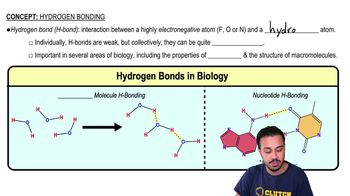
 05:03
05:03