 Back
BackClimate Change and Atmospheric Science in General Biology
 01:36
01:36
Terms in this set (25)
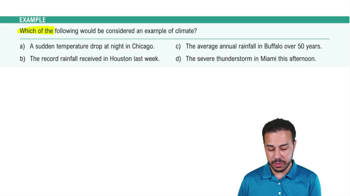
Weather is the atmospheric conditions at a specific time and place, while climate is the average of weather patterns over a long period.
Tree rings show growth patterns; wider rings indicate warmer years with favorable growth conditions, allowing reconstruction of historical temperatures.
Coral bands record growth over centuries, reflecting environmental conditions like water temperature and carbonate availability during each period.
Different sediment layers contain remains of organisms and erosion patterns that indicate rainfall, snowpack, and other climate variables over centuries.
Ice cores preserve gas bubbles and sediment layers that reveal atmospheric composition and temperature changes over thousands of years.
About 0.6°C increase over 30 years, averaging approximately 0.02°C per year.
Recent warming (~0.02°C/year) is much faster than post-ice age warming (~0.0013°C/year over 9700 years).
Milankovitch Cycles: systematic changes in Earth's orbit and orientation relative to the sun cause glacial and interglacial periods over tens of thousands of years.
Temperature anomalies closely track changes in atmospheric CO2 concentrations, indicating a strong correlation over 450,000 years.
It is remote from major human and vegetative sources and near a volcano whose emissions can be accounted for, providing clean baseline data.
Atmospheric CO2 has increased from about 315 ppm in 1958 to over 390 ppm by 2011, correlating with rising global temperatures.
Solar radiation passes through the atmosphere, warms Earth’s surface, which emits infrared radiation absorbed and reemitted by greenhouse gases, warming the surface and troposphere.
Water vapor, carbon dioxide, methane, ozone, nitrous oxide, and various nitrogen oxides.
CO2 varied up to ~300 ppm during past cycles but has spiked dramatically in modern times, exceeding historical peaks.
Starting around the 1800s, coinciding with industrialization, there was a sharp rise in CO2, methane, and nitrous oxide levels.
Carbon dioxide has the greatest contribution, followed by methane at intermediate levels, and nitrous oxide at lower levels.
Rapid increases in carbon emissions from fossil fuels and land use changes since 1850 correlate with rising atmospheric greenhouse gases.
Only about 50% stays in the atmosphere; the rest is absorbed by oceans and terrestrial sinks like vegetation and soil.
Variations in solar energy output and volcanic dust and gases can also affect climate but do not fully explain recent warming trends.
Models incorporating natural factors alone poorly predict observed warming; models including human (anthropogenic) factors better match temperature records.
Oceans warm alongside the atmosphere, often with a lag, and retain heat longer due to higher thermal stability.
Established in 1988 to assess scientific, technological, and socio-economic information on climate change and its impacts and mitigation options.
Industrialized countries agreed to reduce emissions by 5.2% from 1990 levels during 2008-2012, with varying national targets.
The US signed but declined to ratify the Kyoto Protocol, unlike many other countries.
USA and Canada have had the greatest annual carbon emissions since 1800, surpassing Western Europe after 1900.