 Back
BackDNA Tools and Biotechnology
 03:12
03:12
Terms in this set (20)
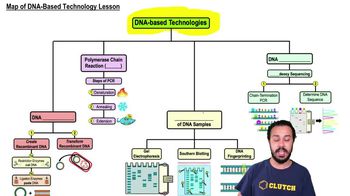
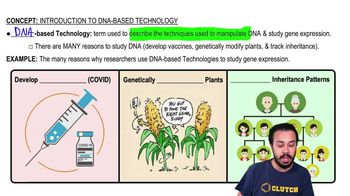
DNA technology refers to methods used to study and manipulate DNA for various applications in research, medicine, and biotechnology.
Biotechnology is the use of living organisms or their components to develop useful products and technologies.
Nucleic acid hybridization is the base pairing of one strand of nucleic acid to the complementary sequence on another strand.
The Sanger method uses dideoxy chain termination to sequence DNA by incorporating chain-terminating nucleotides during replication.
Next-generation sequencing is a high-throughput technique that sequences many DNA fragments simultaneously for rapid results.
Third-generation sequencing sequences single DNA molecules in real time without amplification, allowing longer reads.
Restriction enzymes are proteins that cut DNA at specific sequences called restriction sites.
A sticky end is a single-stranded overhang created by restriction enzymes that can base pair with complementary sequences.
DNA ligase seals the sugar-phosphate backbone of DNA fragments, joining them to form recombinant DNA molecules.
PCR involves denaturation (~95°C), annealing (~50°C) of primers, and extension (~72°C) by DNA polymerase to amplify DNA.
Taq and Pfu polymerases are heat-stable enzymes that synthesize DNA during PCR cycles at high temperatures.
Gel electrophoresis separates DNA by size; negatively charged DNA moves toward the positive electrode, with shorter fragments moving faster.
An expression vector contains promoters and regulatory sequences to enable gene expression in host cells.
cDNA lacks introns, making it suitable for bacterial expression systems that cannot process eukaryotic introns.
Methods include using yeast plasmids, viral vectors, electroporation, and microinjection with thin needles.
A cloning vector is a DNA molecule, often a plasmid, used to carry foreign DNA into a host cell for replication.
Restriction fragments are DNA pieces cut by restriction enzymes that can be joined to vectors to create recombinant DNA.
Restriction sites are specific DNA sequences recognized and cut by restriction enzymes.
PCR amplifies specific DNA sequences, providing sufficient DNA for cloning into vectors.
Electroporation uses electrical pulses to create temporary pores in cell membranes to introduce DNA into cells.