Skip to main content
General Biology
My Course
Learn
Exam Prep
AI Tutor
Study Guides
Textbook Solutions
Flashcards
Explore
Try the app
My Course
Learn
Exam Prep
AI Tutor
Study Guides
Textbook Solutions
Flashcards
Explore
Try the app
Back
General Biology: Cell Biology and Energy
You can tap to flip the card.
Where is DNA located in a prokaryotic cell?
You can tap to flip the card.
👆
Where is DNA located in a prokaryotic cell?
DNA is located in the nucleoid region, which is not membrane-bound.
Track progress
Control buttons has been changed to "navigation" mode.
1/31
Recommended videos
Guided course
04:26
Recap: Prokaryotic vs. Eukaryotic Cells
20258
views
340
rank
Guided course
05:54
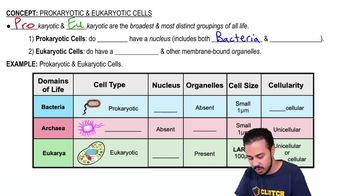
Prokaryotic & Eukaryotic Cells
34438
views
736
rank
4
comments
Guided course
03:54
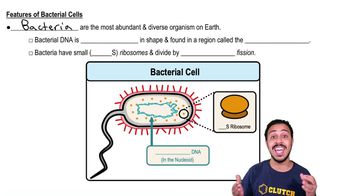
Features of Bacterial Cells
24169
views
422
rank
1
comments
Terms in this set (31)
Hide definitions
Where is DNA located in a prokaryotic cell?
DNA is located in the nucleoid region, which is not membrane-bound.
What features are shared by both eukaryotic and prokaryotic cells?
Both have plasma membranes, cytoplasm, ribosomes, and DNA.
Describe the structure and function of the nuclear envelope.
The nuclear envelope is a double membrane with pores that regulates molecule passage in and out of the nucleus.
What is chromatin?
Chromatin is DNA wrapped around proteins, forming a complex that packages DNA inside the nucleus.
What is the function of ribosomes?
Ribosomes synthesize proteins by translating mRNA.
What is the function of the rough endoplasmic reticulum (ER)?
The rough ER produces proteins, especially those destined for secretion or membranes.
What are the functions of the smooth endoplasmic reticulum (ER)?
The smooth ER synthesizes lipids, detoxifies chemicals, and stores calcium ions.
What is the role of the Golgi apparatus?
The Golgi apparatus modifies, sorts, and ships proteins and lipids received from the ER.
What is the function of lysosomes?
Lysosomes contain enzymes that digest damaged organelles and macromolecules.
Why do plant cells have a central vacuole?
The central vacuole stores water and maintains turgor pressure to support the cell.
What is the function of mitochondria?
Mitochondria generate ATP through cellular respiration.
What evidence supports the endosymbiotic origin of mitochondria and chloroplasts?
They have their own DNA, double membranes, and reproduce independently within cells.
What are the three main fibers of the cytoskeleton?
Microfilaments, intermediate filaments, and microtubules.
What is the fluid mosaic model of the plasma membrane?
It describes the membrane as a fluid phospholipid bilayer with embedded proteins forming a mosaic.
What is diffusion?
Diffusion is the passive movement of molecules from high to low concentration.
What is osmosis?
Osmosis is the diffusion of water across a selectively permeable membrane.
How do animal cells respond to hypertonic solutions?
They lose water and shrink (crenate).
What is the difference between simple diffusion and facilitated diffusion?
Simple diffusion passes molecules directly through the membrane; facilitated diffusion uses transport proteins.
What is active transport?
Active transport moves molecules against their concentration gradient using energy (ATP).
What is endocytosis?
Endocytosis is the process of a cell engulfing material by forming vesicles from the plasma membrane.
What is ATP and its role in the cell?
ATP is the energy currency of the cell, transferring energy through phosphorylation.
What is activation energy?
Activation energy is the energy needed to start a chemical reaction.
How do enzymes speed up reactions?
Enzymes lower activation energy without being consumed.
What is the induced fit model of enzyme action?
The enzyme changes shape to fit the substrate more snugly during binding.
Write the overall chemical equation for cellular respiration.
C6H12O6 + 6 O2 → 6 CO2 + 6 H2O + energy (ATP).
Where does glycolysis occur in the cell?
Glycolysis occurs in the cytoplasm.
What are the products of glycolysis?
Two pyruvate molecules, 2 ATP (net), and 2 NADH.
Where does the citric acid cycle occur?
In the mitochondrial matrix.
How many ATP are produced by oxidative phosphorylation per glucose?
About 26 to 28 ATP molecules.
Why does lack of oxygen kill aerobic cells?
Oxygen is the final electron acceptor in the electron transport chain; without it, ATP production stops.
What is fermentation?
Fermentation is anaerobic energy harvesting that regenerates NAD+ for glycolysis.
 BackBack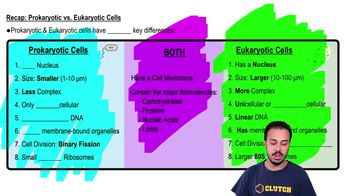
 04:26
04:26