 Back
BackGeneral Biology: Cell Structure and Function
 04:26
04:26
Terms in this set (29)
Contrast is the difference in brightness, color, or appearance between structures that makes them distinguishable, especially under a microscope.
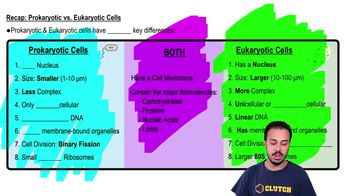
The cell membrane is a thin, flexible barrier surrounding the cell that regulates what enters and leaves the cell.
The nucleus is a membrane-bound organelle containing the cell's DNA and controlling cellular activities.
An organelle is a specialized structure within a cell that performs a specific function.
Cytoplasm is the gel-like material inside a cell that surrounds organelles and supports cellular processes.
The cell wall is a rigid outer layer outside the cell membrane that provides support and protection; found in plants, fungi, bacteria, and some protists.
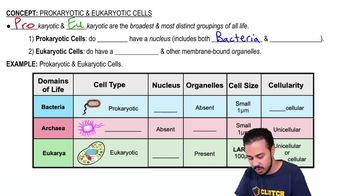
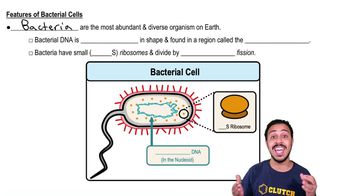
A prokaryotic cell lacks a nucleus and membrane-bound organelles; found in bacteria and archaea.
A eukaryotic cell contains a nucleus and membrane-bound organelles; found in plants, animals, fungi, and protists.
Cyanobacteria are photosynthetic prokaryotes, often called blue-green algae, that produce oxygen through photosynthesis.
A plastid is a plant cell organelle involved in storage or synthesis of food and pigments.
A chloroplast is a plastid containing chlorophyll where photosynthesis occurs.
An amyloplast is a colorless plastid that stores starch in plant cells.
A chromoplast is a plastid containing pigments that give fruits and flowers yellow, orange, or red colors.
Mitochondria are organelles that generate ATP (energy) through cellular respiration; often called the cell's "powerhouses."
The large central vacuole is a large membrane-bound sac in plant cells that stores water, nutrients, wastes, and helps maintain cell pressure.
Cytoplasmic streaming is the movement of cytoplasm within a cell that helps distribute nutrients, organelles, and materials.
A protist is a diverse group of mostly single-celled eukaryotic organisms that are not plants, animals, or fungi.
Amoeboid movement is a type of cell movement involving the extension of the cell membrane and cytoplasm.
Pseudopodia are temporary extensions of the cytoplasm ("false feet") used for movement and feeding by amoebas.
Flagella are long, whip-like structures used by some cells for movement.
A contractile vacuole pumps excess water out of certain freshwater protists to maintain water balance.
Cilia are short, hair-like projections that move cells or move substances across a cell's surface.
An autotroph produces its own food from inorganic substances using light or chemical energy.
A heterotroph obtains food by consuming other organisms or organic matter.
A phototroph uses light as its primary energy source.
A chemotroph obtains energy from chemical compounds rather than light.
Yeast is a unicellular fungus that reproduces mainly by budding and is used in baking and fermentation.
Mold is a multicellular fungus that grows as thread-like filaments called hyphae.
A pyrenoid is a protein-rich structure within chloroplasts of many algae involved in carbon fixation and starch formation.