 Back
BackGeneral Biology Chapter 2: Chemical Bonds and Water Properties
 04:34
04:34
Terms in this set (31)
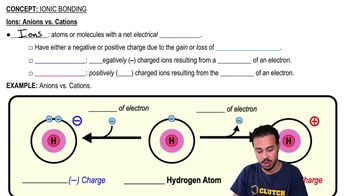
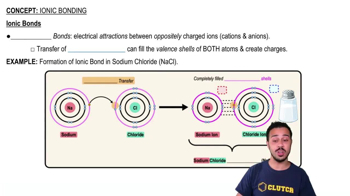
An ionic bond is a chemical bond formed when one atom transfers electrons to another, resulting in oppositely charged ions that attract each other.
A covalent bond is a chemical bond where atoms share one or more pairs of electrons.
A hydrogen bond is a weak attraction between a hydrogen atom in one molecule and an electronegative atom in another molecule.
Water consists of two hydrogen atoms covalently bonded to one oxygen atom, forming a polar molecule with partial charges.
Water has cohesion, adhesion, high specific heat, evaporative cooling, solvent abilities, and surface tension that support life.
The pH scale measures the concentration of hydrogen ions; values below 7 are acidic, above 7 are basic, and 7 is neutral.
An acid increases hydrogen ion concentration in a solution, lowering the pH.
A base reduces hydrogen ion concentration, raising the pH of a solution.
A buffer is a substance that minimizes changes in pH by accepting or donating hydrogen ions.
An atom is the smallest unit of matter that retains the properties of an element.
An electron is a negatively charged subatomic particle orbiting the nucleus of an atom.
A proton is a positively charged subatomic particle found in the nucleus of an atom.
A neutron is a neutrally charged subatomic particle found in the nucleus of an atom.
Electronegativity is the tendency of an atom to attract electrons in a chemical bond.
A polar covalent bond is a covalent bond where electrons are shared unequally, creating partial charges.
A nonpolar covalent bond is a covalent bond where electrons are shared equally between atoms.
Cohesion is the attraction between water molecules due to hydrogen bonding.
Adhesion is the attraction between water molecules and other substances.
Evaporative cooling occurs when water evaporates, removing heat and cooling the surface.
A solution is a homogeneous mixture of two or more substances.
A solvent is the substance that dissolves another substance in a solution, often water.
A solute is the substance dissolved in a solvent to form a solution.
An aqueous solution is a solution where water is the solvent.
A chemical reaction involves the making and breaking of chemical bonds to form new substances.
Reactants are the starting substances in a chemical reaction.
Products are the substances formed as a result of a chemical reaction.
A salt is an ionic compound resulting from the neutralization of an acid and a base.
The atomic number is the number of protons in an atom's nucleus.
Atomic mass is the total number of protons and neutrons in an atom's nucleus.
An isotope is an atom of the same element with different numbers of neutrons.
A radioactive isotope is an unstable isotope that decays over time, emitting radiation.