Skip to main content
General Biology
My Course
Learn
Exam Prep
AI Tutor
Study Guides
Textbook Solutions
Flashcards
Explore
Try the app
My Course
Learn
Exam Prep
AI Tutor
Study Guides
Textbook Solutions
Flashcards
Explore
Try the app
Back
General Biology: Enzyme Function, Cellular Respiration, and Photosynthesis
You can tap to flip the card.
What is allosteric inhibition in enzymes?
You can tap to flip the card.
👆
What is allosteric inhibition in enzymes?
A product binds to a site other than the active site, changing the active site's shape and decreasing substrate binding.
Track progress
Control buttons has been changed to "navigation" mode.
1/29
Recommended videos
02:32
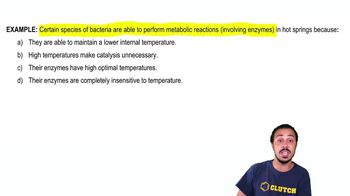
Functions of Enzymes
19130
views
303
rank
1
comments
02:25
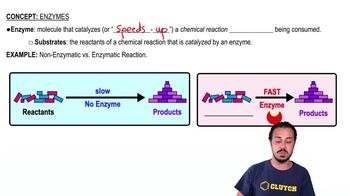
Enzymes Example 1
15380
views
200
rank
02:55
Enzymes
21189
views
363
rank
Terms in this set (29)
Hide definitions
What is allosteric inhibition in enzymes?
A product binds to a site other than the active site, changing the active site's shape and decreasing substrate binding.
What type of inhibition do NSAIDs like Vioxx exhibit on COX-2 enzyme?
They are competitive inhibitors, as high substrate concentrations reduce their efficacy.
How does ethyl alcohol act as an antidote for methyl alcohol poisoning?
Ethyl alcohol competitively inhibits alcohol dehydrogenase by blocking its active site, preventing methyl alcohol breakdown.
What type of inhibition do sulfa antibiotics demonstrate?
Competitive inhibition by occupying the active site and blocking the normal substrate.
How does an acidic environment affect bacterial enzymes?
It causes bacterial enzymes to fail or work less efficiently.
What type of inhibitor is triclosan with respect to sulfotransferase enzyme?
Triclosan is a competitive inhibitor, resembling the substrate and binding the active site.
What role does oxygen play in cellular respiration?
Oxygen accepts electrons at the end of the electron transport chain.
Which molecule collects most electrons from food during cellular respiration?
NAD+ collects the majority of electrons.
Which cellular respiration process is NOT inhibited by cyanide binding to cytochrome oxidase IV?
The reduction of NAD+ and FAD is not inhibited.
How many pyruvate molecules are produced from one glucose molecule during cellular respiration?
Two pyruvate molecules are generated.
Why does stealing electrons from FADH2 and NADH kill insects?
It prevents the electron transport chain from establishing a proton gradient, reducing ATP production.
What kind of poison directly interferes with glycolysis?
An agent that mimics glucose structure but is not metabolized.
How does abundant ATP affect the citric acid cycle?
ATP binds allosterically to slow the enzyme combining acetyl CoA and oxaloacetate, reducing the cycle rate.
What happens to acetyl groups from beta-oxidation of fatty acids?
They directly enter the citric acid cycle.
Where does glycolysis occur in the cell?
Glycolysis occurs in the cytoplasm.
What is the energy source driving ATP synthase in mitochondria?
H+ ions flowing across the mitochondrial inner membrane.
What are the three main products of glycolysis?
ATP, NADH, and pyruvic acid.
Where are the enzymes of the electron transport chain located?
In the inner membrane of the mitochondrion.
Why do plants need two photosystems (PSI and PSII)?
One photosystem alone cannot provide enough energy to reduce NADP+ and produce ATP.
What explains why chloroplasts and mitochondria generate ATP using different energy sources?
Chloroplasts convert solar energy into chemical energy; mitochondria release stored chemical energy.
Why does oxygen production stop if Photosystem II is damaged but Photosystem I functions?
Oxygen is generated only when water is split in Photosystem II.
What is the primary anabolic part of photosynthesis?
Converting CO2 into glucose during the Calvin cycle.
Which light wavelengths result in the highest ATP production during photosynthesis?
Light wavelengths around 450-500 nanometers (blue light) produce the highest ATP rates.
What color of light is reflected by a red leaf?
Red light is reflected.
Where is chlorophyll found in plant cells?
Chlorophyll is located in the thylakoid membranes.
What function does sunlight perform in photosynthesis?
Sunlight excites electrons in chlorophyll to a higher energy level.
What happens if a herbicide blocks electron transfer at photosystems II and I?
Oxygen production decreases and NADPH formation is reduced.
What process is inhibited if the proton gradient across the thylakoid membrane is prevented?
ATP synthesis by ATP synthase is inhibited.
Why are stomata essential for photosynthesis despite water loss?
They allow CO2 to enter, which is necessary for the Calvin cycle.
 BackBack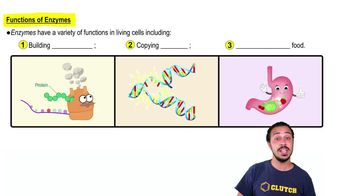
 02:32
02:32