 Back
BackGeneral Biology: Evolution and Natural Selection
 04:22
04:22
Terms in this set (21)
Binomial nomenclature is the two-word naming system for organisms developed by Carolus Linnaeus, consisting of the genus and species names, e.g., Homo sapiens.
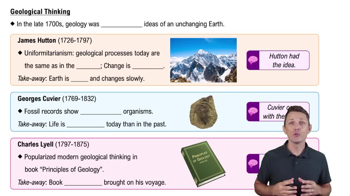
Lyell proposed Uniformitarianism, stating geological processes occur at uniform rates, suggesting Earth is millions of years old, not just thousands.
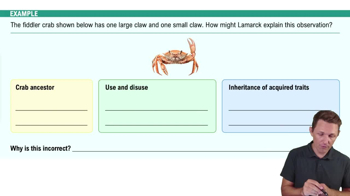
Lamarck proposed that organisms change over time by acquiring adaptations during their lifetime and passing them to offspring, known as the Law of Use and Disuse.
Lamarck did not know that traits are inherited through genes and that genes are not changed by an organism's activities during its lifetime.
Malthus observed that populations grow faster than resources like food, leading to competition and a struggle for survival.
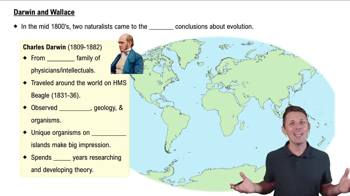
Finches on different islands had different beak shapes adapted to available food, showing adaptation and natural selection in action.
Natural selection is the process where individuals with traits better suited to their environment survive and reproduce more successfully.
Natural selection acts on phenotypes (physical traits), which result from the underlying genotypes (genes).
An adaptation is an inherited characteristic that increases an organism's chance of survival, which can be physical or behavioral.
Mimicry is when a harmless species resembles a harmful one to avoid predators.
Camouflage is an adaptation where an organism resembles its surroundings to avoid detection by predators or prey.
The gene pool is the total collection of alleles in a population.
Genetic changes can be caused by mutations, environmental changes, genetic drift, and gene flow.
Speciation is the formation of a new species through divergence when populations become so different they can no longer interbreed.
Homologous structures are body parts that share a common ancestor but may have different functions, showing evolutionary relationships.
Vestigial structures are body parts that have lost their original function, like the human appendix or whale pelvic bones.
Similarities in embryonic structures among different species suggest a common ancestry.
The fossil record is the collection of all fossils that provide evidence about the history of life on Earth.
Microevolution refers to small evolutionary changes within a population over a short time, such as antibiotic resistance.
Artificial selection is selective breeding by humans to enhance desired traits in plants or animals.
It introduced the theory of natural selection as the mechanism of evolution, explaining how species change over time.