 Back
BackGeneral Biology: Evolution and Natural Selection
 04:22
04:22
Terms in this set (28)
"Nothing in biology makes sense except in the light of evolution." This highlights evolution as the central concept that explains biological diversity and processes.
Binomial nomenclature is the system of naming species using two Latin names: genus and species. It was developed by Carolus Linnaeus.
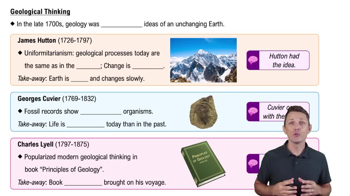
Uniformitarianism is the theory that geological processes occur at uniform rates over time. It was proposed by Charles Lyell.
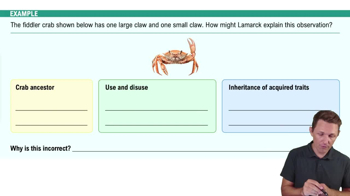
Lamarck proposed that organisms change over time by use and disuse of body parts and that these acquired changes are passed to offspring.
Because traits are inherited through genes, not acquired characteristics, and genes are not changed by an organism's activities during its lifetime.
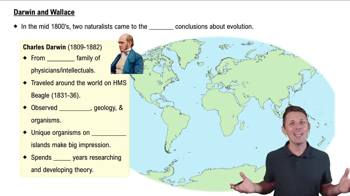
Malthus observed that populations grow faster than resources, leading to a struggle for survival, which influenced Darwin's idea of natural selection.
They showed variation in beak shapes adapted to different food sources, supporting the idea of adaptation and natural selection.
A process where individuals with traits better suited to their environment survive and reproduce more successfully, passing those traits on.
The total collection of alleles in a population's genes.
Mutations, environmental changes, genetic drift, and gene flow can all cause changes in allele frequencies.
An inherited characteristic that increases an organism's chance of survival in its environment.
When a harmless species evolves to resemble a harmful one as a defense mechanism.
Natural selection is a non-random process favoring beneficial traits; genetic drift is a random change in allele frequencies, especially in small populations.
A type of genetic drift where a population's size is drastically reduced, changing allele frequencies in survivors.
Genetic drift that occurs when a few individuals start a new population with different allele frequencies than the original.
Geographic, behavioral, mechanical, and temporal isolation prevent populations from interbreeding, leading to new species.
Prezygotic barriers prevent mating or fertilization; postzygotic barriers prevent viable or fertile offspring after fertilization.
The formation of a new species through divergence and reproductive isolation.
Allele frequencies in a population remain constant unless factors like mutation, selection, or gene flow cause change.
No mutations, no immigration/emigration, no natural selection, random mating, and a large population size.
It can increase or decrease the frequency of phenotypes controlled by one gene, often resulting in two distinct phenotypes.
It can cause directional, stabilizing, or disruptive selection, shifting the distribution of phenotypes in a population.
Similar bone structures in different species indicate common ancestry despite different functions.
Body parts that have lost their original function but remain as evidence of evolutionary history.
Similar embryonic development patterns among species suggest common ancestry.
It provides historical evidence of past life and shows changes in species over time.
Differences in genes within a population that increase the ability to adapt to environmental changes.
Mutations, sexual reproduction (gene shuffling), and gene flow between populations.