 Back
BackGeneral Biology: Evolution and Phylogeny
 04:22
04:22
Terms in this set (29)
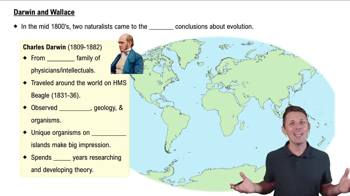
Descent with modification is the process by which species change over time, passing traits to offspring with variations that accumulate across generations.
Artificial selection is the human-driven breeding of organisms to promote desirable traits, demonstrating how selection can change populations.
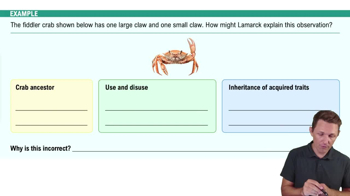
Inherited traits are passed genetically to offspring, while acquired traits are gained during an organism's life and are not inherited.
Homology refers to similarity in traits due to shared ancestry, such as limb structures in different vertebrates.
Biogeography studies the geographic distribution of species, providing evidence for evolution through patterns of species spread and isolation.
Nodes on a phylogenetic tree represent common ancestors where lineages diverged.
Sister taxa are groups that share an immediate common ancestor on a phylogenetic tree.
The hierarchical taxonomy groups range from Domains down to species, organizing biological diversity.
Homologous traits arise from common ancestry; analogous traits arise independently due to similar environmental pressures.
A clade is a group of organisms that includes an ancestor and all its descendants, representing a single branch on the tree of life.
A monophyletic group contains an ancestor and all of its descendants.
Shared ancestral characters are traits inherited from distant ancestors; shared derived characters are new traits unique to a particular clade.
Maximum parsimony is the principle that the simplest explanation or tree with the fewest evolutionary changes is preferred.
A molecular clock uses mutation rates in DNA to estimate the time of evolutionary divergence between species.
Genetic variation is the diversity of alleles and genotypes in a population, essential for evolution.
Mutations in germ cells can be passed to offspring, providing new genetic variation.
Directional, disruptive, and stabilizing selection change phenotype frequencies in populations.
Positive, negative, and balancing selection affect allele frequencies differently in populations.
Sexual selection involves selection for traits that increase mating success, including intrasexual and intersexual selection.
Reproductive isolation prevents gene flow between species and includes pre-zygotic and post-zygotic barriers.
Allopatric speciation occurs when populations are geographically separated, leading to reproductive isolation.
Sympatric speciation occurs without geographic separation, often through genetic or behavioral isolation within the same area.
A hybrid is the offspring of two different species or populations; hybridization can lead to various evolutionary outcomes.
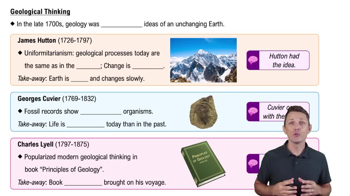
Fossils form when organisms are buried in sedimentary rocks, preserving evidence of past life.
Radiometric dating uses decay rates of radioactive isotopes to determine the age of rocks and fossils.
Plate tectonics explains the movement of Earth's plates; continental drift affects species distribution and evolution.
Mass extinctions are events that drastically reduce biodiversity, often followed by adaptive radiations.
Changes in the sequence or regulation of developmental genes affect organismal development timing, rate, and patterns.
Evolution does not have a predetermined goal; it is shaped by natural selection and random processes over time.