 Back
BackGeneral Biology: Life History and Reproduction
 04:01
04:01
Terms in this set (23)
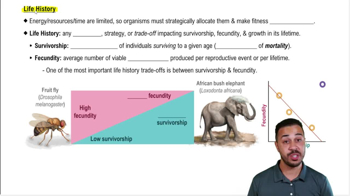
Life history refers to the major events in an organism's life related to surviving, growing, and reproducing.
Organisms reproduce either asexually or sexually, with variation in offspring number, size, and parental care.
Includes binary fission (e.g., E. coli), parthenogenesis (some lizards), and conditional asexual reproduction in species like Daphnia.
Sexual reproduction creates genetic variation via meiosis and fertilization; asexual reproduction produces clones with less variation.
Sexual populations grow slower because only females produce offspring, while asexual populations can reproduce twice as fast.
Sexual reproduction is favored in variable environments; asexual reproduction is favored when organisms are well-adapted to stable environments.
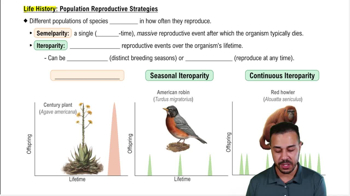
Semelparity: reproduce once then die (e.g., salmon). Iteroparity: reproduce multiple times over lifespan (e.g., deer, humans).
Semelparity is favored when adult mortality is high, so organisms reproduce quickly and invest all energy into one event.
Organisms with longer lifespans tend to reproduce at later ages; shorter-lived species reproduce earlier.
Fishing selects for smaller, younger cod that reproduce earlier, decreasing the average age of sexual maturity over time.
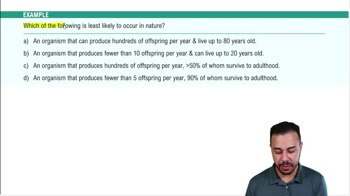
Producing fewer offspring increases survival chances per offspring; producing many offspring reduces individual survival due to limited parental provisioning.
Parental care increases offspring survival, often leading to fewer offspring produced but higher survival rates (e.g., elephants, bicolor damsel fish).
Females invest more energy (larger gametes, gestation), so female reproduction is limited by resources; male reproduction is limited by mate access.
Natural selection based on mating success, leading to traits that improve access to mates or attractiveness.
Competition within one sex (usually males) for mates, often resulting in size dimorphism and traits for fighting.
Mate choice by one sex (usually females), favoring traits that increase attractiveness to the opposite sex.
Ornate tail fins in guppies, bright plumage in birds, large horns in bighorn sheep, all traits that attract mates or aid competition.
Organisms with both male and female reproductive systems, either simultaneously or sequentially (sex change during lifespan).
Protandry: male first, then female; protogyny: female first, then male; sex change maximizes reproductive success.
Sex change is favored when fertility differs by size: smaller individuals benefit from one sex, larger individuals from the other.
Rapid development, early reproduction at small size, semelparity, short lifespan, favored in variable environments.
Slower development, later reproduction at larger size, iteroparity, longer lifespan, favored in stable environments.
Investing energy in one life history trait (e.g., reproduction) often reduces investment in others (e.g., growth or survival).