 Back
BackGeneral Biology - Life History: Survival and Growth
 04:01
04:01
Terms in this set (20)
Life history is the record of major events in an organism’s life, including size and age at maturity, timing of development, reproduction, and age at death.
To survive, grow, and reproduce to pass on genes to offspring.
A life cycle with at least two distinct stages differing in morphology, habitat, physiology, or behavior, such as a butterfly's caterpillar and adult stages.
A life cycle where the organism develops directly from fertilized egg to juvenile, skipping the larval stage, like some salamanders.
Evolution and natural selection optimize life history traits to maximize survival, growth, and gene transmission.
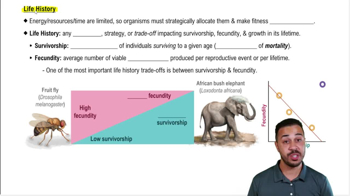
Evolution produces phenotypes that allocate limited resources among competing physiological processes to maximize fitness, leading to trade-offs.
Plants producing many small seeds versus fewer large seeds show a trade-off between seed number and seed size.
The ability of a single genotype to produce different phenotypes under different environmental conditions.
Tadpoles exposed to different food sources develop different mouth sizes and shapes, showing morphological changes despite identical genotypes.
Survival, growth, and reproduction.
Senescence is the decline in fitness due to physiological deterioration, leading to death or loss of reproductive ability.
Type I: high survival early, rapid decline late (e.g., humans). Type II: constant mortality rate (e.g., songbirds). Type III: high early mortality, survivors live long (e.g., marine invertebrates).
When predators preferentially kill individuals with certain traits, altering the trait distribution in the population.
Predation on small individuals can shift the population's average trait size upward and narrow the trait distribution.
Faster development can lead to smaller adult size, which may reduce competitive ability, as seen in Chinook salmon jacks.
Selective pressure favors tadpoles that develop quickly enough to leave drying ponds, often resulting in smaller adult size.
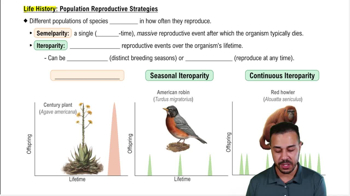
Reproducing multiple times during a lifespan, as opposed to semelparous reproduction which is a single reproductive event.
Individuals may differ in timing and number of offspring due to environmental and genetic factors, showing plasticity.
Fitness is the genetic contribution of an organism to future generations, often maximized by natural selection acting on life history traits.
Because of limited resources, organisms face trade-offs and must allocate energy to competing processes to maximize fitness.