Skip to main content
General Biology
My Course
Learn
Exam Prep
AI Tutor
Study Guides
Textbook Solutions
Flashcards
Explore
Try the app
My Course
Learn
Exam Prep
AI Tutor
Study Guides
Textbook Solutions
Flashcards
Explore
Try the app
Back
General Biology Unit 2 Review
You can tap to flip the card.
ATP yield: fermentation vs respiration
You can tap to flip the card.
👆
ATP yield: fermentation vs respiration
Fermentation produces
2 ATP
while aerobic respiration produces
36 ATP
.
Track progress
Control buttons has been changed to "navigation" mode.
1/27
Recommended videos
Guided course
01:53
Introduction to Cellular Respiration Example 2
16941
views
207
rank
Guided course
04:18
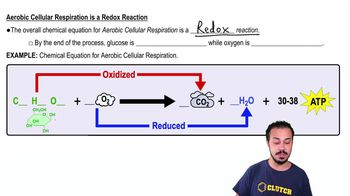
Aerobic Cellular Respiration is a Redox Reaction
25238
views
415
rank
Guided course
02:31
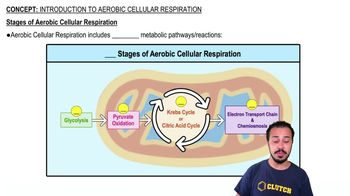
Stages of Aerobic Cellular Respiration
19793
views
315
rank
1
comments
Terms in this set (27)
Hide definitions
ATP yield: fermentation vs respiration
Fermentation produces
2 ATP
while aerobic respiration produces
36 ATP
.
What drives ATP synthase to produce ATP?
ATP synthase harnesses energy from
a hydrogen gradient
to catalyze ATP production.
Which molecule does not supply high energy electrons to the electron transport chain?
ATP
does not supply high energy electrons; NADH, FADH2, Photosystem I and II do.
Processes occurring in mitochondria
The
Citric Acid Cycle
and
pyruvate decarboxylation
occur in mitochondria; glycolysis and fermentation do not.
Pyruvate is converted into what to enter the citric acid cycle?
Pyruvate is converted into
acetyl-CoA
before entering the citric acid cycle.
Correct equation for cellular respiration
C6H12O6 + 6 O2 → 6 CO2 + 6 H2O
represents cellular respiration.
End product of glycolysis
Glycolysis breaks down glucose into
2 molecules of pyruvate
.
Water donates an electron to which photosystem?
Water donates an electron to
Photosystem II
, causing it to split into oxygen and hydrogen.
Product of the Calvin cycle
The Calvin cycle produces
Glyceraldehyde-3-phosphate (G3P)
.
Products of photosynthetic light reactions
Light reactions produce
ATP and NADPH
.
First step in the Calvin cycle (dark reactions)
The first step is
carbon fixation
.
Which molecule is not produced during photosynthesis?
CO2
is not produced; G3P, ATP, O2, and NADPH are produced.
Location of photosynthetic pigments
Photosynthetic pigments are located in the
thylakoid membrane
.
Why do C4 and CAM plants fix CO2 to a 4-carbon molecule first?
To
prevent drying out on hot days
by efficiently fixing CO2.
During anaphase in mitosis, what happens?
During anaphase,
sister chromatids separate
.
What does the G1 checkpoint check for?
It checks for
growth factors, nutrient levels, and cell size
before division.
Where do spindle fibers attach on chromosomes during mitosis?
Spindle fibers attach to the
kinetochore
.
During which mitosis phase does the nucleus break down?
The nucleus breaks down during
prophase
.
When does crossing over occur in meiosis?
Crossing over occurs during
Prophase I
.
What is cytokinesis?
Cytokinesis is when the cell
pinches into two daughter cells
.
What forms spindle fibers during cell division?
The
centrosomes
form spindle fibers.
If egg cells have 10 chromosomes, what is the diploid number?
The diploid number is
20 chromosomes
.
Relationship of two copies of chromosome one in a diploid cell
They are
homologous chromosomes
.
Cause of Down syndrome
Down syndrome is caused by
trisomy 21
.
Phase of meiosis when independent assortment occurs
Independent assortment occurs during
Metaphase I
.
Genotype of a human gamete for genes A, B, and C
A human gamete genotype is
AbC
(one allele per gene).
Inheritance pattern: disorder equally in men and women, skipping generations
This suggests an
autosomal recessive
disorder.
 BackBack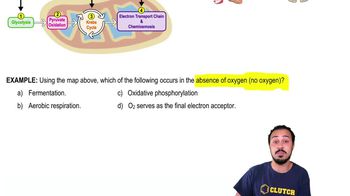
 01:53
01:53