 Back
BackGeneral Biology: Water, Carbon, and Biomolecules
 01:54
01:54
Terms in this set (28)
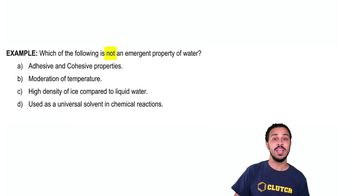
Water's unique chemical and physical properties arise from its molecular structure and polarity, enabling key biological functions.
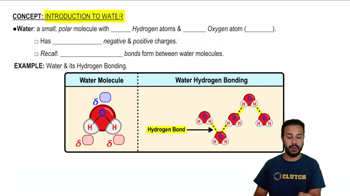
Water molecules have a partial negative charge near oxygen and partial positive charges near hydrogen atoms, creating polarity.
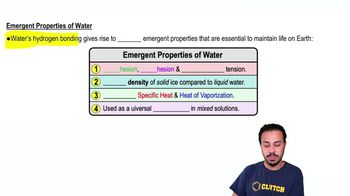
Hydrogen bonds form between the polar water molecules, leading to cohesion, adhesion, and surface tension.
In ice, stable hydrogen bonds form a lattice that makes ice less dense than liquid water, allowing it to float and insulate aquatic life.
Temperature is the average kinetic energy of molecules in a substance.
Water has a high specific heat, requiring much energy to change temperature, which helps maintain homeostasis.
Water absorbs significant heat when evaporating, aiding cooling mechanisms like sweating.
A solution is a mixture of a solute (dissolved substance) and a solvent (dissolving substance), often water.
Hydrophilic substances are polar or charged and dissolve in water; hydrophobic substances are nonpolar and do not dissolve.
Acids increase hydrogen ion (\(H^+\)) concentration; bases decrease it.
The pH scale is a logarithmic measure of hydrogen ion concentration in a solution.
Buffers resist pH changes by absorbing or releasing hydrogen ions to maintain stable conditions.
Carbon forms four covalent bonds, allowing diverse molecular structures essential for life.
Hydrocarbons are molecules composed only of carbon and hydrogen.
Variation occurs in backbone length, double-bond position, and branching or ring formation.
Methyl (-CH3): nonpolar, affects gene expression.
Hydroxyl (-OH): polar, forms alcohols.
Carboxyl (-COOH): acidic.
Amino (-NH2): basic.
Phosphate (-PO4): negative charge.
Sulfhydryl (-SH): forms disulfide bonds.
Formed by dehydration synthesis (removing water) and broken down by hydrolysis (adding water).
Carbohydrates: monosaccharides, linked by glycosidic bonds.
Proteins: amino acids, linked by peptide bonds.
Nucleic acids: nucleotides, linked by phosphodiester bonds.
Energy storage and structural components, e.g., starch for energy and cellulose for structure.
Primary: amino acid sequence.
Secondary: alpha-helix and beta-sheet.
Tertiary: 3D shape from R group interactions.
Quaternary: multiple polypeptide chains.
Loss of structure due to heat, pH changes, or salt concentration.
Chaperones assist in refolding denatured proteins to restore function.
A phosphate group, a pentose sugar (ribose or deoxyribose), and a nitrogenous base.
Purines: adenine and guanine.
Pyrimidines: cytosine, thymine, and uracil.
In DNA, adenine pairs with thymine and cytosine pairs with guanine.
Triglycerides store energy; phospholipids form membranes; steroids like cholesterol aid structure and signaling; waxes provide protection.
One glycerol molecule linked to three fatty acids, used for energy storage.
They have hydrophilic heads and hydrophobic tails, making them ideal for cell membranes.