 Back
BackWater and Its Properties in General Biology
 01:54
01:54
Terms in this set (20)
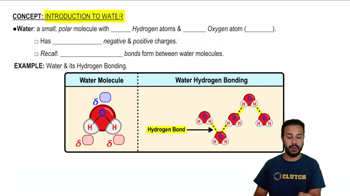
Water has two highly polar covalent bonds arranged in a V shape, with a partially negative oxygen atom and partially positive hydrogen atoms.
Water's polarity allows it to form hydrogen bonds where the partially positive hydrogen atoms attract the partially negative oxygen atoms of neighboring molecules.
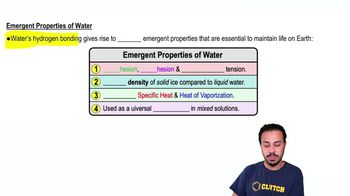
Cohesion is the attraction between water molecules due to hydrogen bonding, causing them to stick together.
Surface tension arises from cohesion among surface water molecules, making it difficult to break the surface of water.
Adhesion is water molecules sticking to other polar or charged substances, aiding in transport in plants.
Water absorbs or releases large amounts of heat with little temperature change due to hydrogen bonds breaking and forming, stabilizing environmental temperatures.
Heat of vaporization is the heat required to convert 1 g of water from liquid to gas, which is high due to hydrogen bonds needing to be broken.
When water evaporates, molecules with the highest kinetic energy leave, cooling the remaining liquid's surface.
Ice is less dense because hydrogen bonds form a stable, spacious crystal lattice, spacing molecules farther apart than in liquid water.
A solute is the substance dissolved, the solvent is the dissolving agent, and the solution is the uniform mixture of both.
Polar and ionic substances dissolve in water (polar solvent), while nonpolar substances do not.
A mole is 6.02 x 10²³ particles of a substance, representing a specific number of atoms or molecules.
Molecular mass is the sum of atomic masses in a molecule (Daltons), molar mass is the mass of one mole of molecules in grams.
Molarity = moles of solute divided by liters of solution; it measures solute concentration.
Hydrophilic molecules are polar or ionic and interact with water; hydrophobic molecules are nonpolar and do not interact with water.
2 H\(_2\)O ⇌ H\(_3\)O+ + OH–
Acids increase [H+] by donating protons; bases decrease [H+] by accepting protons.
pH = -log10[H+]; pH < 7 is acidic, pH = 7 neutral, pH > 7 basic.
Buffers minimize pH changes by donating H+ when pH rises and accepting H+ when pH drops, often using weak acid-base pairs.
The bicarbonate buffer system: H2CO3 ⇌ HCO3– + H+, which regulates blood pH.