Skip to main content
General Biology
My Course
Learn
Exam Prep
AI Tutor
Study Guides
Textbook Solutions
Flashcards
Explore
Try the app
My Course
Learn
Exam Prep
AI Tutor
Study Guides
Textbook Solutions
Flashcards
Explore
Try the app
Back
Water and Life - General Biology
You can tap to flip the card.
What type of bond forms between water molecules?
You can tap to flip the card.
👆
What type of bond forms between water molecules?
Hydrogen bonds
form between the polar covalent bonds of water molecules.
Track progress
Control buttons has been changed to "navigation" mode.
1/20
Recommended videos
05:03
Hydrogen Bonding
22045
views
360
rank
1
comments
Terms in this set (20)
Hide definitions
What type of bond forms between water molecules?
Hydrogen bonds
form between the polar covalent bonds of water molecules.
Name four emergent properties of water that contribute to Earth's suitability for life.
Cohesive behavior, ability to moderate temperature, expansion upon freezing, and versatility as a solvent.
What is cohesion in water molecules?
Cohesion is the attraction between water molecules due to hydrogen bonding, resulting in high surface tension.
How does adhesion help plants transport water?
Adhesion is the attraction between water and plant cell walls, helping water move upward against gravity.
How does water moderate temperature?
Water absorbs heat from warmer air and releases heat to cooler air, changing temperature only slightly.
Define thermal energy and temperature.
Thermal energy is the total kinetic energy of molecules; temperature is the average kinetic energy.
What is a calorie in terms of water heating?
A calorie is the heat needed to raise 1 g of water by 1°C or released when it cools by 1°C.
What is specific heat and why is water's specific heat high?
Specific heat is heat needed to change 1 g of substance by 1°C; water's is high due to hydrogen bonding.
Explain evaporative cooling in water.
Evaporation removes heat from the surface, cooling the remaining liquid, stabilizing temperatures.
Why does ice float on liquid water?
Ice is less dense because hydrogen bonds form a crystalline lattice that spaces molecules farther apart.
What is a solution, solvent, and solute?
A solution is a homogeneous mixture; solvent dissolves the solute, which is the dissolved substance.
Why is water called a versatile solvent?
Water's polarity allows it to dissolve ionic compounds and polar molecules by forming hydration shells.
Define hydrophilic and hydrophobic substances.
Hydrophilic substances attract water; hydrophobic substances repel water, often nonpolar like oils.
What is the significance of water in the search for life on other planets?
Water is essential for life; planets with water, like Mars, are prime targets in the search for life.
What happens during the dissociation of water molecules?
Water molecules split into hydronium ions (H3O+) and hydroxide ions (OH-).
How do acids and bases affect hydrogen ion concentration?
Acids increase H+ concentration; bases reduce H+ concentration in a solution.
What is the pH scale and what does it measure?
The pH scale measures H+ concentration; values below 7 are acidic, above 7 are basic.
What role do buffers play in biological systems?
Buffers minimize pH changes by reversibly combining with H+ and OH- ions.
How does ocean acidification occur?
CO2 dissolves in seawater forming carbonic acid, lowering pH and affecting marine life.
Why is carbonate ion important for marine organisms?
Carbonate ions are needed for calcification to build calcium carbonate structures like coral reefs.
 BackBack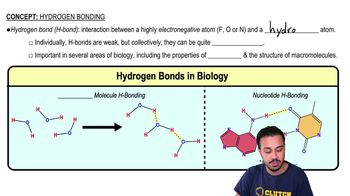
 05:03
05:03