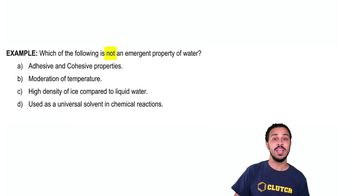
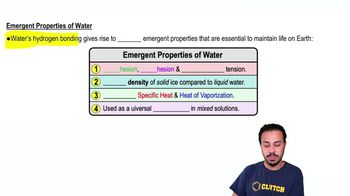
Water exists naturally in all three physical states and has unique properties that support life, such as cohesion, temperature moderation, expansion upon freezing, and solvent versatility.
What type of bond forms between water molecules?
Water molecules form hydrogen bonds due to polar covalent bonds creating partial charges on oxygen (δ–) and hydrogen (δ+).
What causes water molecules to be polar?
Electrons spend more time near oxygen than hydrogen, making water a polar molecule with uneven charge distribution.
Define cohesion and adhesion in water.
Cohesion is the attraction between water molecules via hydrogen bonds; adhesion is the attraction between water and other substances, like plant cell walls.
How does cohesion help plants?
Cohesion helps water molecules stick together, enabling water to move upward against gravity through plant vessels.
How does water moderate temperature?
Water absorbs or releases large amounts of heat with little temperature change due to hydrogen bonds breaking and forming.
Why does ice float on liquid water?
Hydrogen bonds in ice form a stable, ordered structure making ice less dense than liquid water, so it floats.
What is a solution, solvent, and solute?
A solution is a homogeneous mixture; the solvent dissolves the solute; the solute is the substance dissolved.
Why is water called the 'solvent of life'?
Water's polarity allows it to dissolve many ionic and polar substances, making it a versatile solvent.
What is the difference between hydrophilic and hydrophobic substances?
Hydrophilic substances have affinity for water (polar/ionic); hydrophobic substances repel water (nonpolar).
What is a mole in chemistry?
A mole is 6.02 × 10²³ molecules, used to measure the number of molecules in a substance.
Define molarity (M).
Molarity is the number of moles of solute per liter of solution.
How do acids and bases affect water's H+ and OH– concentrations?
 Back
Back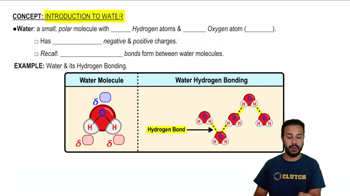
 01:54
01:54