 Back
BackA Phylogenetic Perspective on Biological Diversity: Plants and Animals
Study Guide - Smart Notes
 Tailored notes based on your materials, expanded with key definitions, examples, and context.
Phylogenetic Perspective on Biological Diversity
Introduction to Phylogeny and Diversity
Understanding the evolutionary relationships among living organisms is fundamental to biology. Phylogenetic trees illustrate these relationships and highlight key innovations that have driven diversification in major groups such as plants and animals.
Plant Diversity and Evolution
Nine Major Plant Phyla
Land plants are classified into nine major phyla, each representing significant evolutionary innovations:
Liverworts – Hepatophyta
Mosses – Bryophyta
Hornworts – Anthocerophyta
Lycophytes – Lycophyta
Pteridophytes – Pteridophyta
Cycads – Cycadophyta
Ginkgos – Ginkgophyta
Conifers – Coniferophyta
Angiosperms (flowering plants) – Anthophyta
These groups are organized based on evolutionary relationships and the acquisition of critical innovations.
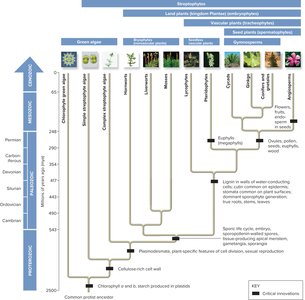
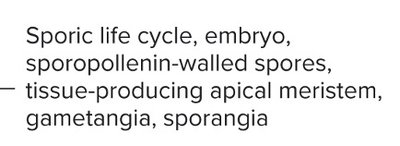
Key Innovations in Plant Evolution
Sporic life cycle: Alternation between multicellular haploid (gametophyte) and diploid (sporophyte) generations.
Embryo retention: Protection and nourishment of the developing embryo within parent tissues.
Sporopollenin-walled spores: Enhanced resistance to desiccation.
Tissue-producing apical meristem: Enables indeterminate growth and complex body structures.
Gametangia and sporangia: Specialized organs for gamete and spore production.
Alternation of Generations
Plants exhibit an alternation of generations, with a shift from gametophyte-dominant (as in bryophytes) to sporophyte-dominant life cycles (as in vascular plants and seed plants). This evolutionary trend is associated with increased complexity and adaptation to terrestrial environments.
Sporophyte: Diploid generation, produces spores by meiosis.
Gametophyte: Haploid generation, produces gametes by mitosis.
Additional info: In seedless vascular plants, both homospory (one type of spore) and heterospory (two types: microspores and megaspores) are observed. Heterospory is a precursor to the evolution of seeds.
Seed Plants: Gymnosperms and Angiosperms
Gymnosperms: Produce seeds not enclosed in fruits; pollen grains deliver nonmotile sperm to ovules, eliminating the need for water in fertilization.
Angiosperms: Characterized by flowers and fruits; double fertilization produces a triploid endosperm that nourishes the embryo. Coevolution with pollinators is common.
Seeds are a key innovation, providing protection and resources for the developing embryo and facilitating dispersal.
Animal Diversity and Evolution
What is an Animal?
Animals are multicellular eukaryotes that lack cell walls, are heterotrophic, and are motile at some stage of their life cycle. They reproduce sexually or asexually.
Evolutionary Relationships and Key Innovations
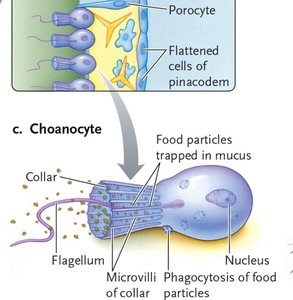
The closest living relatives of animals are choanoflagellates, single-celled protists that resemble sponge choanocytes.
Major Animal Clades and Innovations
Tissue development: Diploblastic (two germ layers) vs. triploblastic (three germ layers: ectoderm, mesoderm, endoderm).
Body symmetry: Radial (e.g., cnidarians) vs. bilateral (e.g., most other animals).
Body cavities: Acoelomate (no body cavity), pseudocoelomate (body cavity not fully lined by mesoderm), coelomate (true body cavity fully lined by mesoderm).
Embryological development: Protostomes (mouth develops from blastopore) vs. deuterostomes (anus develops from blastopore).
Segmentation: Repeated body units, as seen in annelids and arthropods.
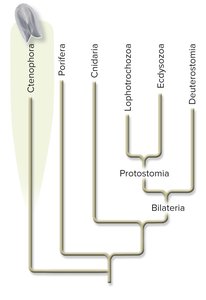
Protostomes vs. Deuterostomes
These two major clades of bilaterian animals are distinguished by embryonic development patterns:
Protostomes: Blastopore becomes mouth; spiral, determinate cleavage.
Deuterostomes: Blastopore becomes anus; radial, indeterminate cleavage.
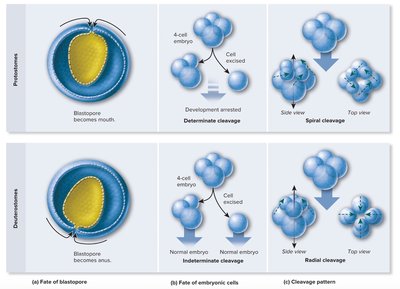
Bilateria: Lophotrochozoa and Ecdysozoa
Bilaterian animals are divided into two major protostome clades:
Lophotrochozoa: Includes annelids, mollusks, and others; many have a lophophore or trochophore larva.
Ecdysozoa: Includes arthropods and nematodes; characterized by molting (ecdysis) of the cuticle.
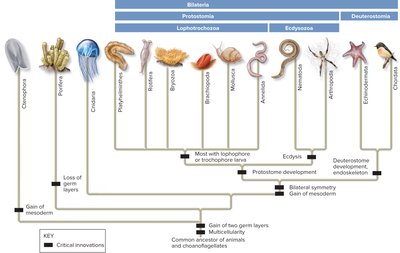
Comparative Anatomy of Selected Protostomes
Brachiopods vs. Bivalve Mollusks: Brachiopods have dorsal and ventral shells, while bivalves have left and right shells.
Platyhelminth (flatworm): Acoelomate body plan.
Nematode (roundworm): Pseudocoelomate body plan.
Oligochaete (segmented worm): Coelomate body plan.
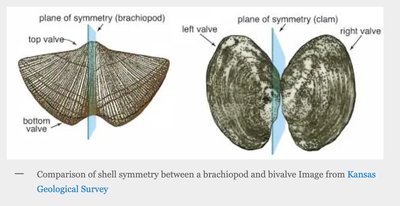
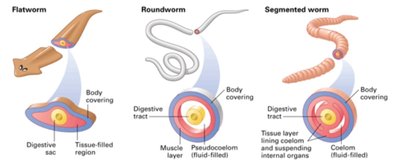
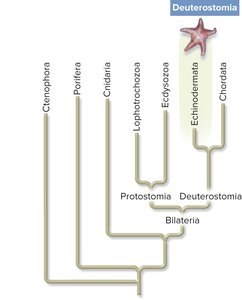
Deuterostomia: Echinoderms and Chordates
Deuterostomes include two major phyla:
Echinodermata: Secondary radial symmetry in adults, water vascular system, endoskeleton, simple nervous system.
Chordata: Defined by notochord, dorsal hollow nerve cord, pharyngeal slits, and postanal tail.
Chordate Diversity
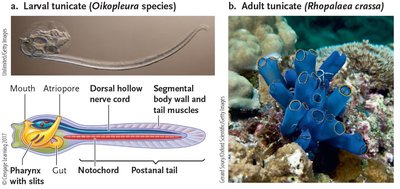
Urochordata (tunicates): Marine filter feeders; larval stage shows all chordate features.
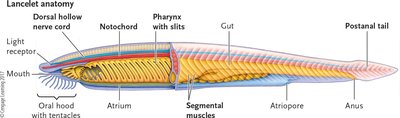
Cephalochordata (lancelets): Retain chordate features throughout life.
Vertebrata: Chordates with a vertebral column.
Key Innovations of Chordates
Notochord: Flexible rod for support.
Dorsal hollow nerve cord: Develops into the central nervous system.
Pharyngeal slits: Openings in the pharynx for filter feeding or gas exchange.
Postanal tail: Muscular tail extending beyond the anus.
Major Vertebrate Clades and Their Characteristics
Clade | Examples (approx. number of species) | Main Characteristics |
|---|---|---|
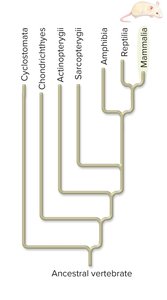
Cyclostomata | Lampreys, hagfish (100) | Jawless fishes, no appendages |
Chondrichthyes | Sharks, skates, rays (970) | Cartilaginous skeleton, teeth not fused to jaw, no swim bladder, well-developed fins, internal fertilization, single blood circulation |
Actinopterygii | Ray-finned fishes (31,830) | Ossified skeleton, single gill opening covered by operculum, fins supported by rays, swim bladder often present, mucous glands in skin |
Sarcopterygii | Lobe-finned fishes (coelacanths, lungfishes) | Ossified skeleton, bony extensions with muscles in fins |
Amphibia | Frogs, toads, salamanders (7,600) | Adults can live on land, freshwater needed for reproduction, metamorphosis, lungs, double blood circulation, moist skin, shell-less eggs |
Testudines | Turtles (346) | Body encased in hard shell, no teeth, retractable head/neck, eggs laid on land |
Squamata | Lizards, snakes (9,900) | Lower jaw not attached to skull, skin covered in scales |
Crocodilia | Crocodiles, alligators (25) | Four-chambered heart, large aquatic predators, parental care |
Aves | Birds (10,425) | Feathers, hollow bones, air sacs, reduced internal organs, endothermic, four-chambered heart |
Mammalia | Mammals (5,500) | Mammary glands, hair, specialized teeth, enlarged skull, external ears, endothermic, four-chambered heart, highly developed brains |
Evolution of Tetrapods and Amniotes
The transition from aquatic to terrestrial life involved several key adaptations:
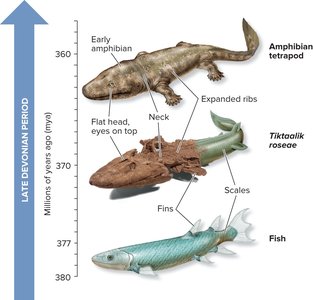
Lobe-finned fishes (Sarcopterygii) gave rise to tetrapods, with modifications such as strengthened vertebral columns and limb girdles.
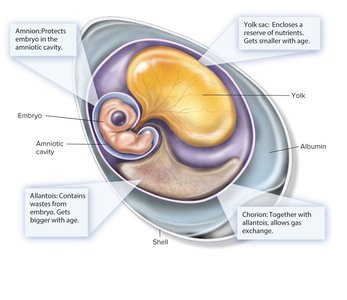
Amniotic egg: Allowed reproduction away from water; includes protective membranes and, in many groups, a shell.
Desiccation-resistant skin, thoracic breathing, and water-conserving kidneys further enabled terrestrial life.
Mammalian Innovations
Mammals are distinguished by mammary glands, hair, specialized teeth, enlarged skulls, and highly developed brains. They are divided into three groups:
Prototheria: Egg-laying mammals (monotremes)
Metatheria: Marsupials
Eutheria: Placental mammals
Summary Table: Major Innovations in Plant and Animal Evolution
Group | Key Innovations |
|---|---|
Plants | Sporic life cycle, embryo retention, vascular tissue, seeds, flowers, fruits |
Animals | Multicellularity, tissues, body symmetry, body cavities, segmentation, protostome/deuterostome development, notochord, vertebral column, amniotic egg, hair, mammary glands |
