 Back
A Tour of the Cell: Structure and Function of Prokaryotic and Eukaryotic Cells
Study Guide - Smart Notes
 Tailored notes based on your materials, expanded with key definitions, examples, and context.
Cell Theory and Basic Attributes of Cells
Principles of Cell Theory
The cell theory is a fundamental concept in biology that describes the properties of cells, the basic unit of life. It is based on three main principles:
All living organisms are composed of one or more cells.
The cell is the smallest unit of life and the functional unit of multicellular organisms.
All cells arise from preexisting cells.
Basic Attributes of Cells
Cell Size: Most cells range from 1 to 100 micrometers in diameter. Cell size is limited by the need to efficiently exchange nutrients and wastes with the environment.
Plasma Membrane: A phospholipid bilayer with embedded proteins that regulates the passage of ions and molecules in and out of the cell.
Cytoplasm: The region inside the plasma membrane but outside the nucleus, containing cytosol (a jellylike fluid), organelles, and other structures.
Genetic Material: All cells use DNA as a hereditary blueprint and RNA to guide protein synthesis.
Types of Cells
Prokaryotic Cells: "Before the nucleus"; found in bacteria and archaea. They lack a true nucleus and membrane-bound organelles.
Eukaryotic Cells: "True nucleus"; found in animals, plants, fungi, and protists. They have a nucleus and various membrane-bound organelles.
Major Features of Eukaryotic Cells
Organelles and Internal Structure
Eukaryotic cells are generally larger and more complex than prokaryotic cells. Their cytoplasm contains a variety of organelles, each with specialized functions.
Nucleus: The control center of the cell, containing DNA, chromatin, and the nucleolus.
Cytoskeleton: A network of protein fibers that provides shape, support, and facilitates movement.
Cell Wall: Found in plants, fungi, and some protists; provides structural support and is composed of cellulose (plants) or chitin (fungi).
The Cytoskeleton
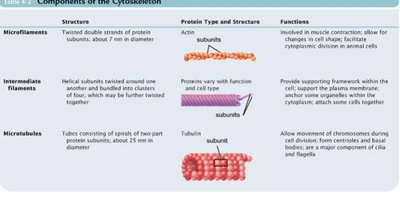
The cytoskeleton is composed of three main types of protein fibers, each with distinct structures and functions:
Type | Structure | Protein Type | Functions |
|---|---|---|---|
Microfilaments | Twisted double strands of actin, ~7 nm diameter | Actin | Muscle contraction, cell shape changes, cytoplasmic division in animal cells |
Intermediate Filaments | Helical subunits twisted around each other, bundled into clusters | Various proteins | Support framework, anchor organelles, attach cells together |
Microtubules | Tubes of tubulin, ~25 nm diameter | Tubulin | Chromosome movement, cilia and flagella structure, organelle movement |
Cilia and Flagella
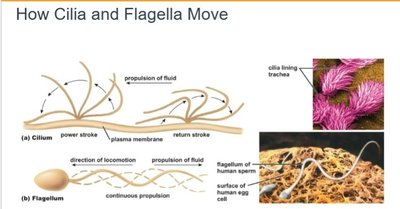
Cilia and flagella are slender extensions of the plasma membrane that enable movement of the cell or movement of fluid past the cell. They are anchored by a basal body and composed of microtubules.
Cilia: Short, numerous, move fluid past cells (e.g., respiratory tract).
Flagella: Longer, usually one or two per cell, propel cells (e.g., sperm).
The Nucleus
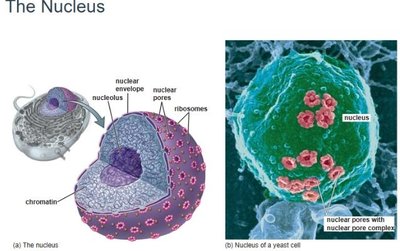
The nucleus is the control center of the eukaryotic cell, containing genetic material and directing cellular activities.
Nuclear Envelope: Double membrane with nuclear pores for molecular exchange.
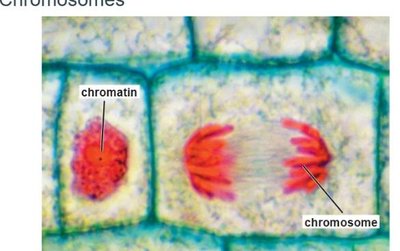
Chromatin: DNA and proteins; condenses into chromosomes during cell division.
Nucleolus: Site of ribosome synthesis.
Chromatin and Chromosomes
Chromatin is the diffuse form of genetic material in the nucleus. During cell division, chromatin condenses into visible chromosomes, which contain genes that encode proteins.
Endomembrane System
The eukaryotic cytoplasm contains an elaborate system of membranes, including:
Endoplasmic Reticulum (ER): Network of membranes; rough ER (with ribosomes) synthesizes proteins, smooth ER (without ribosomes) synthesizes lipids and detoxifies chemicals.
Golgi Apparatus: Modifies, sorts, and packages proteins and lipids for transport.
Vesicles: Membranous sacs for transport within the cell.
Lysosomes: Contain digestive enzymes to break down macromolecules.
Peroxisomes: Detoxify harmful compounds, producing hydrogen peroxide ().
Vacuoles: Storage, water regulation, and support (especially in plants).
Mitochondria and Chloroplasts
Mitochondria and chloroplasts are energy-converting organelles believed to have evolved from prokaryotic ancestors (endosymbiont hypothesis).
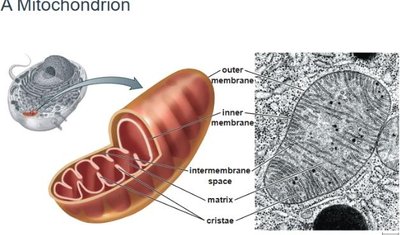
Mitochondria: Extract energy from food molecules and store it in ATP; have a double membrane, with the inner membrane folded into cristae.
Chloroplasts: Found in plants and some protists; capture solar energy for photosynthesis, contain thylakoids and chlorophyll.
Specialized Junctions in Eukaryotic Cells
Cell Junctions
Desmosomes: Strong attachments between cells, found in tissues under stress (e.g., skin, intestine).
Tight Junctions: Leakproof seals between cells, found in tissues that must contain fluids (e.g., bladder).
Gap Junctions: Protein channels for communication between animal cells.
Plasmodesmata: Cytoplasmic connections between plant cells.
Major Features of Prokaryotic Cells
Structure and Function
Prokaryotic cells are simpler and smaller than eukaryotic cells, lacking a nucleus and most organelles.
Cell Wall: Provides structural support; shapes include rod, spiral, and spherical.
Surface Features: May include flagella for movement, pili for adhesion, and capsules for protection.
Nucleoid: Region containing a single, circular DNA chromosome; plasmids may also be present.
Cytoplasm: Contains ribosomes and storage granules.
Prokaryotes are essential for ecosystems, nutrient cycling, and human health.
Additional Vocabulary
Peroxisomes: Organelles that detoxify harmful compounds by transferring hydrogen to oxygen, producing hydrogen peroxide ().
