 Back
A Tour of the Cell: Structure and Function
Study Guide - Smart Notes
 Tailored notes based on your materials, expanded with key definitions, examples, and context.
General Characteristics of Cells
Definition and Importance
Cells are the fundamental units of life, forming the basis of all living organisms. Their small size is essential for efficient nutrient and waste exchange, as a higher surface-to-volume ratio allows for more effective transport across the cell membrane.
Smallest Unit of Living Matter: Most cells are microscopic and cannot be seen with the naked eye.
Surface Area to Volume Ratio: Smaller cells have a greater surface area relative to their volume, facilitating efficient exchange of materials.
Cell Theory: All living things are composed of cells, and all cells arise from pre-existing cells.
Two Main Categories of Cells
Prokaryotes vs. Eukaryotes
Cells are classified into two major types based on structural and genetic differences: prokaryotic and eukaryotic cells.
Characteristic | Prokaryotes | Eukaryotes |
|---|---|---|
Organelles | Absent (no membrane-bound organelles) | Present (membrane-bound organelles) |
DNA Location | Nucleoid region (not membrane-bound) | Contained within a nucleus (membrane-bound) |
Cell Size | Generally smaller (1-10 μm) | Generally larger (10-100 μm) |
Examples | Bacteria, Archaea | Plants, Animals, Fungi, Protists |
Endosymbiotic Theory
Origin of Eukaryotic Cells
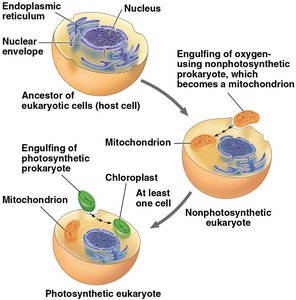
The endosymbiotic theory explains the evolutionary origin of eukaryotic cells as a result of symbiotic relationships between primitive cells. According to this theory, certain organelles, such as mitochondria and chloroplasts, originated as free-living prokaryotes that were engulfed by ancestral eukaryotic cells.
Engulfment: Host cells engulfed aerobic (oxygen-using) and photosynthetic prokaryotes.
Evolution of Organelles: Engulfed cells became specialized organelles (mitochondria and chloroplasts), enhancing cellular efficiency and survival.
Evidence: Mitochondria and chloroplasts contain their own DNA and reproduce independently within the cell.
Prokaryotic Cell Structure
Key Features and Components
Prokaryotic cells have a simpler structure compared to eukaryotes, lacking membrane-bound organelles but possessing specialized adaptations for survival.
Cell Shapes:
Bacilli – rod-shaped
Spiral – spiral-shaped
Cocci – spherical
Capsule/Slime Layer: Protective outer layer that helps prevent desiccation and aids in attachment to surfaces.
Cell Wall: Provides structural support and protection; composed of peptidoglycan in bacteria.
External Structures:
Flagella – long, whip-like appendages for movement
Fimbriae – short, bristle-like fibers for attachment
Conjugation Pili – hollow tubes for DNA exchange between cells
Inclusions: Granules for storage of nutrients and other substances.
Ribosomes: Sites of protein synthesis (smaller than eukaryotic ribosomes).
Eukaryotic Cell Structure: The Cytoplasm
Non-Membrane-Bound Organelles
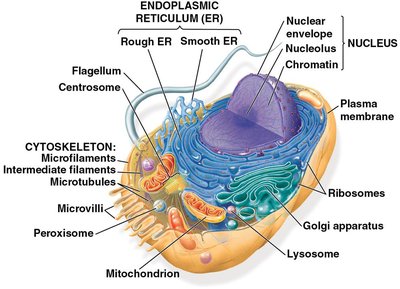
The cytoplasm contains both the cytosol (fluid portion) and various organelles. Some organelles are not surrounded by membranes but play critical roles in cell structure and function.
Ribosomes:
Function: Protein synthesis
Location: Free in cytoplasm or attached to rough ER
Structure: Composed of rRNA and proteins; two subunits (large and small)
Cytoskeleton: Network of protein filaments providing structural support and facilitating movement.
Microfilaments – smallest, made of actin, involved in cell movement and shape
Intermediate Filaments – provide mechanical support
Microtubules – largest, made of tubulin, involved in cell shape, transport, and division
Flagella: Long, whip-like structures for cell motility; composed of tubulin, anchored by a basal body.
Cilia: Short, numerous hair-like structures for movement; share a 9+2 microtubule arrangement with flagella.
Centrosome: Region near the nucleus that organizes microtubules and forms the mitotic spindle during cell division; contains centrioles and pericentriolar material.
Membrane-Bound Organelles
Membrane-bound organelles compartmentalize cellular functions, increasing efficiency and specialization within eukaryotic cells.
Endoplasmic Reticulum (ER):
Rough ER – studded with ribosomes; synthesizes and transports proteins
Smooth ER – lacks ribosomes; synthesizes lipids, detoxifies chemicals
Golgi Complex: Modifies, sorts, and packages proteins and lipids for secretion or delivery to other organelles.
Lysosome: Contains hydrolytic enzymes for intracellular digestion and recycling of cellular components.
Mitochondria: Site of cellular respiration; generates ATP from organic molecules.
Chloroplasts: Found in plants and some protists; site of photosynthesis, converting solar energy to chemical energy.
Peroxisomes: Break down fatty acids and detoxify harmful substances.
Vacuoles: Storage organelles for water, nutrients, and waste; prominent in plant cells.
Hydrolytic Enzyme Formation in the Cell
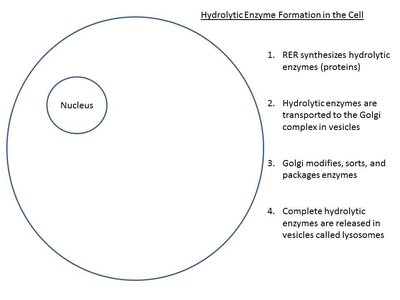
The production and processing of hydrolytic enzymes, which are essential for cellular digestion, involves several organelles working together in a coordinated pathway.
Rough ER synthesizes hydrolytic enzymes (proteins).
Hydrolytic enzymes are transported to the Golgi complex in vesicles.
Golgi modifies, sorts, and packages enzymes.
Complete hydrolytic enzymes are released in vesicles called lysosomes.
Nucleus of Eukaryotic Cells
Structure and Function
The nucleus is the control center of the eukaryotic cell, housing genetic material and coordinating cellular activities such as growth, metabolism, and reproduction.
Contains DNA: Organized with proteins into chromosomes.
Double Membrane: Nuclear envelope composed of a phospholipid bilayer.
Nucleolus: Site of ribosome synthesis.
Nuclear Pores: Allow regulated exchange of materials between the nucleus and cytoplasm.
