Back
BackAcids and Bases: Properties and Behavior in Aqueous Solutions
Study Guide - Smart Notes
 Tailored notes based on your materials, expanded with key definitions, examples, and context.
Acids and Bases
Introduction to Acids and Bases
Acids and bases are fundamental concepts in chemistry and biology, playing a crucial role in the chemical context of life. Their behavior in aqueous solutions affects biological processes, cellular function, and metabolic reactions.
Acids
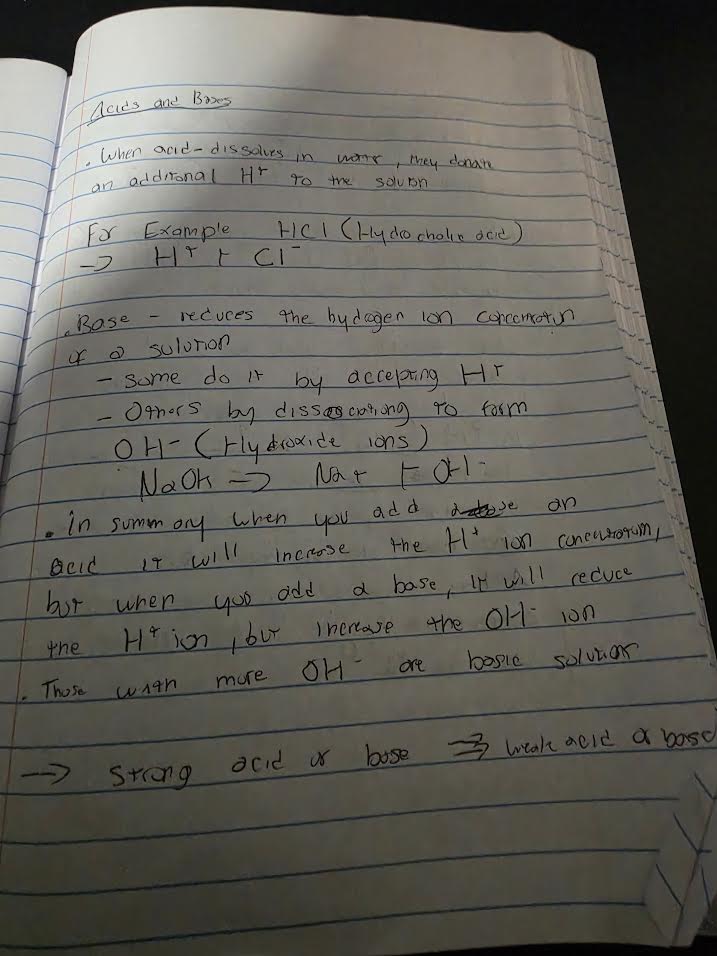
Definition: An acid is a substance that increases the hydrogen ion (H+) concentration of a solution when dissolved in water.
Mechanism: Acids donate H+ ions to the solution.
Example: Hydrochloric acid (HCl) dissociates in water as follows:
This reaction shows the release of hydrogen ions, increasing the solution's acidity.
Bases
Definition: A base is a substance that reduces the hydrogen ion concentration of a solution.
Mechanisms:
Some bases accept H+ ions directly.
Others dissociate to form hydroxide ions (OH-), which combine with H+ to form water, thus reducing H+ concentration.
Example: Sodium hydroxide (NaOH) dissociates in water as follows:
The OH- ions can react with H+ to form water, decreasing the acidity.
Summary of Acid and Base Addition
Adding an acid to a solution increases the H+ ion concentration.
Adding a base reduces the H+ ion concentration and increases the OH- ion concentration.
Solutions with higher OH- concentrations are considered basic.
Strength of Acids and Bases
Strong acids or bases dissociate completely in water, releasing all their H+ or OH- ions.
Weak acids or bases only partially dissociate, establishing an equilibrium between the undissociated and dissociated forms.
Additional info: The concepts of acids and bases are foundational for understanding pH, buffer systems, and the chemical environment of biological molecules, which are further explored in the context of cellular and metabolic processes.