 Back
Acids, Bases, pH, and Buffer Systems in Biological Context
Study Guide - Smart Notes
 Tailored notes based on your materials, expanded with key definitions, examples, and context.
Acids, Bases, and the pH Scale
Definitions and Biological Importance
The concepts of acids, bases, and pH are fundamental to understanding biochemical reactions and cellular homeostasis. Most living cells require a narrow pH range for optimal function, and deviations can disrupt vital processes.
Acid: A substance that releases protons (H+) when dissolved in water. The extent of dissociation determines acid strength.
Base: A substance that accepts protons or releases hydroxide ions (OH-).
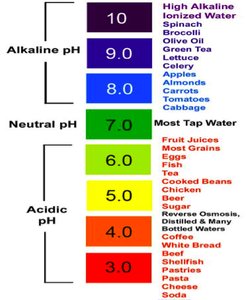
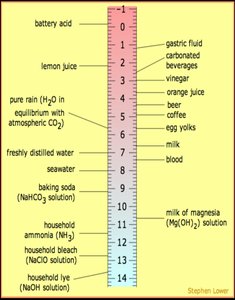
pH Scale: Measures the concentration of H+ ions in solution. It is logarithmic, so each unit change represents a tenfold difference in H+ concentration.
Biological Relevance: Enzyme activity, protein structure, and metabolic reactions are all pH-dependent.
Water as a Universal Solvent
Water is the primary solvent in biological systems, facilitating the dissolution and interaction of hydrophilic molecules. Its ability to dissociate into H+ and OH- ions is central to acid-base chemistry.
Dissociation:
Hydronium Ion Formation:
Acid Strength and Dissociation
Strong vs. Weak Acids
Acids vary in their tendency to release protons. Strong acids dissociate completely, while weak acids only partially ionize, establishing an equilibrium with their conjugate base.
Strong Acid Example: Hydrochloric acid (HCl) dissociates fully in water.
Weak Acid Example: Acetic acid (CH3COOH) dissociates partially.
Equilibrium Expression:
Equilibrium Constant:

Calculating and Interpreting pH
Logarithmic Nature of pH
The pH scale is logarithmic, meaning each unit change reflects a tenfold change in H+ concentration. Even small changes in pH can have significant biological effects.
Formula:
Neutral pH: At equilibrium, , so .








Biological Case Study: Blood Buffering and Acid-Base Homeostasis
Carbon Dioxide and Blood pH
Carbon dioxide (CO2) dissolves in water to form carbonic acid (H2CO3), which dissociates to release protons and bicarbonate (HCO3-). This equilibrium is crucial for maintaining blood pH.
Reaction:
Biological Impact: Increased CO2 lowers pH; removal of CO2 raises pH.
Buffer Systems in the Body
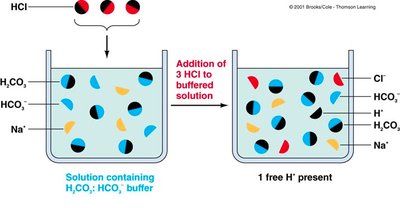
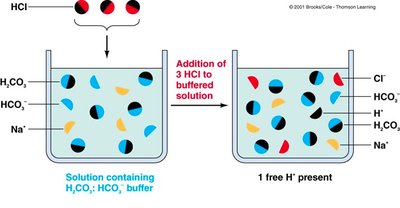
Buffers are mixtures of weak acids and their conjugate bases that resist changes in pH. The bicarbonate buffer system is especially important in blood.
Buffer Action: Excess H+ combines with HCO3- to form H2CO3, reducing acidity.
Clinical Example: Treatment of acidosis with bicarbonate shifts equilibrium to reduce H+ concentration.
Buffer Systems and Homeostasis
Importance of Buffers
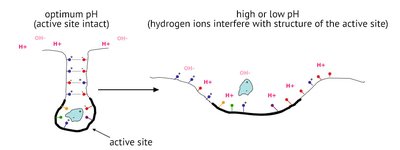
Buffers maintain homeostasis by stabilizing pH, allowing enzymes and proteins to function optimally. Without buffers, fluctuations in pH would disrupt cellular processes and threaten organism survival.
Enzyme Activity: Enzymes have optimal pH ranges; deviations can alter their active sites and reduce function.
Homeostasis: Buffers prevent dangerous shifts in pH, protecting cells and tissues.
Major Body Buffer Systems
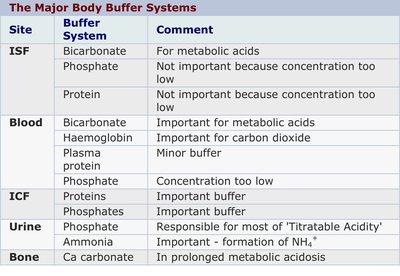
Different tissues and fluids utilize various buffer systems to maintain pH balance.
Site | Buffer System | Comment |
|---|---|---|
ISF | Bicarbonate | For metabolic acids |
ISF | Phosphate | Not important because concentration too low |
ISF | Protein | Not important because concentration too low |
Blood | Bicarbonate | Important for metabolic acids |
Blood | Haemoglobin | Important for carbon dioxide |
Blood | Plasma protein | Minor buffer |
Blood | Phosphate | Concentration too low |
ICF | Proteins | Important buffer |
ICF | Phosphate | Important buffer |
Urine | Phosphate | Responsible for most of 'Titratable Acidity' |
Urine | Ammonia | Important - formation of NH4+ |
Bone | Ca carbonate | In prolonged metabolic acidosis |
Hemoglobin and CO2 Transport
Role of Hemoglobin in Buffering
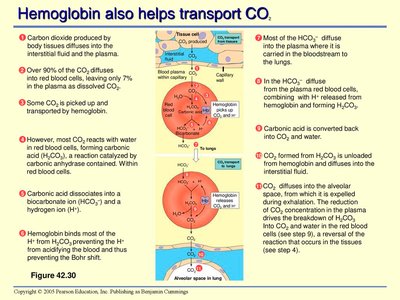
Hemoglobin not only transports oxygen but also helps buffer blood by binding protons and facilitating CO2 transport.
CO2 Transport: CO2 produced by metabolism is carried in blood as bicarbonate, dissolved gas, or bound to hemoglobin.
Buffering Action: Hemoglobin binds H+ released from carbonic acid dissociation, helping maintain pH.
Summary and Insights
Biological Significance of pH Control
Maintaining pH within a narrow range is essential for life. Buffer systems, especially bicarbonate and proteins, protect organisms from harmful pH changes, ensuring proper enzyme function and metabolic stability.
Enzyme Function: Most enzymes operate within a specific pH range.
Buffering Capacity: Multiple compounds, including proteins, serve as buffers in biological systems.
Additional info: Proteins are major buffers in cells, and phosphate buffers are important in urine and intracellular fluid. The Law of Mass Action governs buffer equilibrium, and clinical interventions often use bicarbonate to treat acidosis.
