 Back
Acquired Immunity: B Cells and Antibodies (PP 4)
Study Guide - Smart Notes
 Tailored notes based on your materials, expanded with key definitions, examples, and context.
Acquired Immunity: B Cells and Antibodies
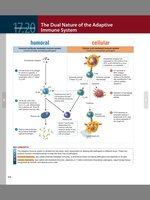
Overview of the Adaptive Immune System
The adaptive immune system is divided into two main branches: humoral and cellular immunity. B cells are central to humoral immunity, producing antibodies that target pathogens. T cells mediate cellular immunity, directly attacking infected cells.
Humoral Immunity: Involves B cells and the production of antibodies.
Cellular Immunity: Involves T cells, which recognize and destroy infected cells.
Antibodies: Proteins produced by B cells that bind to specific antigens.
B Cell Development and Differentiation
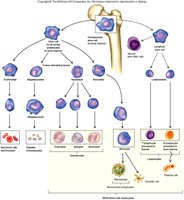
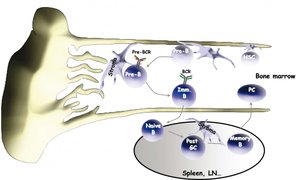
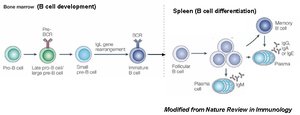
B cells originate from hematopoietic stem cells in the bone marrow. They undergo several stages of maturation before becoming fully functional immune cells. Upon activation, B cells differentiate into plasma cells (antibody-secreting cells) or memory B cells.
Hematopoietic Stem Cells: Give rise to all blood cells, including B cells.
Immature B Cells: Develop in the bone marrow and migrate to secondary lymphoid organs.
Plasma Cells: Secrete large amounts of antibodies.
Memory B Cells: Provide long-term immunity by responding rapidly to subsequent exposures to the same antigen.
B Cell Receptors and Antigen Recognition
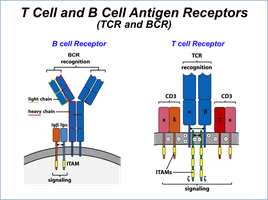
B cells express B cell receptors (BCRs) on their surface, which are membrane-bound antibodies. These receptors recognize specific antigens. T cells express T cell receptors (TCRs), which also recognize antigens but require presentation by other cells.
BCR: Membrane-bound immunoglobulin that binds directly to antigens.
TCR: Recognizes antigens presented by MHC molecules on other cells.
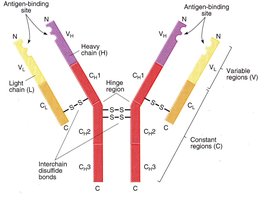
Antibody Structure
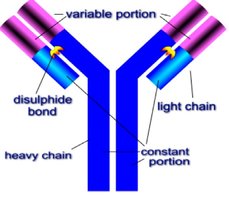
Antibodies are Y-shaped proteins composed of two light chains and two heavy chains. Each chain has a constant and a variable region. The variable region determines antigen specificity, while the constant region mediates effector functions.
Light Chain: Smaller polypeptide chain, part of the antigen-binding site.
Heavy Chain: Larger polypeptide chain, forms the backbone of the antibody.
Variable Region: Provides specificity for antigen binding.
Constant Region: Determines the class and function of the antibody.
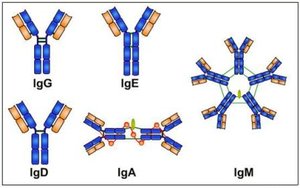
Classes of Antibodies (Immunoglobulins)
There are five main classes of antibodies, each with distinct functions and structures: IgG, IgM, IgA, IgE, and IgD.
IgG: Most abundant, provides long-term immunity.
IgM: First antibody produced during an immune response.
IgA: Found in mucosal areas, protects body surfaces.
IgE: Involved in allergic responses and defense against parasites.
IgD: Functions mainly as a B cell receptor.
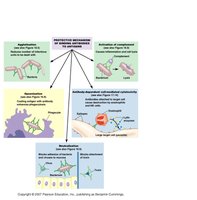
Functions of Antibodies
Antibodies neutralize pathogens, promote agglutination, opsonize microbes for phagocytosis, and activate the complement system.
Agglutination: Clumping of pathogens to facilitate removal.
Neutralization: Blocking pathogen activity.
Opsonization: Marking pathogens for phagocytosis.
Complement Activation: Triggering a cascade that lyses pathogens.
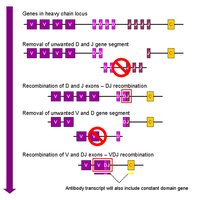
Antibody Diversity: Gene Rearrangement
The immune system generates a vast diversity of antibodies through gene rearrangement. Variable (V), Diversity (D), and Joining (J) gene segments recombine to form unique antigen-binding sites.
V(D)J Recombination: Process that creates diverse antibody specificities.
Heavy Chain: Uses V, D, and J segments.
Light Chain: Uses V and J segments.
Combinatorial Diversity: Millions of possible combinations.

B Cell Maturation and Activation
B cells mature in the bone marrow and migrate to secondary lymphoid organs. Upon encountering an antigen, B cells become activated and differentiate into plasma cells or memory cells.
Immature B Cells: Express IgM.
Mature B Cells: Express both IgM and IgD.
Activation: Occurs upon antigen recognition.
T-Cell Independent and Dependent Responses
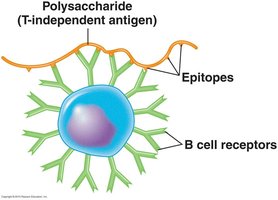
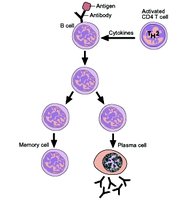
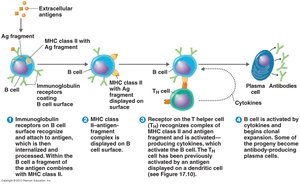
B cells can be activated in two ways: T-cell independent and T-cell dependent. T-cell independent activation occurs when multiple BCRs are cross-linked by repetitive antigens, leading to rapid but less effective responses. T-cell dependent activation involves antigen presentation to helper T cells, resulting in stronger and longer-lasting immunity.
T-Cell Independent: Rapid IgM production, no memory cells.
T-Cell Dependent: Involves helper T cells, leads to isotype switching and memory cell formation.
Isotype Switching and Affinity Maturation
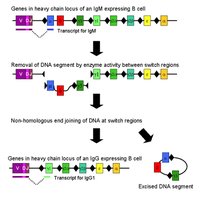
Isotype switching allows B cells to produce different classes of antibodies. Affinity maturation increases the binding strength of antibodies through somatic hypermutation in the variable regions.
Isotype Switching: DNA recombination changes antibody class (e.g., IgM to IgG).
Affinity Maturation: Point mutations in the variable region enhance antigen binding.
Memory Cells: Long-lived cells that produce high-affinity antibodies upon re-exposure.
Immunological Memory and Types of Acquired Immunity
Immunological memory enables rapid and robust responses to repeated infections. Acquired immunity can be natural or artificial, and active or passive.
Primary Response: Slow, mainly IgM, lower antibody titer.
Secondary Response: Fast, mainly IgG, higher antibody titer and quality.
Natural Active Immunity: Acquired through infection.
Natural Passive Immunity: Maternal antibody transfer.
Artificial Active Immunity: Vaccination.
Artificial Passive Immunity: Administration of antibodies.
Type | Source | Example |
|---|---|---|
Natural Active | Infection | Recovery from measles |
Natural Passive | Maternal transfer | IgG via placenta |
Artificial Active | Vaccination | Flu vaccine |
Artificial Passive | Antibody injection | Antivenom |
Example: Vaccination induces artificial active immunity by stimulating the production of memory B cells and antibodies.
----------------------------------------
