 Back
Active Reading Guide: General Biology Exam 1 Study Guidance (Chapters 2–4)
Study Guide - Smart Notes
 Tailored notes based on your materials, expanded with key definitions, examples, and context.
Q1. Define and give an example of the following terms: Matter, Element, Compound.
Background
Topic: Basic Chemistry Concepts in Biology
This question tests your understanding of foundational chemistry terms that are essential for studying biological molecules and processes.
Key Terms:
Matter: Anything that takes up space and has mass.
Element: A fundamental substance that cannot be broken down into other substances by chemical reactions.
Compound: A substance formed when two or more elements bond in fixed ratios.
Step-by-Step Guidance
Start by recalling the definition of matter and think of everyday examples (e.g., water, air, rocks).
Review what makes an element unique—consider the periodic table and how each element is defined by its atomic number.
Understand that compounds are made from elements combined in specific ratios. Try to think of common compounds (like water or carbon dioxide).
For each term, write a clear definition and provide a specific example.
Try solving on your own before revealing the answer!
Final Answer:
Matter: Anything that takes up space and has mass. Example: Water.
Element: A fundamental substance that cannot be broken down by chemical reactions. Example: Carbon (C).
Compound: A substance formed when two or more elements bond in fixed ratios. Example: Water (H2O).
These definitions and examples are foundational for understanding all biological molecules and processes.
Q2. What four elements make up 96% of all living matter?
Background
Topic: Elements Essential for Life
This question focuses on the major elements that are most abundant in living organisms and are critical for biological functions.
Key Terms:
Oxygen (O)
Carbon (C)
Hydrogen (H)
Nitrogen (N)
Step-by-Step Guidance
Recall the periodic table and identify which elements are most common in biological molecules.
Think about the composition of proteins, carbohydrates, lipids, and nucleic acids.
List the four elements that are found in the highest proportions in living organisms.
Try solving on your own before revealing the answer!
Final Answer:
The four elements are Oxygen (O), Carbon (C), Hydrogen (H), and Nitrogen (N).
These elements are the primary building blocks of biological molecules.
Q3. Define each term: Neutron, Proton, Electron, Atomic Number, Atomic Mass, Isotope, Electron Shells, Energy.
Background
Topic: Atomic Structure and Properties
This question tests your understanding of the structure of atoms and the terminology used to describe their components and properties.
Key Terms:
Neutron: Neutral subatomic particle found in the nucleus.
Proton: Positively charged subatomic particle found in the nucleus.
Electron: Negatively charged subatomic particle that orbits the nucleus.
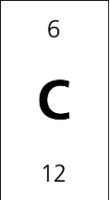
Atomic Number: Number of protons in an atom.
Atomic Mass: Total number of protons and neutrons.
Isotope: Atom with same number of protons but different number of neutrons.
Electron Shells: Energy levels where electrons are found.
Energy: Capacity to cause change.
Step-by-Step Guidance
Review the basic structure of an atom: nucleus (protons and neutrons) and electron shells.
Recall how atomic number and atomic mass are determined.
Understand what makes isotopes unique compared to standard atoms.
Think about how electrons are arranged in shells and how this relates to energy.
Try solving on your own before revealing the answer!
Final Answer:
Neutron: Neutral subatomic particle in the nucleus.
Proton: Positive subatomic particle in the nucleus.
Electron: Negative subatomic particle orbiting the nucleus.
Atomic Number: Number of protons in an atom.
Atomic Mass: Number of protons plus neutrons.
Isotope: Atom with same protons, different neutrons.
Electron Shells: Energy levels for electrons.
Energy: Capacity to cause change.
These terms are essential for understanding atomic structure and chemical behavior.
Q4. What are isotopes? Use carbon as an example in your explanation.
Background
Topic: Isotopes and Atomic Structure
This question tests your understanding of isotopes and their significance in biology and chemistry.
Key Terms:
Isotope: Atoms of the same element with different numbers of neutrons.
Step-by-Step Guidance
Recall the definition of an isotope and how it differs from the standard atom.
Think about carbon, which has several isotopes (e.g., Carbon-12, Carbon-13, Carbon-14).
Describe how the number of neutrons changes in each isotope, while the number of protons remains the same.
Try solving on your own before revealing the answer!
Final Answer:
Isotopes are atoms of the same element with different numbers of neutrons. For carbon, Carbon-12 has 6 neutrons, Carbon-13 has 7 neutrons, and Carbon-14 has 8 neutrons, but all have 6 protons.
This variation in neutron number gives isotopes different atomic masses.
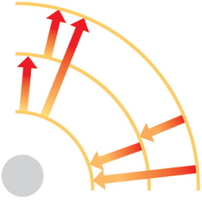
Q7. Label the diagram as shown in Figure 2.6. The cellular processes of photosynthesis and cellular respiration center on the movement of electrons. How is the movement of electrons shown in the diagram related to photosynthesis?
Background
Topic: Electron Movement and Energy in Photosynthesis
This question tests your understanding of how electrons move between energy levels and how this relates to biological processes like photosynthesis.
Key Terms:
Electron Shells: Energy levels where electrons reside.
Photosynthesis: Process where light energy excites electrons.
Step-by-Step Guidance
Examine the diagram showing electron movement between shells.
Recall that in photosynthesis, electrons absorb energy and move to higher shells.
Understand that when electrons return to lower shells, they release energy.
Label the arrows to indicate movement to higher and lower energy levels.
Try solving on your own before revealing the answer!
Final Answer:
Electrons absorb light energy and move to higher energy shells (arrows pointing outward). When they release energy, they return to lower shells (arrows pointing inward). This movement is central to photosynthesis, where light excites electrons.
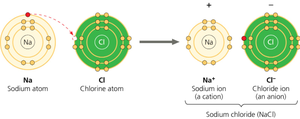
Q16. Another bond type is the ionic bond. Explain what is happening in the following figure.
Background
Topic: Ionic Bond Formation
This question tests your understanding of how ionic bonds form between atoms and how electron transfer leads to charged ions.
Key Terms:
Ionic Bond: Bond formed by the transfer of electrons from one atom to another.
Cation: Positively charged ion.
Anion: Negatively charged ion.
Step-by-Step Guidance
Examine the diagram showing sodium and chlorine atoms.
Identify the electron transfer from sodium to chlorine.
Recognize that sodium becomes a cation (Na+) and chlorine becomes an anion (Cl-).
Understand that the resulting ions are attracted to each other, forming an ionic bond.
Try solving on your own before revealing the answer!
Final Answer:
Sodium transfers an electron to chlorine, resulting in Na+ (cation) and Cl- (anion). The opposite charges attract, forming an ionic bond and creating sodium chloride (NaCl).
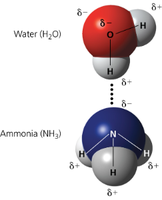
Q18. What is a hydrogen bond? Indicate where the hydrogen bond occurs in the following figure.
Background
Topic: Hydrogen Bonding in Molecules
This question tests your understanding of hydrogen bonds, which are weak attractions between molecules or parts of molecules.
Key Terms:
Hydrogen Bond: Weak bond between a slightly positive hydrogen atom and a slightly negative atom (often oxygen or nitrogen).
Polar Covalent Bond: Bond where electrons are shared unequally.
Step-by-Step Guidance
Examine the diagram showing water and ammonia molecules.
Identify the regions of partial positive (δ+) and partial negative (δ-) charge.
Locate the dashed line representing the hydrogen bond between molecules.
Understand that hydrogen bonds occur between the δ+ hydrogen and δ- oxygen or nitrogen.
Try solving on your own before revealing the answer!
Final Answer:
A hydrogen bond occurs between the δ+ hydrogen atom of one molecule and the δ- atom (oxygen or nitrogen) of another molecule. In the figure, the dashed line shows the hydrogen bond between water and ammonia.
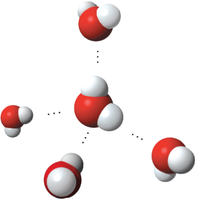
Q1 (Chapter 3). Study the water molecules below. On the central molecule, label oxygen (O) and hydrogen (H). Now, add + and − signs to indicate the charged regions of each molecule. Then, indicate the hydrogen bonds.
Background
Topic: Polar Covalent Bonds and Hydrogen Bonding in Water
This question tests your ability to identify the structure of water molecules and the regions of partial charge that lead to hydrogen bonding.
Key Terms:
Polar Covalent Bond: Unequal sharing of electrons.
Hydrogen Bond: Weak attraction between δ+ hydrogen and δ- oxygen.
Step-by-Step Guidance
Examine the central water molecule and identify the oxygen (O) and hydrogen (H) atoms.
Add δ+ to the hydrogen atoms and δ- to the oxygen atom to indicate partial charges.
Locate the dashed lines between molecules, which represent hydrogen bonds.
Label the regions and bonds as described.
Try solving on your own before revealing the answer!
Final Answer:
The central molecule has oxygen (O) labeled with δ- and hydrogens (H) labeled with δ+. The dashed lines between molecules indicate hydrogen bonds, which occur between the δ+ hydrogen and δ- oxygen of adjacent water molecules.
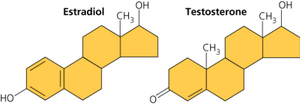
Q7 (Chapter 4). Label each functional group in the following sketch and circle the differences between estradiol and testosterone.
Background
Topic: Functional Groups and Molecular Structure
This question tests your ability to identify functional groups in biological molecules and understand how structural differences affect function.
Key Terms:
Functional Group: Specific group of atoms attached to a molecule that affects its function.
Estradiol: Female sex hormone.
Testosterone: Male sex hormone.
Step-by-Step Guidance
Examine the chemical structures of estradiol and testosterone.
Identify and label the functional groups (e.g., hydroxyl, methyl, carbonyl).
Circle the differences between the two molecules, focusing on the functional groups that distinguish them.
Understand how these structural differences lead to different biological effects.
Try solving on your own before revealing the answer!
Final Answer:
Estradiol has a hydroxyl group (–OH) where testosterone has a carbonyl group (=O). Both have methyl groups (–CH3), but the placement and type of functional group differ, leading to distinct biological functions.
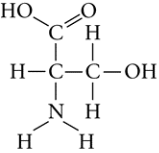
Q9 (Chapter 4). Circle and identify three functional groups in the molecule shown above.
Background
Topic: Functional Groups in Biological Molecules
This question tests your ability to recognize and name functional groups in a molecular structure.
Key Terms:
Functional Group: Group of atoms that confer specific properties to a molecule.
Examples: Amino, Carboxyl, Hydroxyl.
Step-by-Step Guidance
Examine the molecular structure and look for recognizable functional groups.
Identify the amino group (–NH2), carboxyl group (–COOH), and hydroxyl group (–OH).
Circle each group and label them accordingly.
Try solving on your own before revealing the answer!
Final Answer:
Amino group: –NH2
Carboxyl group: –COOH
Hydroxyl group: –OH
These functional groups are key to the molecule's properties and reactivity.
