 Back
Active Transport and Membrane Potential: Mechanisms and Examples
Study Guide - Smart Notes
 Tailored notes based on your materials, expanded with key definitions, examples, and context.
Active Transport Across Cell Membranes
Definition and Overview
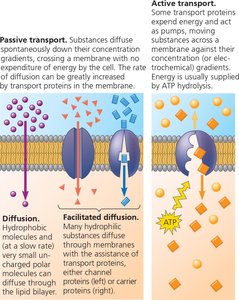
Active transport is a cellular process in which substances are moved across the plasma membrane against their concentration gradients, requiring energy input. Unlike passive transport, which relies on diffusion and does not require energy, active transport enables cells to maintain internal concentrations of ions and molecules that differ from their external environment.
Active transport uses carrier proteins (not channel proteins) to move solutes from areas of low concentration to areas of high concentration.
Energy for active transport is typically supplied by ATP hydrolysis.
Examples include the sodium-potassium pump and proton pumps.
Comparison: Passive vs. Active Transport
Passive transport: Substances move down their concentration gradient (diffusion or facilitated diffusion), requiring no energy.
Active transport: Substances move against their concentration gradient, requiring energy (usually ATP).
The Sodium-Potassium Pump
Mechanism and Steps
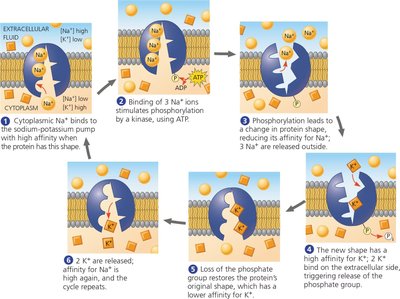
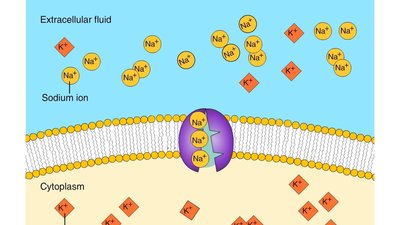
The sodium-potassium pump is a classic example of active transport in animal cells. It maintains high concentrations of potassium ions (K+) inside the cell and high concentrations of sodium ions (Na+) outside the cell. This pump is essential for cellular function, including nerve impulse transmission and muscle contraction.
Cytoplasmic Na+ binds to the pump with high affinity.
ATP is hydrolyzed, and the pump is phosphorylated, changing its shape.
Na+ is released outside the cell.
K+ binds to the new shape of the pump.
The phosphate group is released, restoring the original shape.
K+ is released inside the cell, and the cycle repeats.
Importance
Maintains membrane potential and electrochemical gradients.
Supports essential cellular activities such as electrical signaling in neurons.
Membrane Potential and Electrochemical Gradients
Definition and Role
Membrane potential is the voltage across the plasma membrane, resulting from the unequal distribution of ions.
The cytoplasmic side is typically negative relative to the extracellular side.
Membrane potential acts as an energy source, influencing the movement of charged substances.
Electrochemical Gradient
Two forces drive ion movement: the chemical gradient (concentration difference) and the electrical gradient (membrane potential).
The combined effect is called the electrochemical gradient.
Ions diffuse down their electrochemical gradient, not just their concentration gradient.
Proton Pumps and Electrogenic Transport
Proton Pump Function
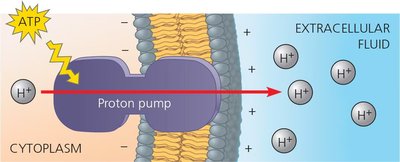
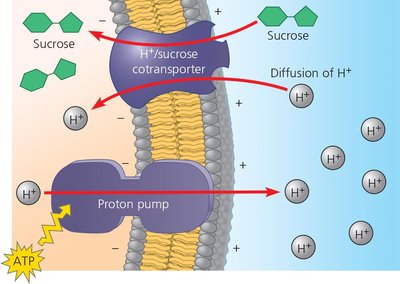
Proton pumps are electrogenic transport proteins that move hydrogen ions (H+) across membranes, generating voltage and storing energy.
ATP hydrolysis powers the pump.
Creates a charge separation across the membrane.
Important in plant, fungal, and bacterial cells.
Cotransport Mechanisms
Cotransport Definition and Example
Cotransport is a mechanism where the "downhill" movement of one solute (diffusing down its gradient) is coupled to the "uphill" movement of another solute (against its gradient) via a cotransporter protein.
Energy stored in the concentration gradient of one solute is used to transport another solute.
Example: In plants, a proton pump creates a gradient, and a cotransporter uses the diffusion of H+ to drive the uptake of sucrose.
In animals, similar cotransporters move glucose into cells.
Indirect Energy Use
ATP hydrolysis indirectly provides energy for cotransport by establishing the initial ion gradient.
Summary Table: Types of Membrane Transport
Type | Energy Required? | Direction | Protein Type | Example |
|---|---|---|---|---|
Diffusion | No | Down gradient | None | O2 across membrane |
Facilitated Diffusion | No | Down gradient | Channel/Carrier | Glucose transport |
Active Transport | Yes (ATP) | Against gradient | Carrier | Sodium-potassium pump |
Cotransport | Indirect (ATP) | Against gradient (for one solute) | Cotransporter | H+/sucrose cotransport |
Key Equations
ATP Hydrolysis
ATP hydrolysis provides energy for active transport:
Membrane Potential
Membrane potential is measured in millivolts (mV) and is determined by ion distribution:
Applications and Examples
Nerve cells use sodium-potassium pumps to generate action potentials.
Plant cells use proton pumps and cotransporters for nutrient uptake.
Kidney cells use active transport for ion reabsorption.
Additional info:
Electrogenic pumps (such as proton pumps) contribute to the overall membrane potential, which is crucial for processes like ATP synthesis in mitochondria and chloroplasts.
Cotransport is a fundamental mechanism in both plant and animal physiology, enabling efficient nutrient and ion uptake.
