 Back
BackAdaptations for Gas Exchange: Respiratory Pigments and Physiological Strategies
Study Guide - Smart Notes
 Tailored notes based on your materials, expanded with key definitions, examples, and context.
Adaptations for Gas Exchange in Animals
Coordination of Circulation and Gas Exchange
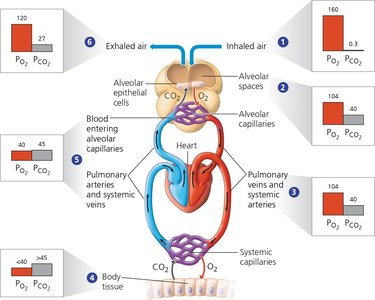
Gas exchange in animals involves the coordinated function of the respiratory and circulatory systems. The exchange of oxygen (O2) and carbon dioxide (CO2) is driven by differences in partial pressures across respiratory surfaces and capillaries. Understanding these gradients is essential for appreciating how gases are loaded and unloaded in the body.
Partial Pressure Gradients: O2 diffuses from areas of higher partial pressure (inhaled air and alveoli) to lower partial pressure (blood in capillaries), while CO2 diffuses in the opposite direction.
Gas Exchange Circuit: Blood picks up O2 in the lungs and delivers it to tissues, while collecting CO2 from tissues to expel in the lungs.
Systemic and Pulmonary Circuits: The heart pumps oxygenated blood through the systemic circuit and returns deoxygenated blood to the lungs via the pulmonary circuit.
Example: During exercise, increased cellular respiration in tissues lowers local O2 and raises CO2, enhancing diffusion gradients for gas exchange.
Respiratory Pigments
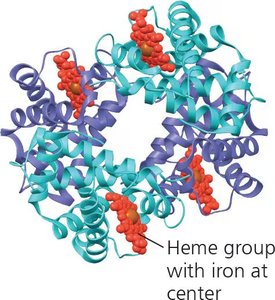
Because O2 is only sparingly soluble in water, animals use respiratory pigments to transport sufficient O2 to meet metabolic demands. These pigments are proteins that reversibly bind O2 and often contain a metal ion as a cofactor.
Hemoglobin: The primary respiratory pigment in vertebrates, found in erythrocytes (red blood cells). Each hemoglobin molecule has four subunits, each with a heme group containing an iron atom that binds one O2 molecule.
Hemocyanin: Found in arthropods and many molluscs, uses copper instead of iron and gives a blue color.
O2 Carrying Capacity: Respiratory pigments increase the O2 carrying capacity of blood from about 4.5 mL/L to approximately 200 mL/L in mammals.
Cooperativity: Hemoglobin exhibits cooperative binding—binding of one O2 increases the affinity for the next, and unloading one O2 facilitates further unloading.
Example: In humans, hemoglobin allows efficient O2 delivery during intense exercise without requiring excessive cardiac output.
Hemoglobin Dissociation and the Bohr Shift
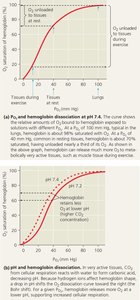
The relationship between O2 partial pressure and hemoglobin saturation is described by the dissociation curve. This curve is steep in the range of tissue PO2, allowing hemoglobin to release large amounts of O2 in response to small drops in PO2. The Bohr shift describes how increased CO2 production (and thus lower pH) decreases hemoglobin's affinity for O2, enhancing O2 delivery to active tissues.
Dissociation Curve: Shows percent saturation of hemoglobin at different PO2 values. Steep slope in tissue PO2 range means hemoglobin can unload O2 efficiently where needed.
Bohr Shift: Lower pH (from CO2 production) shifts the curve right, promoting O2 release.
Equation:
Example: During vigorous exercise, increased CO2 production in muscles causes more O2 to be released from hemoglobin.
Carbon Dioxide Transport
CO2 is transported in the blood in three main forms: dissolved in plasma, bound to hemoglobin, and as bicarbonate ions (HCO3−). The majority is converted to bicarbonate in erythrocytes, which helps buffer blood pH and facilitates CO2 removal in the lungs.
Dissolved CO2: About 7% is transported directly in plasma.
Bicarbonate: Most CO2 reacts with water to form carbonic acid, which dissociates into H+ and HCO3−. HCO3− is transported in plasma to the lungs.
Hemoglobin Buffering: Hemoglobin binds H+, minimizing pH changes in blood.
Equation:
Example: In the lungs, the process reverses, allowing CO2 to diffuse out and be exhaled.
Respiratory Adaptations of Diving Mammals
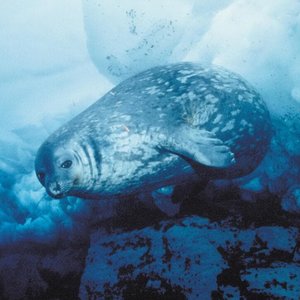
Diving mammals, such as the Weddell seal, have evolved remarkable adaptations for surviving long periods underwater without access to atmospheric oxygen. These adaptations include increased O2 storage and physiological mechanisms to conserve O2 during dives.
O2 Storage: Diving mammals have a higher blood volume per body mass and elevated concentrations of myoglobin in muscles, allowing greater O2 reserves.
O2 Conservation: During dives, heart rate and O2 consumption decrease, and blood flow is prioritized to vital organs. Muscles rely on myoglobin and anaerobic metabolism when blood O2 is restricted.
Diving Reflex: All mammals possess a reflex that reduces heart rate and peripheral blood flow upon submersion, but diving mammals have enhanced versions due to evolutionary selection.
Example: The Weddell seal can dive to depths of 200–500 m for 20 minutes to over an hour, and the Cuvier’s beaked whale can dive nearly 2 miles deep for over 2 hours.
Summary Table: Forms of CO2 Transport in Blood
Form of CO2 Transport | Percentage of Total CO2 | Description |
|---|---|---|
Dissolved in plasma | ~7% | CO2 directly dissolved in blood plasma |
As bicarbonate (HCO3−) | ~70% | CO2 converted to HCO3− in erythrocytes, transported in plasma |
Bound to hemoglobin | ~23% | CO2 binds to amino groups in hemoglobin |
Concept Check
What determines whether O2 and CO2 undergo net diffusion into or out of capillaries? Net diffusion is determined by the partial pressure gradients of O2 and CO2 between capillary blood and surrounding tissues or alveolar air.
How does the Bohr shift help deliver O2 to very active tissues? The Bohr shift lowers hemoglobin's affinity for O2 in response to decreased pH (from increased CO2), promoting O2 release where it is most needed.
Why might a doctor give bicarbonate (HCO3−) to a patient who is breathing rapidly? Rapid breathing can lower blood CO2 and pH; administering bicarbonate helps buffer the blood and maintain acid-base balance.
