 Back
BackAdaptive Immunity: Pathogen-Specific Recognition and the Role of Lymphocyte Receptors
Study Guide - Smart Notes
 Tailored notes based on your materials, expanded with key definitions, examples, and context.
Adaptive Immunity and Pathogen-Specific Recognition
Overview of Animal Immunity
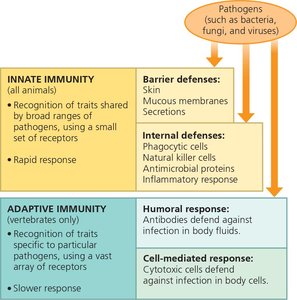
Animals possess two major types of immunity: innate immunity and adaptive immunity. Innate immunity is present in all animals and provides immediate, nonspecific defense against pathogens. Adaptive immunity, unique to vertebrates, is characterized by its specificity and memory, allowing for a tailored response to particular pathogens.
Innate Immunity: Rapid, broad defense using a limited set of receptors.
Adaptive Immunity: Slower, highly specific response using a vast array of receptors.
Lymphocytes: B Cells and T Cells
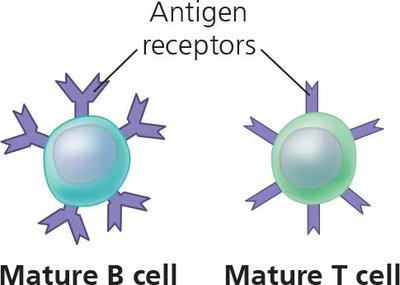
Lymphocytes are the central cells of adaptive immunity. They originate from stem cells in the bone marrow and differentiate into two main types:
B cells: Mature in the bone marrow.
T cells: Mature in the thymus.
Both cell types express unique antigen receptors on their surfaces, enabling them to recognize specific pathogens.
Antigens and Epitopes
Definition and Role in Immunity
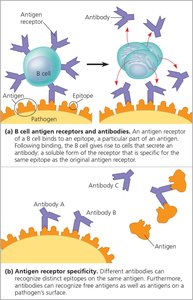
An antigen is any substance that elicits a B or T cell response. Most antigens are large, foreign molecules such as proteins or polysaccharides found on the surface of pathogens. The specific part of an antigen recognized by an antigen receptor is called an epitope.
Each antigen typically has multiple epitopes.
Each lymphocyte displays receptors specific for a single epitope.
Antigen Recognition by B Cells and Antibodies
Structure of B Cell Antigen Receptors
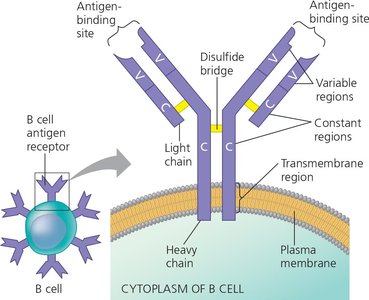
The B cell antigen receptor is a Y-shaped protein composed of two identical heavy chains and two identical light chains, linked by disulfide bridges. Each chain has a constant (C) region and a variable (V) region. The variable regions form the antigen-binding sites, allowing for specificity.
Each B cell receptor has two identical antigen-binding sites.
The constant region anchors the receptor in the plasma membrane.
Antibodies (Immunoglobulins)
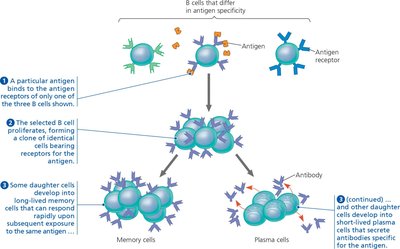
Upon activation, B cells differentiate into plasma cells that secrete antibodies (also called immunoglobulins, Ig). Antibodies have the same structure as B cell receptors but lack the membrane anchor, allowing them to circulate freely in body fluids and bind to antigens.
Antibodies bind to intact antigens in blood and lymph.
They provide direct defense by neutralizing pathogens or marking them for destruction.
Antigen Recognition by T Cells
Structure of T Cell Antigen Receptors
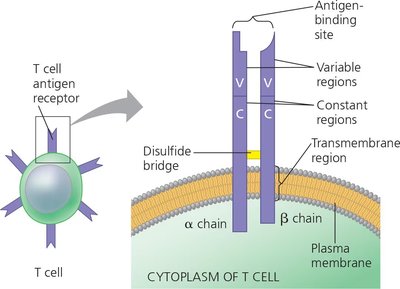
The T cell antigen receptor consists of two different polypeptide chains (α and β), each with variable and constant regions. The variable regions form a single antigen-binding site.
T cell receptors are anchored in the plasma membrane by a transmembrane region.
Role of MHC Molecules in Antigen Presentation
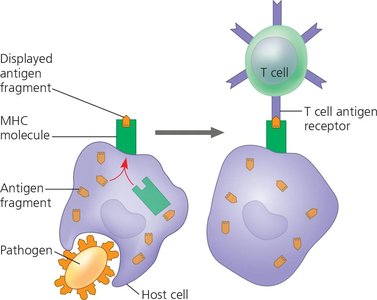
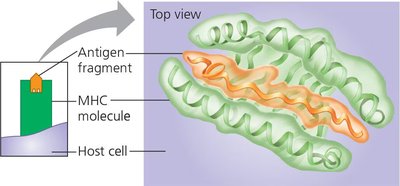
T cells recognize antigens only when they are presented on the surface of host cells by major histocompatibility complex (MHC) molecules. Pathogen proteins are processed into fragments (antigen fragments) inside host cells, which are then displayed by MHC molecules for recognition by T cells.
Antigen presentation: The process by which MHC molecules display antigen fragments on the cell surface.
T cell receptors bind to both the antigen fragment and the MHC molecule.
Generation of Lymphocyte Diversity
Genetic Mechanisms for Diversity
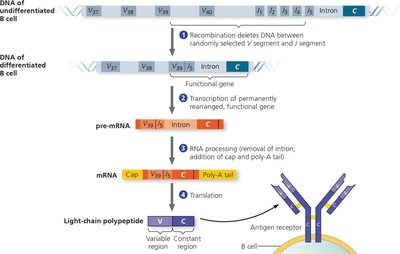
The diversity of antigen receptors is generated by the rearrangement of gene segments encoding the variable regions of these receptors. For example, the immunoglobulin (Ig) gene for the light chain consists of multiple variable (V), joining (J), and constant (C) segments. Random recombination of these segments creates a vast array of possible receptors.
Recombination is mediated by the enzyme recombinase.
Additional diversity arises from mutations during recombination.
Self-Tolerance in Adaptive Immunity
Elimination of Self-Reactive Lymphocytes
During maturation, lymphocytes are tested for self-reactivity. Those that react strongly to the body’s own molecules are eliminated by apoptosis (programmed cell death) or rendered nonfunctional. This process ensures that the immune system does not attack the body’s own tissues, a property known as self-tolerance.
Clonal Selection and Proliferation
Activation and Expansion of Lymphocytes
When a lymphocyte binds its specific antigen, it becomes activated and undergoes multiple rounds of cell division, producing a clone of identical cells. These cells differentiate into:
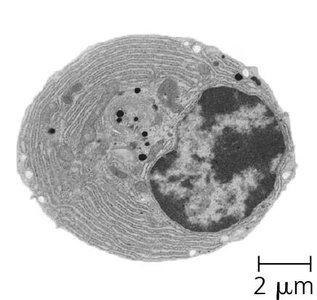
Effector cells: Short-lived cells that combat the antigen (e.g., plasma cells for B cells).
Memory cells: Long-lived cells that respond rapidly upon future exposure to the same antigen.
Immunological Memory
Primary and Secondary Immune Responses
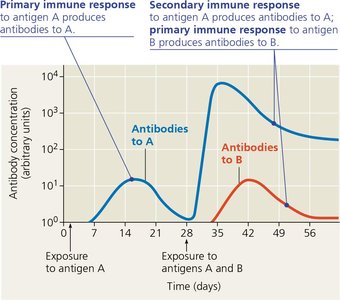
Immunological memory is the ability of the immune system to mount a stronger and faster response upon subsequent exposures to a previously encountered antigen. The first exposure triggers a primary immune response, while later exposures elicit a secondary immune response that is more rapid and robust due to the presence of memory cells.
Primary response peaks 10–17 days after exposure.
Secondary response peaks 2–7 days after re-exposure and is of greater magnitude.
Summary Table: Innate vs. Adaptive Immunity
Feature | Innate Immunity | Adaptive Immunity |
|---|---|---|
Specificity | Broad, recognizes general traits | Highly specific, recognizes unique epitopes |
Response Time | Rapid (minutes to hours) | Slower (days) |
Memory | None | Present (immunological memory) |
Main Cells | Phagocytes, natural killer cells | B cells, T cells |
Major Molecules | Antimicrobial proteins, cytokines | Antibodies, T cell receptors |
Key Terms
Antigen: Substance that elicits an immune response.
Epitope: Specific region of an antigen recognized by receptors.
Lymphocyte: White blood cell (B or T cell) involved in adaptive immunity.
Antibody (Immunoglobulin): Protein produced by B cells that binds antigens.
MHC molecule: Host protein that presents antigen fragments to T cells.
Clonal selection: Process by which an antigen activates and expands specific lymphocytes.
Immunological memory: Enhanced response to previously encountered antigens.
