 Back
4.2 Aerobic Cellular Respiration: How Cells Make ATP
Study Guide - Smart Notes
 Tailored notes based on your materials, expanded with key definitions, examples, and context.
Aerobic Cellular Respiration
Overview of ATP Production in Cells
Aerobic cellular respiration is the process by which eukaryotic cells extract energy from food molecules, primarily glucose, to produce ATP. ATP is a highly unstable, high-energy molecule that must be constantly synthesized by cells. Most ATP is generated inside mitochondria in the presence of oxygen, while glycolysis and fermentation can produce small amounts of ATP in the cytoplasm when oxygen is absent.
ATP: Adenosine triphosphate, the main energy currency of the cell.
Energy Source: Sugars (mainly glucose), fats, and other molecules.
Location: Mitochondria (aerobic respiration), cytoplasm (glycolysis and fermentation).
Major Concepts and Learning Objectives
Write and interpret the overall equation for aerobic cellular respiration.
Identify energy sources, reactants, products, and electron carriers.
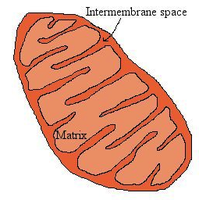
Describe the structure of mitochondria and the location of each stage.
List and explain the stages of aerobic cellular respiration.
Trace the flow of carbon, energy, and oxygen through the process.
Compare aerobic respiration and fermentation.
Redox Reactions and Electron Carriers
Role of Electron Carriers in Cellular Respiration
Cellular respiration involves a series of redox reactions where high-energy electrons from glucose are transferred to electron carriers, which ultimately donate them to oxygen. The main electron carriers are NAD+ and FAD, which cycle between oxidized and reduced forms.
NAD+ (oxidized) → NADH (reduced): Accepts 2 electrons and 1 proton.
FAD (oxidized) → FADH2 (reduced): Accepts 2 electrons and 2 protons.
Overall Equation for Aerobic Cellular Respiration
The process can be summarized by the following equation:
Reactants: Glucose (C6H12O6) and Oxygen (O2)
Products: Carbon dioxide (CO2), Water (H2O), and ATP
Energy Release from Glucose
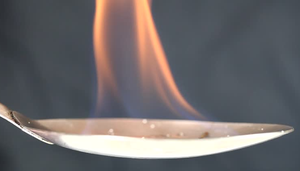
When glucose is burned in a flame, it releases energy as heat and light, converting to CO2 and H2O. In cells, this energy is harnessed through controlled steps to produce ATP.
Stages of Aerobic Cellular Respiration
1. Glycolysis
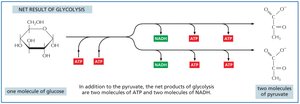
Glycolysis is the first stage, occurring in the cytoplasm. It breaks down one molecule of glucose into two molecules of pyruvate, producing a net gain of 2 ATP and 2 NADH.
Location: Cytoplasm
Reactants: Glucose, 2 ATP (investment phase)
Products: 2 Pyruvate, 2 ATP (net), 2 NADH
Redox: Glucose is oxidized, NAD+ is reduced to NADH
2. Pyruvate Processing
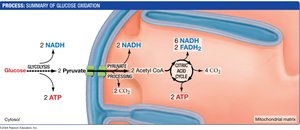
If oxygen is available, pyruvate enters the mitochondrial matrix and is converted to acetyl CoA, releasing CO2 and producing NADH.
Location: Mitochondrial matrix
Reactants: 2 Pyruvate
Products: 2 Acetyl CoA, 2 CO2, 2 NADH
3. Citric Acid Cycle (Krebs Cycle)
Acetyl CoA enters the citric acid cycle, where it is fully oxidized to CO2. This cycle produces NADH, FADH2, and ATP.
Location: Mitochondrial matrix
Reactants: 2 Acetyl CoA
Products: 4 CO2, 6 NADH, 2 FADH2, 2 ATP
Electron Transport Chain and Oxidative Phosphorylation
Electron Transport Chain (ETC)
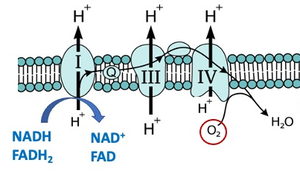
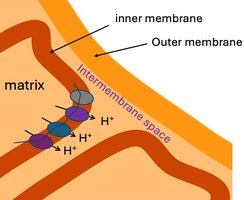
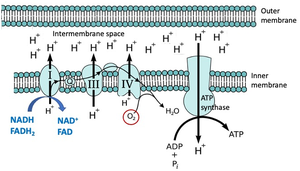
NADH and FADH2 donate their electrons to the ETC, located in the inner mitochondrial membrane. The ETC passes electrons through a series of protein complexes, pumping protons (H+) into the intermembrane space and creating a proton gradient.
Location: Inner mitochondrial membrane
Final Electron Acceptor: Oxygen (O2), which forms water (H2O)
Chemiosmosis and ATP Synthase
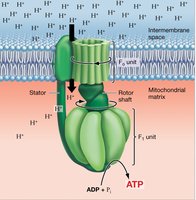
The proton gradient across the inner membrane creates a proton motive force. Protons flow back into the matrix through the ATP synthase enzyme, driving the synthesis of ATP from ADP and inorganic phosphate (Pi).
Process: Chemiosmosis
Enzyme: ATP synthase
ATP Yield: About 25-30 ATP per glucose
Summary Table: Stages of Aerobic Cellular Respiration
Stage | Location | Main Reactants | Main Products | ATP Yield |
|---|---|---|---|---|
Glycolysis | Cytoplasm | Glucose | 2 Pyruvate, 2 NADH | 2 |
Pyruvate Processing | Mitochondrial Matrix | 2 Pyruvate | 2 Acetyl CoA, 2 NADH, 2 CO2 | 0 |
Citric Acid Cycle | Mitochondrial Matrix | 2 Acetyl CoA | 6 NADH, 2 FADH2, 4 CO2, 2 ATP | 2 |
ETC & Oxidative Phosphorylation | Inner Membrane | NADH, FADH2, O2 | H2O, ATP | ~25-30 |
Fermentation: ATP Production Without Oxygen
Fermentation Pathways
When oxygen is not available, cells rely on fermentation to regenerate NAD+ and allow glycolysis to continue. Fermentation produces much less ATP than aerobic respiration.
Location: Cytoplasm
ATP Yield: 2 ATP per glucose
Types: Lactic acid fermentation (animals), Alcohol fermentation (yeast)
Key Point: Pyruvate accepts electrons from NADH, forming lactic acid or alcohol and CO2
Comparison: Aerobic Respiration vs. Fermentation
Process | Oxygen Required | ATP Yield | End Products |
|---|---|---|---|
Aerobic Respiration | Yes | ~30 ATP | CO2, H2O |
Fermentation | No | 2 ATP | Lactic acid (animals), Alcohol & CO2 (yeast) |
Key Terms and Concepts
Oxidation: Loss of electrons (e.g., glucose is oxidized during respiration).
Reduction: Gain of electrons (e.g., NAD+ is reduced to NADH).
Electron Transport Chain: Series of proteins that transfer electrons and pump protons.
ATP Synthase: Enzyme that synthesizes ATP using the proton gradient.
Fermentation: Anaerobic process regenerating NAD+ for glycolysis.
Summary Flow of Carbon, Energy, and Oxygen
Carbon: Glucose → Pyruvate → Acetyl CoA → CO2
Energy: Glucose → ATP (via NADH, FADH2, ETC)
Oxygen: O2 → H2O (final electron acceptor)
Additional info: The notes expand on the original content by providing definitions, context, and summary tables for clarity and completeness.
