 Back
BackAgriculture and Soil: Structure, Management, and Environmental Impacts
Study Guide - Smart Notes
 Tailored notes based on your materials, expanded with key definitions, examples, and context.
Importance and History of Agriculture
Overview of Agriculture
Agriculture is the practice of raising crops and livestock for human use, providing essential resources such as food and clothing. As the global population grows, agriculture must adapt to meet increasing demands. Both crop and livestock production require significant inputs, including soil, sunlight, water, nutrients, and pollinators. Rangelands and croplands occupy substantial portions of Earth's surface, with rangelands covering 26% and croplands 12% globally.
Key Inputs: Soil, water, sunlight, nutrients, pollinators
Land Use: Rangeland (livestock) and cropland (crops)
Historical Development
Agriculture began approximately 10,500 years ago, transforming human societies from hunter-gatherers to settled communities. This shift enabled selective breeding (artificial selection) and surplus food production, which supported population growth and occupational diversification. The Industrial Revolution further revolutionized agriculture through mechanization, monocultures, and increased use of fertilizers and chemicals, significantly impacting the environment.
Artificial Selection: Humans select desirable traits in crops and livestock
Mechanization: Machines increase efficiency and yield
Soil: Formation, Structure, and Types
Soil Composition and Importance
Healthy soil is fundamental for agriculture, providing mineral and organic matter, nutrients, water retention, and a structure for root growth. Soil also supports mutualistic fungi (mycorrhizae) that enhance plant nutrient uptake. While soil can be maintained as a renewable resource, its formation is a slow process, taking thousands of years.
Mineral Matter: Inorganic particles from weathered rock
Organic Matter: Decomposed plant and animal material (humus)
Mycorrhizae: Fungi that form symbiotic relationships with plant roots
Soil Structure and Horizons
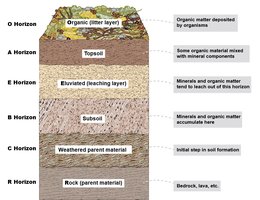
Soil is organized into distinct layers called horizons, each with unique characteristics. The topsoil (A horizon) is especially important for agriculture due to its high organic content and fertility. Most soil organisms are found in the O and A horizons. Leaching, the downward movement of minerals, affects nutrient distribution.
O Horizon: Organic matter layer
A Horizon: Topsoil, rich in organic material
E Horizon: Leaching layer
B Horizon: Subsoil, accumulation of minerals
C Horizon: Weathered parent material
R Horizon: Bedrock
Soil Types and Texture
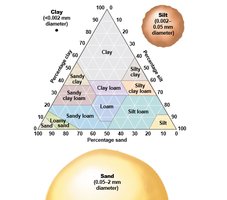
Soils differ in organic content, horizon width, pH, and texture. Texture is determined by the relative proportions of sand, silt, and clay. Loam, an even mix of all three, is ideal for agriculture due to its balance of drainage and nutrient retention.
Sand: Largest particles, high porosity, poor water retention
Silt: Medium-sized particles, moderate properties
Clay: Smallest particles, high water retention, sticky
Loam: Balanced mix, best for crops
Water Use in Agriculture
Irrigation and Its Challenges
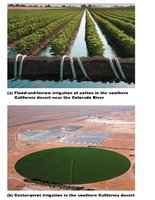
Rainfall alone may not meet crop water needs, making irrigation essential in many regions. Irrigation accounts for 70% of human water withdrawals. However, over-irrigation can cause waterlogging (roots cannot exchange gases) and salinization (salt buildup on soil surface), both of which reduce soil productivity.
Irrigation: Artificial application of water to crops
Waterlogging: Excess water saturates soil, harming roots
Salinization: Accumulation of salts due to evaporation and saline water use
Reducing Water Use
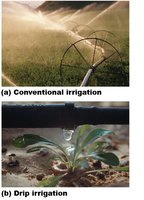
Efficient water use in agriculture can be achieved by growing crops suited to local climates and adopting advanced irrigation technologies, such as drip irrigation, which minimizes water loss compared to conventional methods.
Crop Selection: Grow drought-tolerant crops in dry regions
Efficient Irrigation: Use drip or targeted systems to reduce waste
Soil Nutrients and Fertilization
Essential Nutrients
Plants require macronutrients such as nitrogen (N), phosphorus (P), and potassium (K), as well as trace elements. These nutrients are depleted by plant uptake and leaching, necessitating replenishment through fertilizers.
Inorganic Fertilizer: Manufactured or mined substances
Organic Fertilizer: Derived from plant or animal waste
Overapplication: Leads to runoff, leaching, and eutrophication (nutrient pollution in water bodies)
Precision Agriculture: Technology-driven approach to optimize fertilizer use and minimize environmental impact
Pollination in Agriculture
Pollination Mechanisms
Pollination is the transfer of pollen from male to female plant structures, enabling fertilization. While some crops are wind-pollinated, most rely on insects, especially honeybees. Declines in pollinator populations due to pesticides and habitat loss threaten crop yields.
Wind Pollination: Common in grasses
Insect Pollination: Essential for many fruits and vegetables
Pollinator Decline: Linked to pesticide use and habitat destruction
Environmental Issues in Agriculture
Land and Soil Degradation
Modern agriculture faces the challenge of increasing food production without expanding farmland, which is limited. Unsustainable practices lead to land and soil degradation, including erosion, desertification, and nutrient depletion.
Soil Degradation: Decline in soil quality due to overuse, deforestation, and poor management
Loss of Productive Land: 12-17 million acres lost annually
Soil Erosion
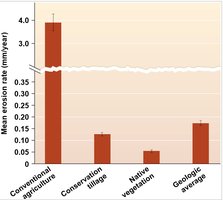
Soil erosion is the displacement of topsoil by wind or water, often accelerated by human activities such as overgrazing, overcultivation, and deforestation. Erosion rates often exceed soil formation rates, threatening long-term agricultural productivity.
Causes: Wind, water, removal of vegetation
Human Impact: Most current erosion is anthropogenic
Desertification
Desertification is the process by which fertile land becomes desert, typically due to drought, deforestation, or inappropriate agriculture. It is most common in drylands and is exacerbated by climate change and poor land management.
Causes: Erosion, overgrazing, salinization, drought
Historical Example: The "Dust Bowl" in the US prompted soil conservation efforts
Soil Conservation Practices
Methods to Prevent Soil Degradation
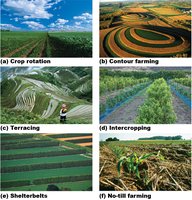
Farmers use various strategies to conserve soil and maintain productivity. These include crop rotation, contour farming, terracing, intercropping, shelterbelts, and conservation tillage. Each method helps reduce erosion, maintain soil fertility, and support sustainable agriculture.
Crop Rotation: Alternating crops to restore nutrients and reduce pests
Contour Farming: Plowing along land contours to reduce runoff
Terracing: Creating steps on slopes to prevent erosion
Intercropping: Planting different crops together for ground cover and pest control
Shelterbelts: Planting trees as windbreaks
Conservation Tillage: Minimizing soil disturbance
Rangeland Management and Overgrazing
Impacts of Overgrazing
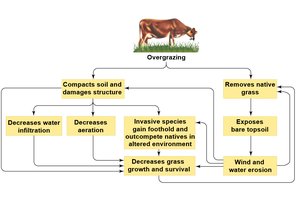
Overgrazing occurs when livestock consume more vegetation than can regrow, leading to soil erosion, compaction, and invasion by non-native species. This process reduces land productivity and can trigger a cycle of degradation known as the "Tragedy of the Commons." Public lands in the US are particularly vulnerable to overgrazing.
Soil Compaction: Reduces water infiltration and root growth
Loss of Vegetation: Exposes soil to erosion
Invasive Species: Outcompete native plants in degraded environments
Policy Approaches for Land Conservation
Government Programs and Incentives
Policies such as subsidies and conservation programs influence land use. While subsidies can encourage farming on marginal lands, conservation programs like the Farm Bill, Wetlands Reserve Program, and Conservation Reserve Program incentivize sustainable practices and land restoration.
Farm Bill: Supports conservation through periodic renewal
Wetlands Reserve Program: Pays landowners to protect wetlands
Conservation Reserve Program: Pays farmers to retire erodible land and restore vegetation
