 Back
BackAlternation of Generations, Plant Phylogeny, and Fairy Rings: Step-by-Step Study Guidance
Study Guide - Smart Notes
 Tailored notes based on your materials, expanded with key definitions, examples, and context.
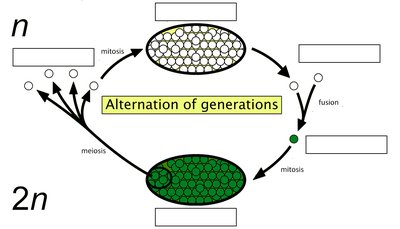
Q1. Alternation of Generations: Fill in the blanks and label the diagram
Background
Topic: Plant Life Cycles – Alternation of Generations
This question tests your understanding of the alternation of generations, a fundamental concept in plant biology describing the life cycle that alternates between multicellular haploid (gametophyte) and multicellular diploid (sporophyte) phases.
Key Terms and Formulas:
Gametophyte: Multicellular haploid phase ()
Sporophyte: Multicellular diploid phase ()
Meiosis: Cell division that produces haploid spores from diploid cells
Mitosis: Cell division that produces identical cells (used by gametophytes to produce gametes)
Zygote: Diploid cell formed by fusion of two gametes
Step-by-Step Guidance
Identify the two main phases: The multicellular haploid phase is called the gametophyte, and the multicellular diploid phase is called the sporophyte.
Recall that the mature sporophyte () produces haploid spores () by meiosis. These spores grow into gametophytes.
Understand that gametophytes produce gametes () by mitosis. Two gametes fuse to form a diploid zygote ().
The zygote divides by mitosis to become a multicellular sporophyte, completing the cycle.
Use the diagram to label each phase and process, matching the terms to their correct locations.
Try solving on your own before revealing the answer!
Q2. Haploid spores are produced by the [ sporophyte / gametophyte ]
Background
Topic: Plant Reproduction
This question tests your knowledge of which phase produces spores in the alternation of generations.
Key Terms:
Sporophyte: Diploid phase that produces spores
Gametophyte: Haploid phase that produces gametes
Step-by-Step Guidance
Recall that spores are produced by meiosis.
Determine which phase undergoes meiosis to produce spores.
Consider the ploidy of the phase that produces spores (diploid or haploid).
Try solving on your own before revealing the answer!
Q3. A zygote is produced by the fusion of [ gametophytes / gametes / spores ]
Background
Topic: Fertilization in Plant Life Cycles
This question tests your understanding of what cellular fusion creates a zygote in plants.
Key Terms:
Zygote: Diploid cell formed by fusion
Gametes: Haploid reproductive cells
Step-by-Step Guidance
Recall the definition of a zygote.
Identify which cells fuse to form a zygote.
Consider the ploidy of the cells involved in the fusion.
Try solving on your own before revealing the answer!
Q4. Spores that are produced by [ meiosis / mitosis ] will produce a gametophyte.
Background
Topic: Cell Division in Plant Life Cycles
This question tests your understanding of how spores are produced and their role in the life cycle.
Key Terms:
Meiosis: Reduces chromosome number, produces haploid spores
Mitosis: Maintains chromosome number
Step-by-Step Guidance
Recall which process produces haploid spores from a diploid sporophyte.
Determine which process is responsible for generating genetic diversity.
Connect the process to the production of gametophytes.
Try solving on your own before revealing the answer!
Q5. Gametes are produced by [ meiosis / mitosis ].
Background
Topic: Gamete Formation in Plants
This question tests your knowledge of how gametes are produced in the gametophyte phase.
Key Terms:
Gametes: Haploid reproductive cells
Mitosis: Produces identical cells
Meiosis: Reduces chromosome number
Step-by-Step Guidance
Recall the ploidy of gametophytes and gametes.
Determine which process produces gametes from gametophytes.
Consider whether chromosome number changes during this process.
Try solving on your own before revealing the answer!
Q6. Sporophytes are [ diploid / haploid ]. Gametophytes are [ diploid / haploid ].
Background
Topic: Ploidy Levels in Plant Life Cycles
This question tests your understanding of the chromosome number in each phase.
Key Terms:
Diploid (): Two sets of chromosomes
Haploid (): One set of chromosomes
Step-by-Step Guidance
Recall which phase is diploid and which is haploid.
Match the ploidy to the correct phase.
Try solving on your own before revealing the answer!
Q7. A zygote is [ diploid / haploid ]. A spore is [ diploid / haploid ]. A gamete is [ diploid / haploid ].
Background
Topic: Ploidy of Cells in Plant Life Cycles
This question tests your knowledge of the chromosome number in zygotes, spores, and gametes.
Key Terms:
Zygote: Diploid ()
Spore: Haploid ()
Gamete: Haploid ()
Step-by-Step Guidance
Recall the ploidy of each cell type.
Match the ploidy to the correct cell type.
Try solving on your own before revealing the answer!
Q8. Sporophytes and gametophytes are both produced through the process of [ meiosis / mitosis ]
Background
Topic: Cell Division in Plant Life Cycles
This question tests your understanding of how multicellular phases are generated.
Key Terms:
Mitosis: Produces multicellular organisms from single cells
Meiosis: Produces haploid spores
Step-by-Step Guidance
Recall how a zygote becomes a sporophyte and how a spore becomes a gametophyte.
Determine which process is involved in increasing cell number without changing ploidy.
Try solving on your own before revealing the answer!
Q9. Which of the following is the best description of the process of alternation of generations? (Check all that apply)
Background
Topic: Life Cycle Stages in Plants
This question tests your ability to identify the correct stages present in alternation of generations.
Key Terms:
Multicellular haploid stage
Multicellular diploid stage
Unicellular stages (not typical in alternation of generations)
Step-by-Step Guidance
Review the definitions of each stage.
Identify which stages are present in alternation of generations.
Check all that apply based on your understanding.
Try solving on your own before revealing the answer!
Q10. Mapping the Plant Tree: Label derived characters (flowers, embryos, seeds, vascular tissues, double fertilization) on a phylogenetic tree
Background
Topic: Plant Evolution and Phylogeny
This question tests your understanding of the evolutionary relationships among major plant groups and the appearance of key derived traits.
Key Terms:
Phylogenetic tree: Diagram showing evolutionary relationships
Derived characters: Traits that evolved in specific lineages (e.g., flowers, seeds)
Step-by-Step Guidance
Review the major groups of plants: nonvascular plants, seedless vascular plants, gymnosperms, angiosperms.
Recall where each derived character first appears in the evolutionary history.
Match each character (a–e) to the correct location on the tree.
Try solving on your own before revealing the answer!
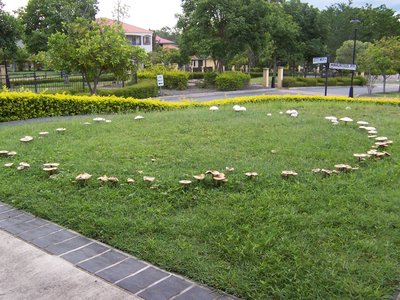
Q11. Fairy Rings: Structure, oldest part, and ecological effects
Background
Topic: Fungal Biology and Ecology
This question tests your understanding of fungal growth, mycelium structure, and the ecological impact of fairy rings in grasslands.
Key Terms:
Mycelium: Network of fungal hyphae
Hyphae: Thread-like structures that make up the mycelium
Ecological benefit: Positive impact (e.g., decomposition)
Ecological cost: Negative impact (e.g., nutrient depletion)
Step-by-Step Guidance
Define the type of organism responsible for fairy rings and describe mycelium in one sentence each.
Analyze the diagram or description to determine which location (A–D) is the oldest part of the organism, using reasoning about fungal growth patterns.
Discuss one ecological benefit (such as nutrient recycling) and one ecological cost (such as grass dieback) of fairy ring formation.
Try solving on your own before revealing the answer!
Final Answers
Q1: The multicellular haploid phase is the gametophyte, and the multicellular diploid phase is the sporophyte.
Q2: Haploid spores are produced by the sporophyte.
Q3: A zygote is produced by the fusion of gametes.
Q4: Spores that are produced by meiosis will produce a gametophyte.
Q5: Gametes are produced by mitosis.
Q6: Sporophytes are diploid. Gametophytes are haploid.
Q7: A zygote is diploid. A spore is haploid. A gamete is haploid.
Q8: Sporophytes and gametophytes are both produced through the process of mitosis.
Q9: The best descriptions are: a life cycle that includes a multicellular diploid stage and a multicellular haploid stage.
Q10: Derived characters appear as follows: a. flowers (angiosperms), b. embryos (all land plants), c. seeds (seed plants), d. vascular tissues (vascular plants), e. double fertilization (angiosperms).
Q11: 1. Fairy rings are made by fungi; mycelium is a network of hyphae that absorbs nutrients. 2. The oldest part is the center of the ring, where the fungus began growing. 3. Ecological benefit: decomposition and nutrient recycling; ecological cost: depletion of nutrients and possible grass dieback.
These answers reflect the key concepts and reasoning steps for each question. Review the explanations above to reinforce your understanding!
