 Back
Amino Acids, Proteins, and Nucleic Acids: Structure and Function Study Guide
Study Guide - Smart Notes
 Tailored notes based on your materials, expanded with key definitions, examples, and context.
Q1. Draw the basic structure of an amino acid.
Background
Topic: Amino Acid Structure
This question tests your understanding of the general structure of amino acids, which are the building blocks of proteins.
Key Terms:
Amino group (–NH2)
Carboxyl group (–COOH)
R group (side chain)
Hydrogen atom
Central (alpha) carbon
Step-by-Step Guidance
Start by drawing a central carbon atom (the alpha carbon).
Attach four groups to this carbon: an amino group, a carboxyl group, a hydrogen atom, and an R group (which varies for each amino acid).
Arrange the groups so that the amino and carboxyl groups are opposite each other, with the hydrogen and R group filling the remaining positions.
Try solving on your own before revealing the answer!
Final Answer:
The basic structure of an amino acid is:
, with the central carbon also bonded to a hydrogen atom and an R group.
This structure is universal for all amino acids, with the R group determining the specific properties of each.
Q2. Circle each of the four functional groups in your amino acid drawing and name them.
Background
Topic: Functional Groups in Amino Acids
This question checks your ability to identify and name the four groups attached to the central carbon in an amino acid.
Key Terms:
Amino group (–NH2)
Carboxyl group (–COOH)
Hydrogen atom
R group (side chain)
Step-by-Step Guidance
Look at your amino acid drawing and identify each group attached to the central carbon.
Circle the amino group and label it as "Amino group".
Circle the carboxyl group and label it as "Carboxyl group".
Circle the hydrogen atom and label it as "Hydrogen atom".
Circle the R group and label it as "R group" or "Side chain".
Try solving on your own before revealing the answer!
Final Answer:
The four functional groups are:
Amino group (–NH2)
Carboxyl group (–COOH)
Hydrogen atom
R group (side chain)
Each is attached to the central (alpha) carbon.
Q3. Predict the properties of the functional groups found in Alanine, Serine, and Glutamate.
Background
Topic: Amino Acid Properties
This question tests your ability to use an amino acid table to determine the chemical properties of the side chains (R groups) in different amino acids.
Key Terms:
Hydrophobic
Hydrophilic
Polar
Nonpolar
Acidic
Basic
Step-by-Step Guidance
Find Alanine, Serine, and Glutamate in your amino acid table.
Identify the R group for each amino acid.
Determine if the R group is polar or nonpolar, acidic or basic, hydrophobic or hydrophilic.
Write a brief description of the properties for each amino acid based on its R group.
Try solving on your own before revealing the answer!
Final Answer:
Alanine: Nonpolar, hydrophobic (methyl group as R group)
Serine: Polar, hydrophilic (hydroxyl group as R group)
Glutamate: Acidic, hydrophilic (carboxyl group as R group)
These properties affect how each amino acid interacts in proteins.
Q4. Define a condensation reaction in your own words.
Background
Topic: Condensation Reactions
This question tests your understanding of how monomers (like amino acids) are joined to form polymers (like proteins).
Key Terms:
Condensation reaction
Dehydration synthesis
Monomer
Polymer
Step-by-Step Guidance
Recall that a condensation reaction involves joining two molecules together.
Think about what is removed during this process (usually water).
Describe how this reaction forms a new bond between the molecules.
Try solving on your own before revealing the answer!
Final Answer:
A condensation reaction is a process where two molecules are joined together, and a molecule of water is released as a byproduct. This is also called dehydration synthesis.
Q5. Draw a two-amino acid polymer and indicate the peptide bond.
Background
Topic: Peptide Bond Formation
This question tests your ability to visualize how amino acids are linked together to form proteins.
Key Terms:
Peptide bond
Condensation reaction
Polymer
Step-by-Step Guidance
Draw two amino acids side by side, each with their basic structure.
Show the amino group of one amino acid reacting with the carboxyl group of the other.
Indicate the bond formed between the carbon of the carboxyl group and the nitrogen of the amino group (the peptide bond).
Try solving on your own before revealing the answer!
Final Answer:
The peptide bond is formed between the carboxyl group of one amino acid and the amino group of another, resulting in a C–N bond. This is the linkage that forms the backbone of proteins.
Q6. Draw a nucleotide, label the five carbons, and summarize the role of each carbon.
Background
Topic: Nucleotide Structure
This question tests your understanding of the structure of nucleotides, which are the building blocks of nucleic acids like DNA and RNA.
Key Terms:
Pentose sugar (ribose or deoxyribose)
Phosphate group
Nitrogenous base
Carbon numbering (1', 2', 3', 4', 5')
Step-by-Step Guidance
Draw the pentose sugar ring and label each carbon (1', 2', 3', 4', 5').
Attach the phosphate group to the 5' carbon.
Attach the nitrogenous base to the 1' carbon.
Summarize the role of each carbon: 1' (base attachment), 2' (distinguishes ribose from deoxyribose), 3' (site for polymerization), 4' (connects to 5'), 5' (phosphate attachment).
Try solving on your own before revealing the answer!
Final Answer:
The five carbons in the pentose sugar are labeled 1' through 5'.
1': Attaches to the nitrogenous base
2': Determines if the sugar is ribose (OH) or deoxyribose (H)
3': Site for polymerization (phosphodiester bond formation)
4': Connects to the 5' carbon
5': Attaches to the phosphate group
Q7. Draw a second nucleotide attached to the first, indicating the phosphodiester bond.
Background
Topic: Nucleic Acid Polymerization
This question tests your understanding of how nucleotides are linked together to form DNA or RNA strands.
Key Terms:
Phosphodiester bond
3' and 5' carbons
Polymerization
Step-by-Step Guidance
Draw a second nucleotide next to the first, with its pentose sugar and phosphate group.
Show the phosphate group of the second nucleotide connecting to the 3' carbon of the first nucleotide.
Indicate the phosphodiester bond between the 3' hydroxyl of one sugar and the phosphate attached to the 5' carbon of the next.
Try solving on your own before revealing the answer!
Final Answer:
The phosphodiester bond links the 3' carbon of one nucleotide's sugar to the phosphate group attached to the 5' carbon of the next nucleotide, forming the backbone of DNA/RNA.
Q8. Identify structural features of DNA using a model: sugar-phosphate backbone, nitrogenous bases, major groove, phosphodiester bonds, hydrogen bonds, and 3’/5’ carbons.
Background
Topic: DNA Structure
This question tests your ability to recognize and describe the major structural features of DNA, including its double helix and the locations of key bonds and grooves.
Key Terms:
Sugar-phosphate backbone
Nitrogenous bases
Major groove
Minor groove
Phosphodiester bonds
Hydrogen bonds
3’ and 5’ carbons
Purines (adenine, guanine)
Step-by-Step Guidance
Examine a DNA model or diagram and locate the sugar-phosphate backbone (the outer part of the helix).
Identify the nitrogenous bases (A, T, G, C) and note which are purines (adenine and guanine).
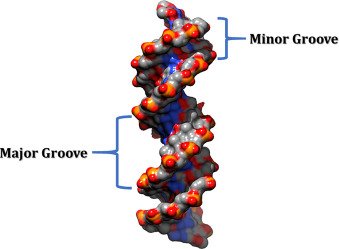
Find the major and minor grooves in the double helix structure.
Locate the phosphodiester bonds connecting the sugars and phosphates along the backbone.
Identify the hydrogen bonds between complementary bases in the center of the helix.
Point out the 3’ and 5’ carbons in a nucleotide and describe their orientation in the strand.
Try solving on your own before revealing the answer!
Final Answer:
Sugar-phosphate backbone: forms the sides of the DNA ladder
Nitrogenous bases: form the rungs, purines are adenine and guanine
Major groove: wider space in the helix, minor groove: narrower space
Phosphodiester bonds: link sugars and phosphates
Hydrogen bonds: connect complementary bases (A-T, G-C)
3’ and 5’ carbons: define the directionality of the DNA strand
The image above highlights the major and minor grooves in the DNA double helix.
Q9. Outline the differences between the primary and secondary structures of DNA vs. RNA.
Background
Topic: DNA and RNA Structure
This question tests your understanding of how DNA and RNA differ in their structural organization at the primary and secondary levels.
Key Terms:
Primary structure
Secondary structure
DNA
RNA
Step-by-Step Guidance
Recall that primary structure refers to the sequence of nucleotides.
Secondary structure refers to the folding or shape formed by interactions between nucleotides.
Compare DNA and RNA: DNA is usually double-stranded and forms a double helix; RNA is usually single-stranded and can fold into various shapes.
Note differences in sugar (deoxyribose vs. ribose) and bases (thymine in DNA, uracil in RNA).
Try solving on your own before revealing the answer!
Final Answer:
Primary structure: DNA and RNA both have a nucleotide sequence, but DNA uses deoxyribose and thymine, RNA uses ribose and uracil.
Secondary structure: DNA forms a double helix (with major and minor grooves), RNA forms single-stranded structures that can fold into hairpins and loops.
These differences affect their function and stability in cells.
