 Back
An Introduction to Animals: Structure, Diversity, and Evolution
Study Guide - Smart Notes
 Tailored notes based on your materials, expanded with key definitions, examples, and context.
Chapter 30: An Introduction to Animals
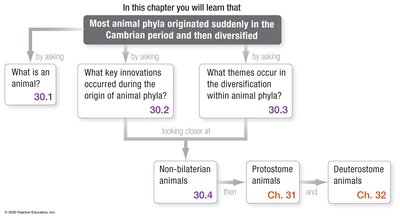
Overview of Animal Diversity
Animals are a highly diverse group of multicellular eukaryotes, with millions of species estimated to exist. Only a fraction of these have been described, and biologists continue to discover new species as they race against extinction. The animal kingdom is organized into 30–35 phyla, with ongoing debate and revision as new information emerges.
Estimated Species: Between 3 and 10 million animal species exist.
Described Species: About 1.4 million species have been formally described.
Phyla: 30–35 recognized animal phyla.
What Is an Animal?
Key Characteristics of Animals
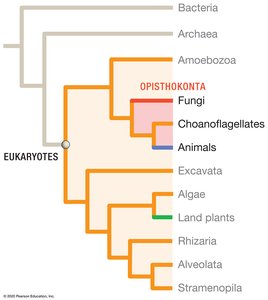
Animals originated from single-celled eukaryotes and belong to the lineage Opisthokonta, with choanoflagellates as their closest living relatives. They form a monophyletic clade, sharing several defining traits:
Multicellularity: Cells lack cell walls and possess an extensive extracellular matrix (ECM) for cell–cell adhesion and communication.
Heterotrophy: Animals obtain carbon compounds from other organisms, primarily by ingesting food.
Motility: Movement under their own power at some stage in their life cycle.
Neurons and Muscle Cells: All animals except sponges have neurons and muscle cells for electrical signaling and contraction.
Key Innovations in Animal Evolution
Sources of Evidence
Biologists use multiple lines of evidence to study animal evolution:
Fossils: Provide direct evidence of ancient animals, their appearance, and habitats.
Comparative Morphology: Distinguishes shared characteristics and synapomorphies, helping define body plans and relationships.
Comparative Development (Evo-Devo): Reveals patterns of gene expression and morphological change during development.
Comparative Genomics: Offers insight into genetic similarities and evolutionary history.
Origin of Multicellularity
Sponges-First Hypothesis
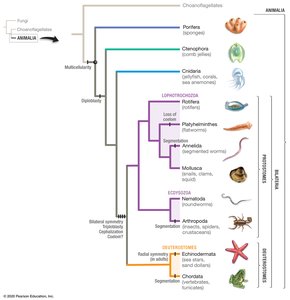
Sponges are considered the most ancient animal lineage, appearing over 700 million years ago. Morphological evidence supports their basal position:
Benthic and Sessile: Both sponges and choanoflagellates live attached to substrates.
Feeding Cells: Sponges use choanocytes, similar to choanoflagellate cells, to trap organic debris.
Cell Specialization: Sponges have multiple specialized cell types organized in layers surrounded by ECM.
Epithelium: Some sponges possess true epithelium, a layer of tightly joined cells essential for animal form and function.
Origin of Embryonic Tissue Layers and Muscle
Diploblasts and Triploblasts
Animals are classified based on the number of embryonic tissue layers:
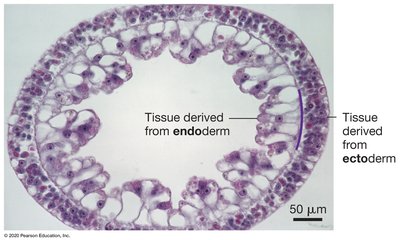
Diploblasts: Have two germ layers—ectoderm (outside-skin) and endoderm (inside-skin).
Triploblasts: Have three germ layers—ectoderm, endoderm, and mesoderm (middle-skin).
Germ layers develop into distinct adult tissues and organs:
Ectoderm: Skin and nervous system
Endoderm: Lining of digestive tract
Mesoderm: Circulatory system, muscle, bones, and most organs
Origin and Diversification of Tissues
Diploblastic Lineages
Two major animal groups are recognized as diploblasts:
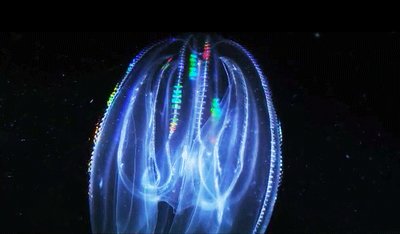
Ctenophora: Comb jellies
Cnidaria: Jellyfish, corals, sea pens, hydra, and anemones
Origin of Muscle
Muscle Evolution and Homology
All animals share homologous genes for contractile proteins (actin and myosin). The genetic toolkit for muscle evolved gradually, with components co-opted and elaborated in different lineages. Functional similarity in muscle is often achieved through convergent evolution with deep genetic homology.
Origin of Bilateral Symmetry, Cephalization, and the Nervous System
Body Symmetry
Body symmetry is a key aspect of animal body plans:
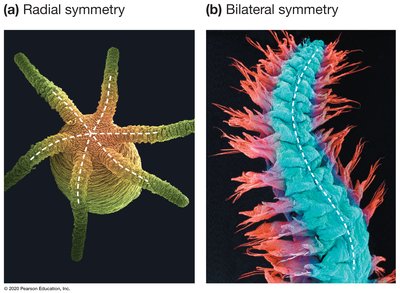
Radial Symmetry: Seen in cnidarians, ctenophores, and some sponges; at least two planes of symmetry.
Bilateral Symmetry: Most other animals; single plane of symmetry and elongated bodies.
Nervous System Evolution
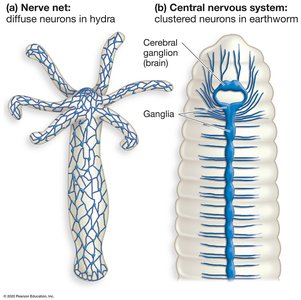
Sponges lack nerve cells and symmetry. Radially symmetric cnidarians and ctenophores have nerve cells organized into a nerve net, while some ctenophores have clusters of nerves (ganglia). Bilaterians have diverse nervous systems, ranging from nerve nets to complex central nervous systems (CNS), with neurons clustered in tracts, cords, or ganglia. Cephalization—the concentration of sensory and neural structures in the head—coincided with CNS evolution.
Origin of the Coelom
Body Cavities in Bilaterians
The basic bilaterian body shape is a tube within a tube, with a coelom (fluid-filled cavity) between the tubes:
True Coelomates: Coelom completely lined with mesoderm.
Acoelomates: No coelom (e.g., flatworms).
Pseudocoelomates: Coelom partially lined with mesoderm (e.g., roundworms, rotifers).
Origin of Protostomes and Deuterostomes
Embryonic Development
Bilaterally symmetric triploblasts with CNS, cephalization, and coelom gave rise to diverse animal lineages. Embryonic development divides animals into two major subgroups:
Protostomes: Mouth develops before anus.
Deuterostomes: Anus develops before mouth.
Three germ layers form during gastrulation, with the blastopore becoming the anus in deuterostomes. Development is variable in protostomes.
Origin of Segmentation
Segmentation and Genetic Toolkits
Segmentation is the division of the body into series of similar structures, such as the vertebrate backbone. Hox genes for segmentation arose early in animal evolution and are homologous across phyla, but have been lost or co-opted in different lineages, leading to convergent evolution of segmentation.
Themes in Animal Diversification
Factors Driving Diversification
Higher Oxygen Levels: Enabled evolution of large, mobile animals.
High-Quality Food Sources: Algae provided oxygen and nutritious food.
Evolution of Predation: Predators exert selection pressure on prey.
New Niches: Diversification created new ecological niches.
Genetic Toolkits: Evolution of genetic toolkits increased morphological diversity.
Sensory Organs
Diversity of Sensory Abilities
Cephalization led to concentration of sensory organs in the head. Most animals have common senses (sight, hearing, taste, smell, touch) and specialized abilities (detecting magnetic fields, electrical activity, air pressure changes).
Sense | Example |
|---|---|
Sight | Flies use compound eyes to find food and mates, and escape predators. |
Hearing | Bats use hearing to find prey and avoid obstacles in the dark. |
Taste/Smell | Male moths detect chemical signals with elaborate antennae. |
Touch | Sea anemones detect and capture prey using touch. |
Ecological Roles and Feeding Strategies
Classification by Diet
Detritivores: Feed on dead organic matter (e.g., millipedes).
Herbivores: Feed on plants or algae (e.g., pandas).
Carnivores: Feed on other animals (e.g., owls).
Omnivores: Eat both plants and animals (e.g., humans).
Ecological Role | Example |
|---|---|
Detritivores | Millipedes feed on decaying leaves. |
Herbivores | Pandas eat bamboo. |
Carnivores | Owls hunt and consume prey. |
Omnivores | Humans eat a combination of plants and animals. |
Parasites
Endoparasites: Live inside hosts, usually wormlike.
Ectoparasites: Live outside hosts, with limbs or mouthparts for grasping.
Feeding Strategies
Suspension Feeders: Filter particles from water or air (e.g., barnacles).
Deposit Feeders: Ingest organic material from substrates (e.g., sea cucumbers).
Fluid Feeders: Suck or mop up liquids (e.g., butterflies, moths).
Mass Feeders: Take chunks of food into their mouths (e.g., lions).
Strategy | Example |
|---|---|
Suspension feeders | Barnacles capture plankton with specialized legs. |
Deposit feeders | Sea cucumbers mop up detritus from the seafloor. |
Fluid feeders | Butterflies drink nectar through a proboscis. |
Mass feeders | Lions bite off chunks of meat from prey. |
Movement and Skeletal Systems
Locomotion and Skeleton Types
Animal locomotion serves functions such as finding food, mates, escaping predators, and dispersing. Animals possess one or more of three skeletal systems:
Hydrostatic Skeletons: Support from flexible body wall surrounding fluid or soft tissue.
Endoskeletons: Support from rigid internal structures (e.g., bones, spicules).
Exoskeletons: Support from rigid external structures (e.g., arthropod armor).
Limbs contribute to movement diversity, developing as outpockets of the body wall and taking various forms (lobe-like, tube feet, jointed limbs).
Reproduction and Life Cycles
Asexual and Sexual Reproduction
Asexual Reproduction: Occurs via fission or budding; more efficient but less genetic diversity.
Sexual Reproduction: Most common; leads to greater genetic diversity, favored in variable environments.
Some animals: Can reproduce both ways depending on environment.
Fertilization and Embryo Development
Internal Fertilization: Sperm transferred inside female's body.
External Fertilization: Common in aquatic species; eggs and sperm released into environment.
Animals are grouped by where embryos develop:
Viviparous: Embryos develop inside female, live birth.
Oviparous: Eggs laid outside, develop independently.
Ovoviviparous: Eggs retained inside female, nourished by yolk, live birth.
Life Cycles and Metamorphosis
Most animals have diploid-dominant life cycles. Metamorphosis is a major innovation, involving drastic change from larval to adult stages. Larvae differ from adults in form, habitat, and diet; metamorphosis transforms larvae into juveniles, which mature into adults.
Key Lineages of Non-Bilaterian Animals
Porifera (Sponges)
Multicellular, lacking true tissues, symmetry, muscles, and nerves.
Benthic: Live attached to substrates.
Feeding: Mostly suspension feeders; some harbor photosynthetic symbionts.
Movement: Adults are sessile; larvae swim using cilia.
Reproduction: Both asexual and sexual; fertilization often internal.
Ctenophora (Comb Jellies)
Radially symmetric, diploblastic, gelatinous, planktonic.
Feeding: Predators with sticky cells (coloblasts) for trapping prey.
Movement: Use cilia for locomotion.
Reproduction: Most have both male and female organs; external fertilization.
Cnidaria (Jellyfish, Corals, Anemones, Hydroids)
Radially symmetric, diploblastic, gelatinous polyps and medusae.
Feeding: Predators with stinging cells (cnidocytes) for prey capture.
Movement: Polyps and medusae move via muscle-like cell contractions; larvae swim with cilia.
Reproduction: Polyps reproduce asexually; medusae reproduce sexually; fertilization usually external.
Corals: Ecosystem engineers; build reefs with calcium carbonate skeletons; mutualistic relationship with photosynthetic protists (zooxanthellae).
Summary Table: Major Non-Bilaterian Animal Lineages
Group | Symmetry | Tissues | Feeding | Movement | Reproduction |
|---|---|---|---|---|---|
Porifera (Sponges) | None | No true tissues | Suspension feeders | Sessile adults, ciliated larvae | Asexual and sexual |
Ctenophora (Comb Jellies) | Radial | Diploblastic | Predators (coloblasts) | Cilia for locomotion | External fertilization |
Cnidaria (Jellyfish, Corals, Anemones) | Radial | Diploblastic | Predators (cnidocytes) | Muscle-like contractions, ciliated larvae | Asexual and sexual |
