 Back
An Introduction to Carbohydrates: Structure, Function, and Biological Roles
Study Guide - Smart Notes
 Tailored notes based on your materials, expanded with key definitions, examples, and context.
An Introduction to Carbohydrates
Overview of Carbohydrates
Carbohydrates are one of the four major types of biological macromolecules essential to life, alongside proteins, nucleic acids, and lipids. They play critical roles in energy storage, cell structure, and cell identity. Carbohydrates are composed of monomers called monosaccharides, which can be linked to form oligosaccharides and polysaccharides. - Monosaccharides: Simple sugars, such as glucose and ribose, serve as the building blocks for larger carbohydrates. - Oligosaccharides: Short chains of monosaccharides, often involved in cell recognition. - Polysaccharides: Long chains of monosaccharides, such as starch, glycogen, cellulose, chitin, and peptidoglycan, with diverse structural and functional roles.
Monosaccharide Structure and Diversity
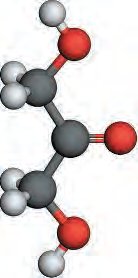
Monosaccharides vary in their molecular structure, which determines their function. The main differences include the location of the carbonyl group, the number of carbon atoms, and the spatial arrangement of hydroxyl groups. - Aldose: Monosaccharide with a carbonyl group at the end of the carbon chain. - Ketose: Monosaccharide with a carbonyl group within the carbon chain. - Triose, Pentose, Hexose: Monosaccharides with three, five, or six carbons, respectively. - Structural Isomers: Glucose and galactose are both hexoses but differ in the spatial arrangement of a single hydroxyl group, affecting their biological function. 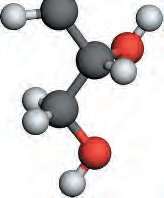
Linear and Ring Forms of Monosaccharides
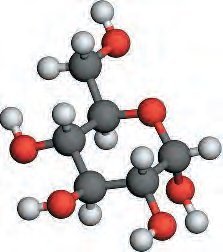
In aqueous solutions, monosaccharides with five or more carbons typically form ring structures. The ring formation involves the carbonyl group reacting with a hydroxyl group, resulting in two possible orientations for the new hydroxyl group: alpha (α) or beta (β). - α-glucose: Hydroxyl group below the plane of the ring. - β-glucose: Hydroxyl group above the plane of the ring. - These forms exist in equilibrium, with β-glucose being more stable. 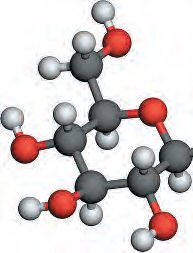
Formation of Glycosidic Linkages
Monosaccharides polymerize via condensation reactions between hydroxyl groups, forming covalent glycosidic linkages. The location and geometry of these linkages vary, leading to structural diversity in oligosaccharides and polysaccharides. - α-1,4-glycosidic linkage: Common in starch and glycogen. - β-1,4-glycosidic linkage: Found in cellulose and chitin. - Disaccharides: Maltose (two glucose units, α-linkage) and lactose (glucose and galactose, β-linkage). 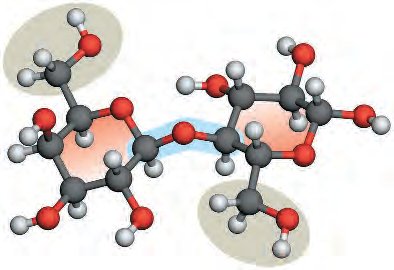

Polysaccharide Structure and Function
Starch: Energy Storage in Plants
Starch is a polysaccharide composed entirely of α-glucose monomers, joined primarily by α-1,4-glycosidic linkages. It exists in two forms: - Amylose: Unbranched, helical structure (only α-1,4 linkages). - Amylopectin: Branched, with α-1,6 linkages at branch points (about 1 in every 30 glucose residues). 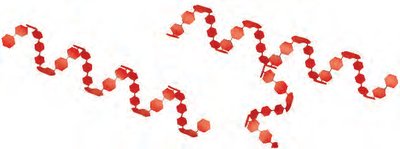
Glycogen: Energy Storage in Animals
Glycogen is similar to amylopectin but is more highly branched, with α-1,6 linkages occurring about every 10 glucose residues. It is stored in liver and muscle cells and is rapidly mobilized to release glucose for energy. 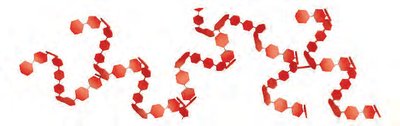
Cellulose: Structural Support in Plants
Cellulose is a polymer of β-glucose monomers joined by β-1,4-glycosidic linkages. The geometry of these linkages causes each glucose residue to be flipped relative to its neighbor, resulting in linear, parallel strands that form strong fibers via hydrogen bonding. 
Chitin: Structural Support in Fungi and Animals
Chitin is composed of N-acetylglucosamine (NAG) monomers joined by β-1,4-glycosidic linkages. Like cellulose, chitin forms strong, hydrogen-bonded fibers and is a key component of fungal cell walls and insect exoskeletons. 
Peptidoglycan: Structural Support in Bacteria
Peptidoglycan consists of alternating NAG and N-acetylmuramic acid (NAM) monomers, joined by β-1,4-glycosidic linkages. Peptide bonds link amino acid chains attached to NAM, forming a strong, cross-linked structure in bacterial cell walls.
Biological Roles of Carbohydrates
Structural Support
Structural polysaccharides such as cellulose, chitin, and peptidoglycan form fibers that provide strength and elasticity to cells and organisms. Their β-glycosidic linkages make them resistant to enzymatic degradation, contributing to durability. - Dietary fiber: Cellulose in plants is indigestible for most animals but aids digestive health by adding bulk and moisture to fecal material.
Cell Identity and Recognition
Complex carbohydrates attached to lipids (glycolipids) and proteins (glycoproteins) on the cell surface serve as identification badges, enabling cell–cell recognition and signaling. - Blood type: Determined by specific oligosaccharides on blood cell surfaces. - Fertilization: Glycoproteins on egg cells are recognized by sperm, ensuring species-specific binding. 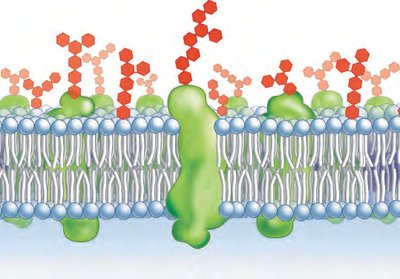
Energy Storage and Release
Carbohydrates store chemical energy in their C–C and C–H bonds, which have high potential energy. Plants convert sunlight into chemical energy via photosynthesis, storing it in carbohydrates. Animals and plants hydrolyze storage polysaccharides (starch and glycogen) to release glucose, which is used to synthesize ATP. - Photosynthesis summary equation: - ATP synthesis from glucose: 
Summary Table: Major Polysaccharides
Polysaccharide | Monomer | Linkage | Function |
|---|---|---|---|
Starch | α-glucose | α-1,4 and α-1,6 | Energy storage in plants |
Glycogen | α-glucose | α-1,4 and α-1,6 | Energy storage in animals |
Cellulose | β-glucose | β-1,4 | Structural support in plants |
Chitin | NAG | β-1,4 | Structural support in fungi and animals |
Peptidoglycan | NAG & NAM | β-1,4 + peptide bonds | Structural support in bacteria |
Key Terms and Concepts
- Monosaccharide: Simple sugar, carbohydrate monomer. - Glycosidic linkage: Covalent bond joining monosaccharides. - Polysaccharide: Polymer of monosaccharides. - Cellulose, Chitin, Peptidoglycan: Structural polysaccharides. - Starch, Glycogen: Energy-storage polysaccharides. - Glycoprotein, Glycolipid: Molecules involved in cell identity. - Photosynthesis: Process converting sunlight to chemical energy in carbohydrates. Additional info: Academic context was added to clarify the structural diversity of carbohydrates, the significance of glycosidic linkages, and the biological importance of carbohydrate functions in cell structure, identity, and energy storage.
