 Back
An Introduction to Invertebrates: Diversity, Structure, and Evolution
Study Guide - Smart Notes
 Tailored notes based on your materials, expanded with key definitions, examples, and context.
Chapter 33: An Introduction to Invertebrates
Overview of Invertebrate Diversity
Invertebrates are animals that lack a backbone and represent over 95% of all known animal species. They inhabit nearly every environment on Earth and display remarkable morphological diversity, ranging from microscopic forms to species up to 18 meters long. Understanding invertebrate diversity involves classifying them into groups based on evolutionary relationships, which helps clarify their vast variety of forms and functions.
Kingdom Animalia contains approximately 1.3 million described species, with estimates of total species ranging up to 10–20 million.
Major invertebrate groups include Porifera (sponges), Cnidaria (jellies, corals), Lophotrochozoa (flatworms, molluscs, annelids), Ecdysozoa (arthropods, nematodes), and Deuterostomia (echinoderms, some chordates).
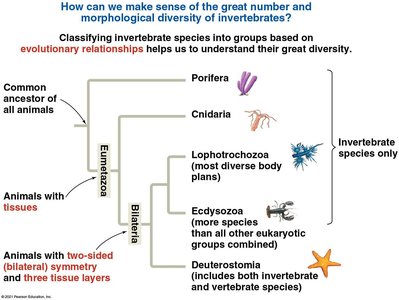
Main Invertebrate Phyla and Their Characteristics
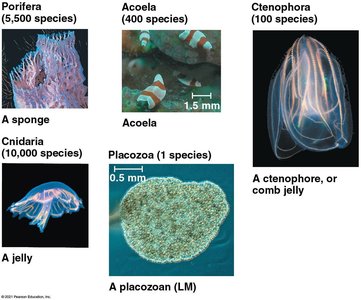
Invertebrates are classified into several major phyla, each with unique structural and functional features. The following table summarizes key phyla and their representative species:
Phylum | Species Estimate | Key Features | Example |
|---|---|---|---|
Porifera | 5,500 | No true tissues, filter feeders | Sponge |
Cnidaria | 10,000 | Radial symmetry, diploblastic, gastrovascular cavity | Jellyfish |
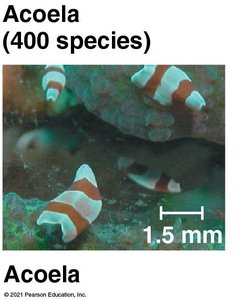
Acoela | 400 | Simple nervous system, saclike gut | Acoel flatworm |
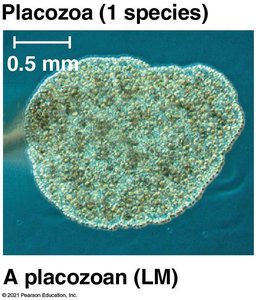
Placozoa | 1 | Bilayer of cells, asexual reproduction | Trichoplax adhaerens |
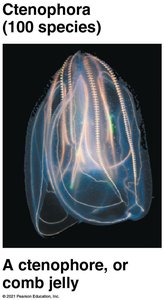
Ctenophora | 100 | Diploblastic, radial symmetry, ciliated combs | Comb jelly |
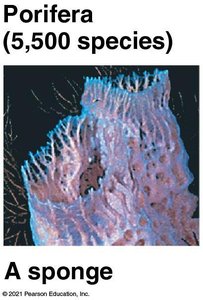
Porifera (Sponges)
Sponges are among the simplest animals, lacking true tissues and organs. They are mostly marine and are sedentary filter feeders.
Body Structure: Sac-like body with pores, central cavity (spongocoel), and an opening (osculum).
Cell Types: Choanocytes (collar cells) for feeding, amoebocytes for digestion and support.
Reproduction: Most are hermaphrodites, with sequential hermaphroditism common.
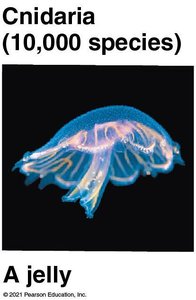
Cnidaria
Cnidarians include corals, hydras, and jellies. They are diploblastic and radially symmetrical, with a central gastrovascular cavity.
Body Forms: Sessile polyp and motile medusa.
Feeding: Tentacles with cnidocytes (stinging cells) and nematocysts for prey capture.
Nervous System: Noncentralized nerve net and sensory structures.
Other Basal Animal Phyla
Acoela: Simple flatworms with a saclike gut and basic nervous system.
Placozoa: Only one known species, Trichoplax adhaerens, with a simple bilayer structure.
Ctenophora: Comb jellies with eight rows of cilia for movement; important planktonic animals.
Lophotrochozoa
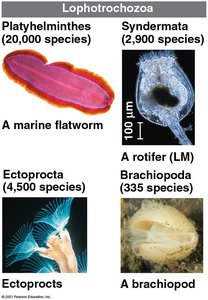
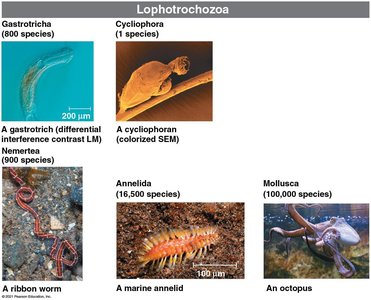
Lophotrochozoa is a diverse clade identified by molecular data, including flatworms, rotifers, ectoprocts, brachiopods, molluscs, and annelids. Members may have a lophophore (feeding structure) or trochophore larval stage.
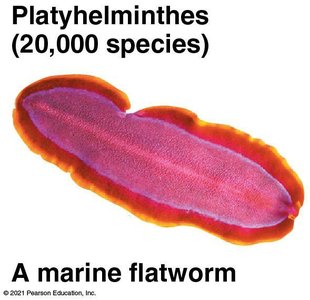
Platyhelminthes: Flatworms with bilateral symmetry, no body cavity, and a branched gastrovascular cavity.
Syndermata: Includes rotifers (microscopic, complex organ systems) and acanthocephalans (parasitic).
Ectoprocta: Sessile, colonial animals with a tough exoskeleton.
Brachiopoda: Marine animals with dorsal and ventral shells, lophophore for feeding.
Gastrotricha: Tiny, ciliated worms living at the bottom of aquatic habitats.
Cycliophora: Symbionts on lobsters, unique reproductive strategies.
Nemertea: Ribbon worms with a proboscis for prey capture and a closed circulatory system.
Annelida: Segmented worms, including earthworms and leeches.
Mollusca: Soft-bodied animals, often with a hard shell; includes snails, clams, squids, and octopuses.
Ecdysozoa
Ecdysozoans are characterized by a tough external cuticle that is periodically shed (ecdysis). This group includes more species than all other eukaryotic groups combined.
Loricifera: Tiny marine animals with a protective lorica.
Priapula: Marine worms with a large proboscis.
Tardigrada: Water bears, known for their resilience to extreme conditions.
Onychophora: Velvet worms, originally marine, now terrestrial.
Nematoda: Roundworms, abundant in soil and aquatic habitats, many are parasitic.
Arthropoda: The largest animal phylum, including insects, crustaceans, and arachnids, all with segmented exoskeletons and jointed appendages.
Summary Table: Major Invertebrate Groups
Group | Key Features | Representative Species |
|---|---|---|
Porifera | No true tissues, filter feeders | Sponge |
Cnidaria | Radial symmetry, stinging cells | Jellyfish |
Lophotrochozoa | Diverse body plans, lophophore/trochophore | Flatworm, Rotifer, Mollusc, Annelid |
Ecdysozoa | Molting cuticle, jointed appendages | Roundworm, Arthropod |
Deuterostomia | Includes invertebrates and vertebrates | Echinoderm, Chordate |
Key Terms and Concepts
Invertebrate: Animal lacking a backbone.
Filter feeder: Organism that obtains food by filtering water for particles.
Diploblastic: Having two germ layers (ectoderm and endoderm).
Bilateral symmetry: Body plan with right and left halves that are mirror images.
Lophophore: Crown of ciliated tentacles for feeding.
Ecdysis: Shedding of the cuticle during growth.
Example: The phylum Arthropoda includes insects, which are the most diverse group of animals on Earth, occupying nearly every habitat and playing crucial ecological roles as pollinators, decomposers, and food sources for other animals.
Additional info: This summary covers the main invertebrate phyla, their evolutionary relationships, and key structural and functional adaptations, providing a foundation for further study of animal diversity and evolution.
