Back
An Introduction to Invertebrates: Diversity, Structure, and Function
Study Guide - Smart Notes
 Tailored notes based on your materials, expanded with key definitions, examples, and context.
An Introduction to Invertebrates
Overview of Invertebrate Diversity
Invertebrates are animals that lack a backbone and represent more than 95% of known animal species. They are morphologically diverse and inhabit nearly every ecosystem on Earth. The study of invertebrates reveals the evolutionary innovations and adaptations that have allowed animals to colonize a wide range of habitats.
Definition: Invertebrates are animals without a vertebral column (backbone).
Diversity: Over 1.3 million described species, with estimates of total species ranging up to 20 million.
Habitats: Found in marine, freshwater, and terrestrial environments.
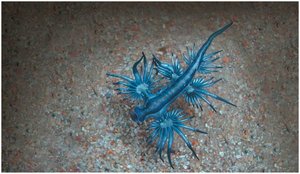
Example: The blue dragon (Glaucus atlanticus) is a sea slug with finger-like appendages that resemble the limbs of a dragon.
Major Invertebrate Groups
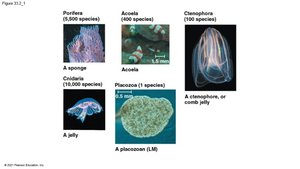
Invertebrates are classified into several major groups based on body plan, symmetry, and developmental patterns. The following table summarizes key phyla and their representative species:
Phylum | Species Count | Representative |
|---|---|---|
Porifera | 5,500 | Sponges |
Placozoa | 1 | Trichoplax adhaerens |
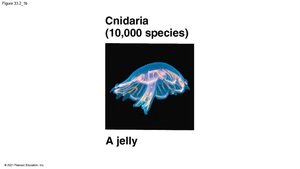
Cnidaria | 10,000 | Jellies, corals, hydras |
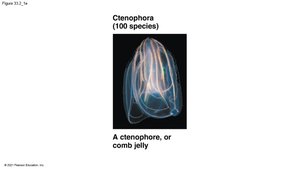
Ctenophora | 100 | Comb jellies |
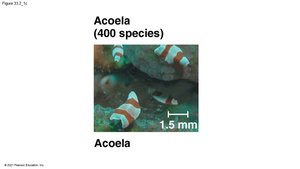
Acoela | 400 | Simple flatworms |
Porifera and Placozoa
Porifera (Sponges)
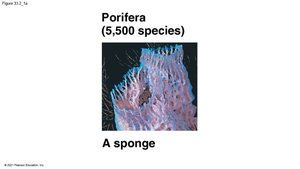
Sponges are among the simplest animals and are considered basal due to their early divergence from other animal lineages. They are sessile filter feeders lacking true tissues.
Structure: Body is a porous sac with a central cavity (spongocoel) and an opening (osculum).
Feeding: Water flows through pores, and choanocytes (collar cells) capture food particles by phagocytosis.
Cell Types: Amoebocytes are totipotent cells involved in digestion, nutrient transport, and skeletal fiber production.
Reproduction: Most are hermaphrodites, often exhibiting sequential hermaphroditism.
Placozoa
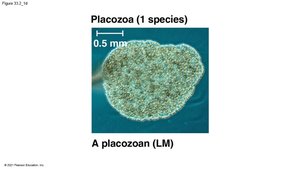
Placozoans are simple, flat animals composed of a few thousand cells arranged in two layers. The only known species, Trichoplax adhaerens, reproduces by fission or budding.
Cnidaria and Ctenophora
Cnidaria
Cnidarians are radially symmetrical, diploblastic animals with a gastrovascular cavity. They include corals, jellies, sea anemones, and hydras.
Body Forms: Two main forms—sessile polyp and motile medusa.
Feeding: Tentacles armed with cnidocytes (stinging cells) capture prey; nematocysts within cnidocytes eject stinging threads.
Symmetry: Radial symmetry allows interaction with the environment from all sides.
Ctenophora
Ctenophores, or comb jellies, are diploblastic and radially symmetrical. They move using eight rows of ciliary plates (combs) and are important members of marine plankton.
Acoela
Acoelans are simple flatworms with a saclike gut and a basic nervous system. They are considered basal bilaterians.
Lophotrochozoa
Major Lophotrochozoan Phyla
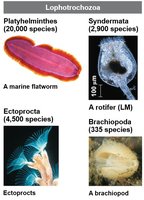
Lophotrochozoa is a diverse clade identified by molecular data, including flatworms, rotifers, ectoprocts, brachiopods, annelids, and molluscs. Members may have a lophophore (feeding structure) or a trochophore larval stage.
Phylum | Species Count | Representative |
|---|---|---|
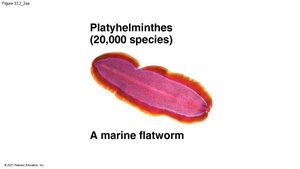
Platyhelminthes | 20,000 | Flatworms |
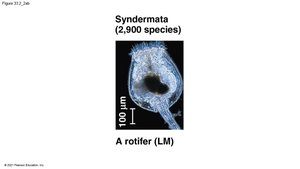
Syndermata | 2,900 | Rotifers |
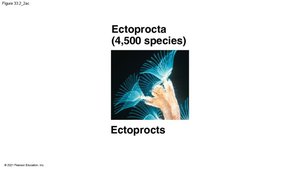
Ectoprocta | 4,500 | Bryozoans |
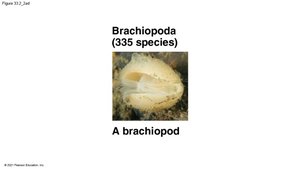
Brachiopoda | 335 | Lamp shells |
Platyhelminthes (Flatworms)
Flatworms are bilaterally symmetrical acoelomates with a central nervous system. They lack a body cavity and circulatory organs. Many are parasitic, including tapeworms and flukes.
Syndermata (Rotifers and Acanthocephalans)
Rotifers are microscopic animals with complex organ systems, while acanthocephalans are parasitic. Rotifers have a crown of cilia for feeding and a complete digestive tract.
Ectoprocta and Brachiopoda
Ectoprocts (bryozoans) are colonial, sessile animals with a lophophore. Brachiopods resemble clams but have dorsal and ventral shells and a stalk for attachment.
Other Lophotrochozoan Phyla
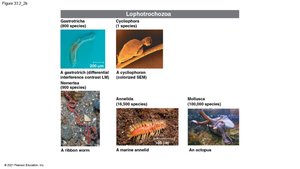
Phylum | Species Count | Representative |
|---|---|---|
Gastrotricha | 800 | Gastrotrichs |
Cycliophora | 1 | Symbion pandora |
Nemertea | 900 | Ribbon worms |
Annelida | 16,500 | Segmented worms |
Mollusca | 100,000 | Octopuses, snails, clams |
Ecdysozoa
Major Ecdysozoan Phyla
Ecdysozoans are animals that molt their cuticle during growth (ecdysis). This group includes more species than all other eukaryotic groups combined, with notable phyla such as Nematoda and Arthropoda.
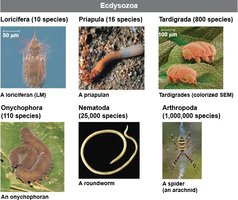
Phylum | Species Count | Representative |
|---|---|---|
Loricifera | 10 | Loriciferans |
Priapula | 16 | Priapulans |
Onychophora | 110 | Velvet worms |
Tardigrada | 800 | Water bears |
Nematoda | 25,000 | Roundworms |
Arthropoda | 1,000,000 | Insects, spiders, crustaceans |
Deuterostomia
Major Deuterostome Phyla
Deuterostomes include both invertebrate and vertebrate species. Key phyla are Hemichordata, Echinodermata, and Chordata.
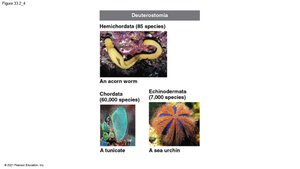
Phylum | Species Count | Representative |
|---|---|---|
Hemichordata | 85 | Acorn worms |
Echinodermata | 7,000 | Sea urchins, sea stars |
Chordata | 60,000 | Tunicates, vertebrates |
Summary of Animal Phylogeny
The animal kingdom is divided into five major clades: Porifera, Cnidaria, Lophotrochozoa, Ecdysozoa, and Deuterostomia. These groups are distinguished by their developmental patterns, body plans, and molecular data.