 Back
BackAn Introduction to Invertebrates: Diversity, Structure, and Major Clades
Study Guide - Smart Notes
 Tailored notes based on your materials, expanded with key definitions, examples, and context.
An Introduction to Invertebrates
Overview of Invertebrate Diversity
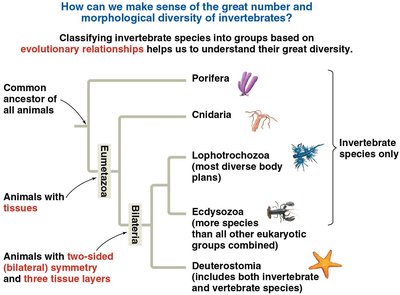
Invertebrates are animals that lack a backbone and account for over 95% of known animal species. They inhabit nearly every environment on Earth and display remarkable morphological diversity, ranging from microscopic organisms to those over 18 meters in length. Understanding their diversity involves classifying them into evolutionary groups based on shared characteristics and genetic data.
Invertebrates: Animals without a backbone.
Morphological diversity: Includes a wide range of body forms and sizes.
Classification: Based on evolutionary relationships, which helps clarify their diversity.
Major Clades of Invertebrates
Invertebrates are classified into several major clades, each with unique features. The main groups include Porifera, Cnidaria, Lophotrochozoa, Ecdysozoa, and Deuterostomia. These groups are distinguished by characteristics such as the presence of tissues, symmetry, and developmental patterns.
Porifera: Sponges, lack true tissues.
Cnidaria: Radially symmetrical animals with true tissues.
Lophotrochozoa: Diverse body plans, including flatworms, molluscs, and annelids.
Ecdysozoa: Animals that molt their cuticle, such as nematodes and arthropods.
Deuterostomia: Includes both invertebrate and vertebrate species, such as echinoderms and chordates.

Phylum Porifera (Sponges)
General Characteristics
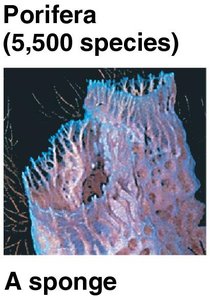
Sponges are among the simplest animals and are primarily marine, sessile filter feeders. They lack true tissues and organs, and their bodies are organized as a porous sac through which water flows.
Sessile: Fixed in one place; do not move.
Filter feeders: Capture food particles from water passing through their bodies.
Hermaphrodites: Most sponges function as both male and female at different times.
Body Structure and Function
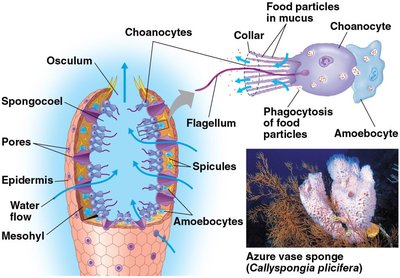
The sponge body is perforated with pores, allowing water to flow into a central cavity (spongocoel) and out through the osculum. Specialized cells called choanocytes generate water flow and capture food particles, while amoebocytes distribute nutrients and produce skeletal fibers.
Choanocytes: Flagellated cells that create water currents and trap food.
Amoebocytes: Mobile cells involved in digestion and structure formation.
Spicules: Structural elements that provide support.
Phylum Cnidaria
General Characteristics
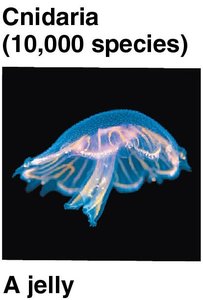
Cnidarians are ancient eumetazoans with true tissues, radial symmetry, and a simple body plan. They include corals, jellies, and hydras. Their bodies are organized as a sac with a central gastrovascular cavity, and a single opening serves as both mouth and anus.
Diploblastic: Having two tissue layers (ectoderm and endoderm).
Radial symmetry: Body parts arranged around a central axis.
Gastrovascular cavity: Central digestive compartment.
Body Forms: Polyp and Medusa
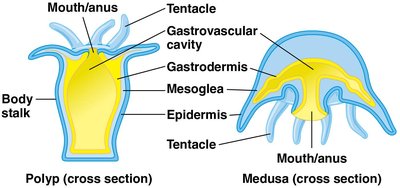
Cnidarians exhibit two main body forms: the sessile polyp and the motile medusa. Polyps are cylindrical and adhere to substrates, while medusae are bell-shaped and free-swimming.
Polyp: Sessile, mouth-up orientation.
Medusa: Motile, mouth-down orientation.
Feeding and Defense: Cnidocytes and Nematocysts
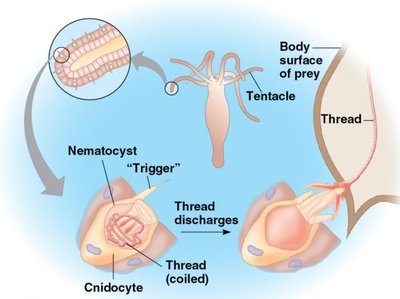
Cnidarians are predators that use tentacles armed with specialized cells called cnidocytes for prey capture and defense. Nematocysts, found within cnidocytes, are organelles that eject a stinging thread to immobilize prey.
Cnidocyte: Unique stinging cell of cnidarians.
Nematocyst: Stinging organelle within the cnidocyte.
Major Clades of Cnidaria
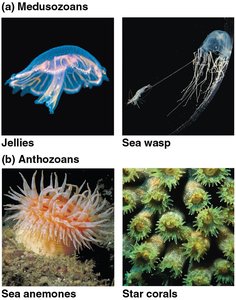
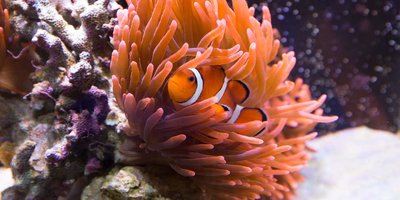
Cnidaria is divided into two major clades: Medusozoa (which includes jellies, box jellies, and hydras) and Anthozoa (which includes sea anemones and corals). Medusozoans typically have a medusa stage, while anthozoans exist only as polyps.
Medusozoa: Jellies, sea wasps, hydras.
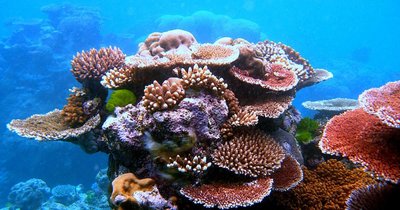
Anthozoa: Sea anemones, corals; form symbioses with algae and build reefs.
Bilateria: Lophotrochozoa
General Features
Lophotrochozoa is a diverse clade of bilaterians, characterized by bilateral symmetry and triploblastic development (three tissue layers). Most have a coelom and a complete digestive tract. This group includes flatworms, molluscs, and annelids.
Bilateral symmetry: Body plan with right and left halves that are mirror images.
Triploblastic: Having three germ layers (ectoderm, mesoderm, endoderm).
Coelom: Body cavity lined by mesoderm.

Phylum Platyhelminthes (Flatworms)
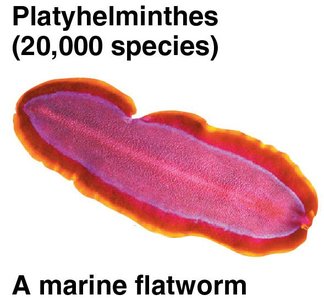
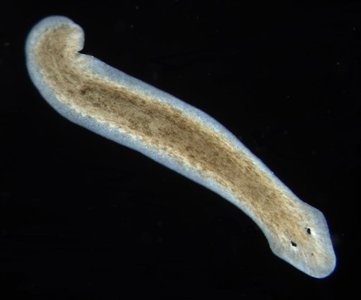
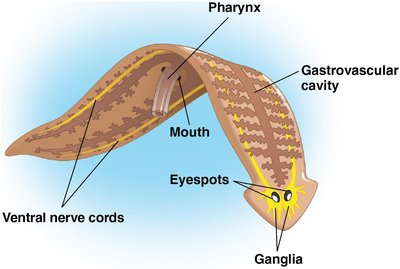
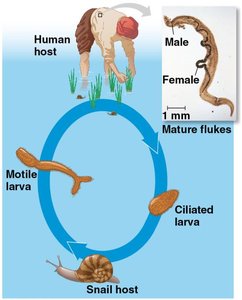
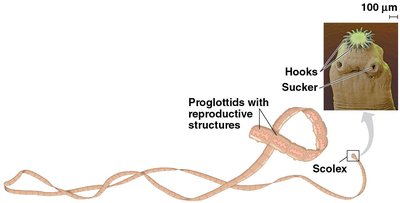
Flatworms are acoelomate, dorsoventrally flattened animals with bilateral symmetry. They lack circulatory and respiratory systems, and their gastrovascular cavity branches throughout the body. Many are free-living, while others are parasitic.
Acoelomate: Lacking a body cavity.
Planarians: Free-living flatworms with light-sensitive eyespots and a simple nervous system.
Trematodes and tapeworms: Parasitic flatworms with complex life cycles.
Phylum Mollusca
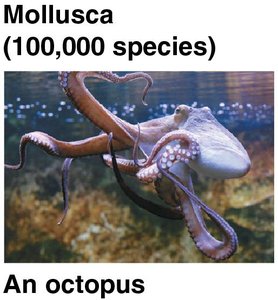
Molluscs are soft-bodied animals, many of which are protected by a hard calcium carbonate shell. The phylum includes snails, clams, squids, and octopuses. Molluscs share a common body plan with a muscular foot, visceral mass, and mantle.
Muscular foot: Used for movement.
Visceral mass: Contains internal organs.
Mantle: Secretes the shell and forms a cavity for gills and excretion.
Radula: A toothed, chitinous ribbon used for feeding (in most molluscs).
Major Molluscan Clades
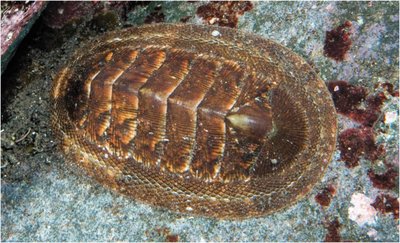
Polyplacophora (chitons): Marine animals with eight-plated shells.
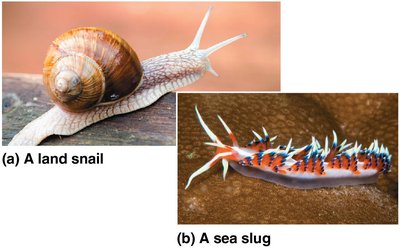
Gastropoda: Snails and slugs, the largest group of molluscs.
Bivalvia: Clams, oysters, mussels; have two-part shells and are mostly filter feeders.
Cephalopoda: Squids, octopuses; active predators with complex nervous systems and closed circulatory systems.
 *Additional info: The notes above are expanded with academic context to ensure completeness and clarity for college-level biology students. All images included are directly relevant to the adjacent explanations and reinforce the educational content.*
