 Back
Animal Behavior: Mechanisms, Development, Evolution, and Ecology
Study Guide - Smart Notes
 Tailored notes based on your materials, expanded with key definitions, examples, and context.
Animal Behavior
Introduction to Animal Behavior
Animal behavior is the study of how animals interact with each other and their environment. It encompasses the mechanisms, development, evolutionary history, and ecological significance of behavioral patterns. Understanding animal behavior provides insights into how and why animals act in certain ways, which is essential for fields such as ecology, evolution, and conservation biology.
Key Questions in Animal Behavior
What triggers the behavior? (Stimulus and physiological mechanisms)
How does development influence behavior? (Role of genes and environment)
How does the behavior aid survival and reproduction? (Adaptive value)
What is the evolutionary history of the behavior? (Phylogenetic context)
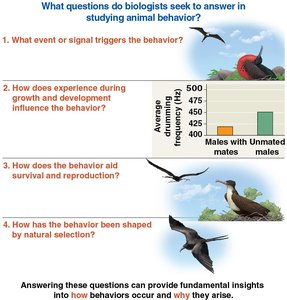
Additional info: These four questions, first formalized by Niko Tinbergen, are foundational for the scientific study of animal behavior and are often divided into proximate (how) and ultimate (why) causes.
Concept 51.1: Sensory Inputs and Behavioral Responses
Definition of Behavior
Behavior is an action carried out by muscles under the control of the nervous system. Behaviors are shaped by natural selection and can range from simple reflexes to complex social interactions.
Example: Birdsong production involves coordinated muscle activity and neural control.
Proximate vs. Ultimate Causation
Proximate causation: Explains how a behavior occurs (mechanisms and development).
Ultimate causation: Explains why a behavior occurs (evolutionary significance and adaptive value).
Fixed Action Patterns (FAPs)
A fixed action pattern is a sequence of unlearned, innate behaviors that is triggered by a specific stimulus (sign stimulus) and carried to completion once initiated.
Example: Male stickleback fish attack objects with a red underside, regardless of shape, due to a fixed action pattern triggered by the color red.
Concept 51.2: Learning and Behavioral Plasticity
Innate vs. Learned Behavior
Innate behavior: Genetically programmed and performed the same way by all individuals of a species (e.g., spider web building).
Learned behavior: Modified by experience and environmental influences.
Types of Learning
Imprinting: Rapid, irreversible learning during a sensitive period (e.g., young birds recognizing their mother).
Spatial learning: Establishing memories of spatial structure (e.g., wasps using landmarks to locate nests).
Associative learning: Linking one stimulus with another (e.g., taste aversion in blue jays after eating a monarch butterfly).
Classical conditioning: Associating an arbitrary stimulus with a reward or punishment (e.g., Pavlov’s dogs).
Operant conditioning: Learning to associate a behavior with a reward or punishment (trial-and-error learning).
Cognition: Complex mental processes such as awareness, reasoning, and problem-solving (e.g., chimpanzees using tools).
Social learning: Learning by observing others (e.g., young chimpanzees learning to crack nuts by watching adults).
Genetic and Environmental Influences
Cross-fostering studies: Used to distinguish genetic and environmental influences on behavior by raising young of one species with adults of another.
Twin studies: Compare identical twins raised apart to assess genetic vs. environmental contributions to behavior.
Concept 51.3: Behavioral Ecology and Evolution
Foraging Behavior
Foraging includes all activities related to searching for, capturing, and consuming food. Natural selection favors foraging strategies that maximize benefits and minimize costs (optimal foraging theory).
Example: Mule deer forage in open areas to reduce predation risk, even if food is less abundant.
Mating Behavior and Systems
Mating systems: Patterns of relationships between males and females (monogamy, polygyny, and polyandry).
Sexual dimorphism: Differences in appearance between males and females, often related to mating system.
Parental care: Influenced by certainty of paternity and the needs of offspring.
Sexual Selection
Intrasexual selection: Competition among individuals of the same sex for mates.
Intersexual selection: Mate choice, often by females, based on specific traits (e.g., ornamentation, courtship displays).
Game Theory in Behavioral Ecology
Game theory models the fitness consequences of different behavioral strategies in competitive situations. Frequency-dependent selection can maintain multiple strategies in a population (e.g., side-blotched lizard throat color morphs).
Concept 51.4: Genetic Basis and Evolution of Behavior
Genetic Control of Behavior
Master regulatory genes: Control suites of behaviors (e.g., fru gene in fruit flies).
Genetic variation: Can lead to behavioral differences within and between populations (e.g., prey preference in garter snakes).
Altruism and Inclusive Fitness
Altruism refers to behaviors that reduce an individual's own fitness while increasing the fitness of others. Inclusive fitness combines direct fitness (offspring produced) and indirect fitness (helping relatives reproduce).
Hamilton’s Rule: Altruism is favored when where r is the coefficient of relatedness, B is the benefit to the recipient, and C is the cost to the altruist.
Relationship | Coefficient of Relatedness (r) |
|---|---|
Siblings | 0.5 |
Aunt/Niece or Nephew | 0.25 |
First Cousins | 0.125 |
Kin Selection and Reciprocal Altruism
Kin selection: Favors altruism toward close relatives, enhancing inclusive fitness.
Reciprocal altruism: Altruism toward unrelated individuals, with the expectation of future reciprocation; requires stable social groups and mechanisms to punish cheaters.
Animal Communication
Signals and Communication Modes
Communication is the transmission and reception of signals between animals. Signals can be visual, chemical, tactile, or auditory, and often occur in stimulus-response chains.
Example: Fruit fly courtship involves visual, chemical, tactile, and auditory signals in a specific sequence.
Honeybee waggle dance: Communicates direction and distance to food sources using symbolic movement.
Pheromones: Chemical signals that can trigger behavioral responses at very low concentrations (e.g., alarm substances in minnows).
Summary Table: Types of Animal Communication
Mode | Example | Function |
|---|---|---|
Visual | Fiddler crab claw waving | Mate attraction |
Chemical | Pheromones in bees | Alarm, trail marking |
Tactile | Fruit fly touching | Courtship |
Auditory | Birdsong | Territory, mate attraction |
