 Back
Animal Behavior: Mechanisms, Types, and Evolutionary Significance
Study Guide - Smart Notes
 Tailored notes based on your materials, expanded with key definitions, examples, and context.
Animal Behavior
Introduction to Animal Behavior
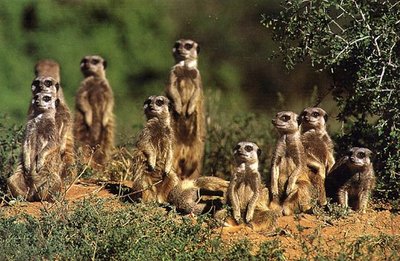
Animal behavior encompasses everything an animal does and how it does it, including responses to environmental stimuli. Behaviors can be innate (inherited or developmentally fixed) or learned (acquired during an animal’s lifetime). Studying behavior is essential because it is a component of an organism’s phenotype and is subject to natural selection, potentially leading to increased fitness, reproductive success, and survival.
Behavior: The sum of an animal’s responses to internal and external stimuli.
Innate behavior: Inherited, developmentally fixed actions.
Learned behavior: Modified by experience during an animal’s lifetime.
Fitness: The ability to survive and reproduce in a given environment.
Proximate and Ultimate Causes of Behavior
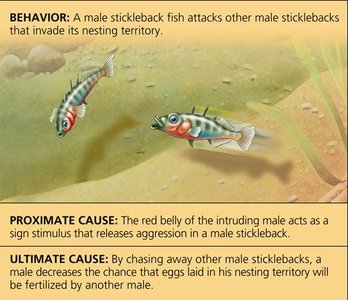
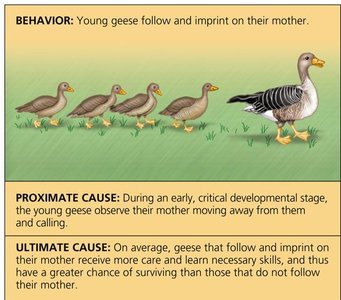
Behavioral biologists ask two main types of questions: proximate (mechanistic) and ultimate (evolutionary). Proximate causes address the immediate stimuli and mechanisms underlying a behavior, while ultimate causes explore the evolutionary significance and adaptive value of the behavior.
Proximate causes: "How" and "what" questions about the mechanisms of behavior.
Ultimate causes: "Why" questions about the evolutionary significance and adaptive value.
Types of Behaviors
Innate Behaviors
Innate behaviors are automatic, fixed, and "built-in" responses that are exhibited by all individuals of a species, regardless of environmental differences. These behaviors are often triggered by specific stimuli.
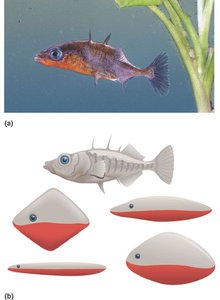
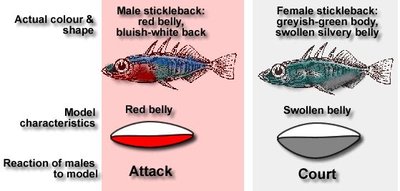
Fixed Action Patterns (FAP): Sequences of unchangeable behaviors that are usually carried to completion once initiated. Triggered by a specific stimulus known as a sign stimulus or releaser.
Examples of Fixed Action Patterns
Stickleback fish: Male sticklebacks attack objects with red bellies, a behavior triggered by the sign stimulus of the red color.
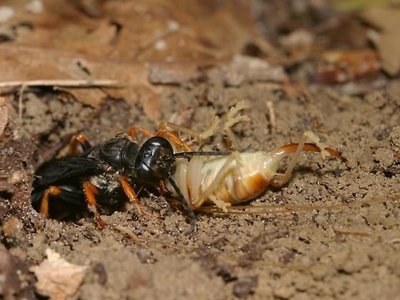
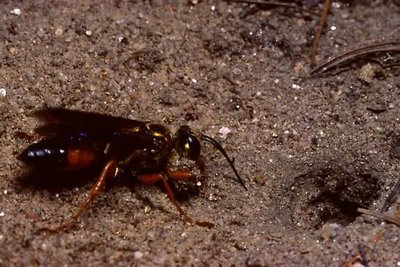
Digger wasps: Exhibit stereotyped behaviors in nest recognition and prey handling.
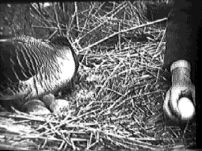
Egg rolling in geese: Geese will roll eggs (or egg-like objects) back into their nest with a fixed sequence of movements.
Directed Movements: Taxis and Kinesis
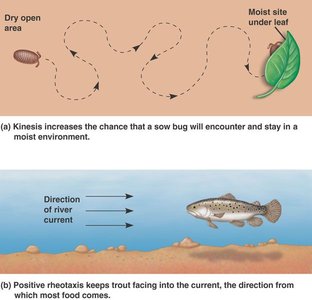
Animals exhibit directed movements in response to stimuli. Taxis is a directed movement toward or away from a stimulus, while kinesis is a change in the rate of movement in response to a stimulus.
Phototaxis: Movement toward or away from light.
Chemotaxis: Movement in response to chemical stimuli.
Kinesis: Increased or decreased movement rate depending on environmental conditions.
Learning and Imprinting
Imprinting
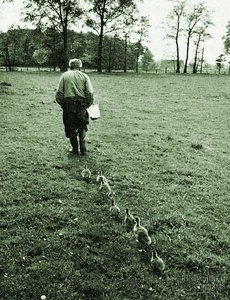
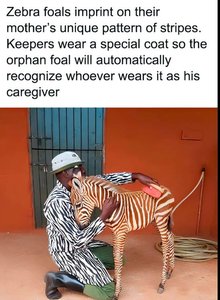
Imprinting is a form of learning that occurs during a specific critical period early in life, resulting in strong social attachments. It involves both innate and learned components. Classic studies by Konrad Lorenz demonstrated imprinting in birds, where hatchlings follow the first moving object they see, usually their mother.
Critical period: A limited developmental phase when imprinting can occur.
Brood parasites: Species like cuckoos do not imprint on their own species’ song, which is innate.

Associative Learning
Associative learning involves forming associations between environmental features. Two main types are:
Operant conditioning: Learning to associate a behavior with a reward or punishment (trial and error learning).
Classical conditioning: Associating a neutral stimulus with a significant stimulus (Pavlovian conditioning).
Habituation
Habituation is the loss of response to a stimulus after repeated exposure, allowing animals to ignore irrelevant stimuli and focus on important changes in their environment.
Example: Animals stop responding to non-threatening, repeated noises.
Social Behaviors
Types of Social Behaviors
Social behaviors are interactions between individuals that have evolved as adaptations. These include communication, agonistic behaviors, dominance hierarchies, altruism, and cooperation.
Language: Complex communication systems, such as honey bee dances.
Agonistic behaviors: Threatening and submissive rituals, often symbolic and non-injurious.
Dominance hierarchy: Social ranking within a group, such as a pecking order.
Altruistic behavior: Actions that reduce individual fitness but increase the fitness of others, often explained by kin selection.
Cooperation: Working together for mutual benefit, such as group hunting.

Communication
Animals communicate using various signals, including chemical (pheromones), visual, auditory, and tactile cues. Communication is essential for social interaction, mating, territory defense, and warning of danger.
Pheromones: Chemical signals that trigger responses in other individuals, such as alarm or sex pheromones.
Bird and insect song: Used for species identification, mating rituals, and territory defense. Bird song often has both learned and innate components, while insect song is typically innate.
Adaptive Value of Social Behaviors
Many social behaviors have adaptive value, increasing the survival and reproductive success of individuals and their relatives. Kin selection explains altruistic behaviors that benefit related individuals, thereby increasing inclusive fitness.
Example: Belding ground squirrels give alarm calls to warn relatives of predators, even at personal risk.
Summary Table: Types of Animal Behavior
Type of Behavior | Definition | Example |
|---|---|---|
Innate (Fixed Action Pattern) | Inherited, unchangeable sequence of actions | Egg rolling in geese |
Imprinting | Learning during a critical period | Ducklings following the first moving object |
Associative Learning | Association between two stimuli | Pavlov’s dogs salivating at a bell |
Habituation | Decreased response to repeated stimulus | Ignoring repeated, harmless noises |
Social Behavior | Interactions among individuals | Dominance hierarchies, altruism |
Additional info: This summary integrates foundational concepts from Chapter 51 (Animal Behavior) of a typical General Biology curriculum, including definitions, mechanisms, and evolutionary significance of behavior. Examples and images are chosen to reinforce key concepts and provide visual context for understanding animal behavior in nature.
