 Back
Active Learning Animal Communication: Mechanisms, Types, and Applications
Study Guide - Smart Notes
 Tailored notes based on your materials, expanded with key definitions, examples, and context.
Animal Communication
Introduction to Animal Communication
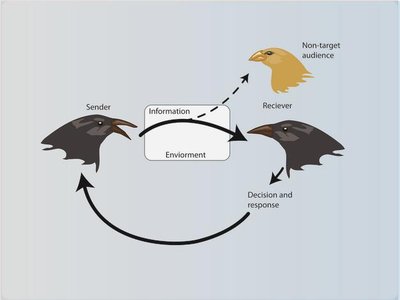
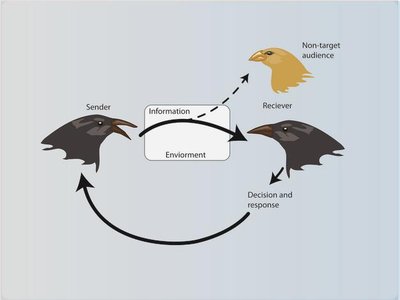
Animal communication is the process by which animals convey information to one another, influencing the behavior of the receiver. Communication can occur within the same species (intraspecific) or between different species (interspecific), and involves a sender, a receiver, and often, the environment as a medium for the signal.
Sender: The individual initiating the signal.
Receiver: The individual for whom the signal is intended.
Non-target audience: Other organisms that may intercept the signal unintentionally.
Environment: The medium through which the signal travels, which can affect the signal's transmission and reception.
Types of Animal Communication
Animals use a variety of communication types, each adapted to their ecological and social needs. The main types include:
Auditory Communication: Use of sound signals, such as bird songs or insect calls, to convey information over distances or in dense habitats.
Visual Communication: Use of visual signals, such as body coloration, displays, or bioluminescence, often important in mating and territorial behaviors.
Chemical Communication: Use of pheromones or other chemical signals to mark territory, attract mates, or signal alarm.
Tactile Communication: Use of touch, such as grooming or physical contact, to reinforce social bonds or convey information.
Applications and Contexts of Communication
Animal communication serves various functions depending on the relationship between the sender and receiver:
Conspecific (same sex): Establishing dominance, territory, or cooperation.
Conspecific (potential mate): Courtship and mate selection, often involving elaborate displays or signals to ensure species recognition.
Prey: Warning signals or deceptive signals to avoid predation.
Predator: Signals used to lure or ambush prey.
Offspring: Parental care signals, such as feeding calls or distress signals.
Potential Flaws in Communication
Animal communication is not always perfect. Signals can be intercepted by unintended receivers (e.g., predators or competitors), or distorted by environmental factors, leading to potential costs for the sender or receiver.
Mechanisms and Examples of Animal Communication
Honeybee Dances: Round and Waggle Dance
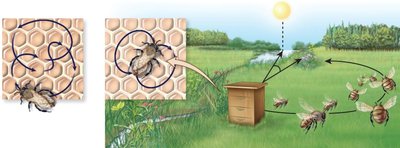
Honeybees use complex dances to communicate the location of food sources to other members of the hive. The two main types of dances are:
Round Dance: Indicates that food is nearby, but does not provide directional information.
Waggle Dance: Communicates both the direction and distance to a food source. The angle of the waggle run relative to the vertical corresponds to the angle between the food source and the sun.
Applied Communication: Courtship Signals
Many animals use specialized signals during courtship to attract mates and ensure species recognition. For example:
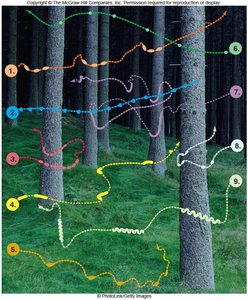
Fireflies: Males emit species-specific flashing patterns, which are recognized by females. Females respond with their own flashes, allowing males to locate them. This system helps prevent hybridization between species.
Sociality and Communication
Communication is essential for maintaining social structures in animal groups. Social animals use a combination of signals to coordinate group activities, establish hierarchies, and reinforce social bonds.
Summary Table: Types and Functions of Animal Communication
Type of Communication | Signal Example | Main Function |
|---|---|---|
Auditory | Bird song, wolf howl | Territory, mating, alarm |
Visual | Peacock display, firefly flashes | Courtship, warning, dominance |
Chemical | Ant pheromones, scent marking | Trail marking, mate attraction |
Tactile | Grooming, nuzzling | Social bonding, reassurance |
Additional info: Animal communication is a key topic in behavioral ecology and is essential for understanding animal behavior, evolution, and social organization.
