 Back
Animal Development and Body Symmetry: Key Concepts in General Biology
Study Guide - Smart Notes
 Tailored notes based on your materials, expanded with key definitions, examples, and context.
Animal Development
Zygote to Gastrula: Early Embryonic Stages
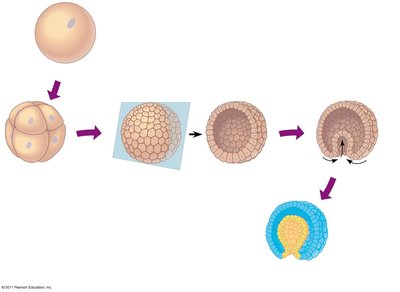
The development of animals begins with the formation of a zygote, which undergoes a series of cell divisions and morphological changes to become a multicellular organism. These stages are fundamental to understanding embryology and developmental biology.
Zygote: The single fertilized egg cell that marks the start of development.
Cleavage: Rapid mitotic cell divisions that produce a multicellular embryo. The cells formed are called blastomeres.
Blastula: A hollow ball of cells with a fluid-filled cavity called the blastocoel.
Gastrulation: A process where cells move inward, forming distinct germ layers: ectoderm (outer layer), endoderm (inner layer), and sometimes mesoderm (middle layer). The archenteron forms as the primitive gut, and the blastopore becomes an opening that will develop into either the mouth or anus.
Example: These stages are observed in most animal phyla, including vertebrates and invertebrates.
Body Symmetry in Animals
Types of Symmetry: Radial and Bilateral
Body symmetry is a key characteristic used to classify animals. It describes how body parts are arranged around a central axis or plane.
Radial Symmetry: Body parts are arranged around a central axis, like spokes on a wheel. Animals with radial symmetry (e.g., cnidarians such as jellyfish) can be divided into similar halves by multiple planes.
Bilateral Symmetry: Body has a left and right side that are mirror images. Only one plane divides the body into equal halves. Most animals, including vertebrates, exhibit bilateral symmetry.
Example: Radial symmetry is seen in sea anemones, while bilateral symmetry is seen in fish, mammals, and insects.
Body Planes and Sections
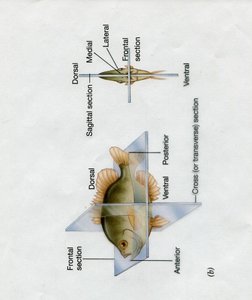
Understanding anatomical directions and planes is essential for describing the structure and function of animal bodies.
Dorsal: The back or upper side.
Ventral: The belly or lower side.
Anterior: The front or head end.
Posterior: The rear or tail end.
Frontal (coronal) section: Divides the body into dorsal and ventral parts.
Sagittal section: Divides the body into left and right parts.
Transverse (cross) section: Divides the body into anterior and posterior parts.
Example: These terms are used in anatomy to describe locations and directions in animal bodies, especially in vertebrates.
Exchange and Gastrovascular Cavities
Cellular and Tissue-Level Exchange
Animals must exchange gases, nutrients, and wastes with their environment. The structure of their bodies affects how this exchange occurs.
Single-celled organisms: Exchange occurs directly across the cell membrane.
Multicellular organisms: Specialized structures, such as gastrovascular cavities, facilitate exchange. These cavities allow for the distribution of nutrients and removal of wastes.
Gastrovascular cavity: A central cavity with a single opening that functions in both digestion and distribution of substances. Found in simple animals like cnidarians and flatworms.
Example: Hydra and planarians use gastrovascular cavities for internal transport and exchange.
Type of Organism | Exchange Mechanism |
|---|---|
Single-celled | Direct diffusion across membrane |
Multicellular (with gastrovascular cavity) | Internal cavity for distribution and exchange |
Additional info: In more complex animals, circulatory systems replace gastrovascular cavities for efficient transport.
