 Back
Animal Development: Principles, Mechanisms, and Human Development
Study Guide - Smart Notes
 Tailored notes based on your materials, expanded with key definitions, examples, and context.
Animal Development
Principles of Animal Development
Animal development is the process by which a multicellular organism grows and becomes more organized and complex, transforming from a fertilized egg to a sexually mature adult. Three core principles underlie this process:
Cell Division: Cells multiply as they divide, increasing the number of cells in the organism.
Cell Differentiation: Daughter cells become specialized in structure and function, such as nerve or muscle cells. Although most cells share the same genes, different sets of genes are switched on or off in different places and at different times, leading to specialization.
Cell Movement and Organization: Cells move and organize into structures, forming tissues and organs such as the brain or muscles.
Example: The transformation of a fertilized egg into a complex organism involves orchestrated cell division, differentiation, and organization.
Direct vs. Indirect Development
Animals exhibit two main types of development, each with distinct characteristics and evolutionary strategies.
Direct Development
The newborn animal closely resembles the adult form.
Occurs in some invertebrates and fish, and in all mammals and reptiles, including birds.
Hatchlings and newborns are generally larger and require significant parental care and feeding after birth or hatching.
Fewer offspring are produced, but parental investment increases survival rates.
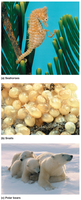
Indirect Development
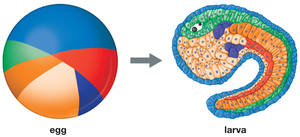
The newborn (larva) has a very different body structure than the adult.
Occurs in most amphibians and invertebrates.
Females produce large numbers of eggs with little yolk; larvae feed and grow before undergoing metamorphosis into adults.
Larvae and adults often occupy different ecological niches.
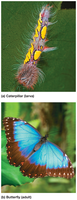
Nourishment Strategies
Yolk: Birds, most reptiles, and many fish produce eggs with large yolk reserves to nourish embryos.
Maternal Nourishment: Mammals, some snakes, and a few fish have eggs with little yolk; embryos are nourished within the mother’s body.
How Animals Develop
Early Developmental Stages
Amphibians are model organisms for studying development due to their large, observable eggs and embryos. Development begins with fertilization, forming a zygote, which undergoes a series of mitotic divisions called cleavage.
Morula: A solid ball of cells formed after several divisions.
Blastula: A hollow ball of cells formed as cleavage continues and a cavity develops within the morula.
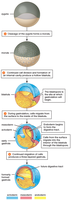
Cleavage patterns vary among species, influenced by yolk amount. For example, bird eggs divide only partially but still form a blastula.
Gastrulation and Tissue Layer Formation
Gastrulation begins when a dimple called the blastopore forms on one side of the blastula, leading to the formation of three primary tissue layers (gastrula):
Ectoderm (outer layer)
Mesoderm (middle layer)
Endoderm (inner layer)
Organogenesis
Organogenesis is the process by which organs develop from the three embryonic layers. This involves:
Activation and inhibition of “master” genes in specific cells, regulating the formation of structures such as limbs and organs.
Programmed cell death (apoptosis) to shape body parts.
Extraembryonic Membranes and the Amniotic Egg
All animal embryos develop in water. In terrestrial vertebrates, the evolution of the amniotic egg allowed development on land. The amniotic egg contains four extraembryonic membranes:
Membrane | Structure (Reptile) | Function (Reptile) | Structure (Mammal) | Function (Mammal) |
|---|---|---|---|---|
Chorion | Membrane lining the inside of the shell | Acts as a respiratory surface; regulates exchange of gases and water | Fetal contribution to the placenta | Gas, water, and nutrient exchange |
Amnion | Sac surrounding the embryo | Encloses embryo in fluid | Sac surrounding the embryo | Encloses embryo in fluid |
Allantois | Sac connected to embryo’s gut | Stores metabolic wastes; aids in gas exchange | Small, membranous sac | Forms part of the umbilical cord; helps absorb nutrients |
Yolk sac | Membrane lining the yolk | Contains yolk as food source | Small, membranous sac | Helps absorb nutrients; forms part of the umbilical cord |
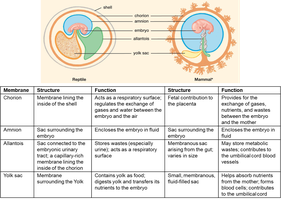
Control of Animal Development
Genetic Regulation and Cell Differentiation
Development is controlled by gene expression. Nearly all cells contain the full genetic code, but only certain genes are active in each cell, determining its structure and function. This is regulated by:
Transcription Factors: Proteins that bind to specific genes and stimulate or inhibit their transcription into mRNA.
Maternal Regulators: Molecules inherited from the egg cytoplasm guide early differentiation by activating specific genes in daughter cells.
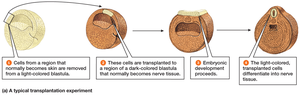
Cell Signaling (Induction): Cells communicate via chemical signals, influencing the fate of neighboring cells.
Organizer Regions and Master Genes
Specialized cell groups, such as the organizer near the blastopore in amphibians, release proteins that influence the development of nearby cells, determining body axes and organ formation. Master genes, including homeobox genes, regulate the patterning of body segments and regions. Mutations in these genes can result in dramatic changes, such as extra body segments or misplaced organs.
Development of Humans
Early Human Development
Fertilization typically occurs in the uterine tube. The zygote undergoes cleavage, forming a morula and then a blastocyst as it travels to the uterus. Gastrulation and organogenesis occur during the first two months, establishing the basic body plan and organ systems.
By the third week, the brain and spinal cord begin to form.
The heart starts to beat around the fourth week.
By the third month, the fetus can move and respond to stimuli.
Placenta and Maternal-Fetal Exchange
The placenta forms from embryonic and maternal tissues, facilitating the exchange of nutrients, gases, and wastes between mother and embryo. Early in development, the embryo receives nutrients directly from the uterine lining; later, the placenta takes over this role.
Birth and Lactation
Labor involves coordinated uterine contractions, culminating in delivery.
After birth, hormonal changes stimulate milk production and release, providing nutrition and immune protection to the newborn.
Aging
Biological Basis of Aging
Aging is the gradual accumulation of damage to essential biological molecules, especially DNA, leading to cell dysfunction, declining health, and eventually death. Damage arises from DNA-copying errors, radiation, and chemicals, while repair mechanisms decline with age.
Aging reduces muscle and bone mass, skin elasticity, reaction speed, sensory abilities, and immune function.
Lifespan varies by species, with some animals exhibiting negligible senescence.
Medical advances and diet can influence lifespan, but the apparent human maximum is about 130 years.
