 Back
BackAnimal Diversity and Anatomy: Study Guide for Bio 2 Final
Study Guide - Smart Notes
 Tailored notes based on your materials, expanded with key definitions, examples, and context.
Opisthokonta
Taxonomic Grouping and Key Organisms
Opisthokonta is a broad eukaryotic clade that includes animals, fungi, and several related protists. Understanding this group is essential for recognizing evolutionary relationships among major life forms.
Key Members: Animals, fungi, and choanoflagellates.
Choanoflagellates: Single-celled or colonial protists considered the closest living relatives of animals. Their collar cells resemble sponge cells, supporting the evolutionary link.
Relationship to Animals: Choanoflagellates share structural similarities with sponge choanocytes, suggesting a common ancestor.
Fungi, Parazoa, & Radiata
Fungi: Anatomy and Symbiosis
Fungi are a diverse kingdom characterized by their mode of nutrition and reproductive structures. Basidiomycota, a major fungal phylum, forms fruiting bodies known as basidiocarps.
Basidiomycota Anatomy: Fruiting body includes cap, gills, stipe, and spores.
Symbiosis: Many fungi form mutualistic relationships with plants (mycorrhizae), enhancing nutrient uptake.
Lichens: Composite organisms formed by a symbiotic association between a fungus and a photosynthetic partner (algae or cyanobacteria).
Lichen Growth Forms: Crustose (flat), foliose (leafy), and fruticose (branching).
Parazoa and Radiata: Basic Anatomy
Parazoa: Includes sponges, which lack true tissues but possess specialized cells.
Radiata: Includes cnidarians (e.g., jellyfish), characterized by radial symmetry and specialized stinging cells (cnidocytes).
Metazoa
Sponges and Classification
Metazoa encompasses all multicellular animals. Sponges (Phylum Porifera) are basal metazoans with simple body plans.
Generalized Anatomy: Sponges have pores (ostia), a central cavity (spongocoel), and an osculum for water exit.
Classification: Based on body structure and cell types; rationale includes evolutionary relationships and functional adaptations.
Lophotrochozoa
Anatomy and Classification
Lophotrochozoa is a superphylum of protostome animals, including annelids, mollusks, and platyhelminthes. Classification relies on anatomical features and developmental patterns.
Key Anatomical Structures: Lophophore (feeding structure), trochophore larva.
Tapeworm Anatomy: Scolex (head), proglottids (segments).
Earthworm Anatomy: Segmented body, clitellum, setae.
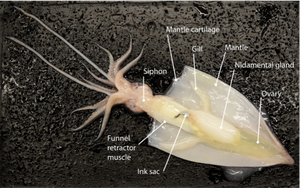
Squid Anatomy: Mantle, siphon, tentacles, ink sac.
Squid Dissection: Female Anatomy
The female squid displays distinct reproductive and anatomical features.
Key Structures: Mantle, siphon, gills, nidamental gland, ovary, ink sac, funnel retractor muscle.
Ecdysozoa
Anatomy and Classification
Ecdysozoa includes arthropods and nematodes, characterized by molting (ecdysis) of their exoskeleton.
Horseshoe Crab Anatomy: Carapace, telson, walking legs.
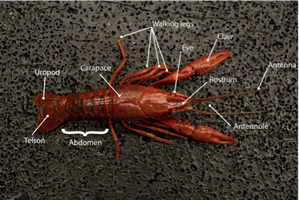
Crayfish Anatomy: Segmented body, claws, antennae, uropod, telson, carapace, abdomen.
Grasshopper Anatomy: Head, thorax, abdomen, wings, legs.
Insecta vs. Other Ecdysozoans: Insects have three body segments and six legs; other arthropods may differ in segmentation and appendages.
Chilopoda vs. Diplopoda: Chilopoda (centipedes) have one pair of legs per segment; Diplopoda (millipedes) have two pairs per segment.
Crayfish Dissection: External Anatomy
The crayfish is a representative arthropod, with distinct external features used for classification and identification.
Key Structures: Carapace, abdomen, telson, uropod, walking legs, claws, antennae, antennule, rostrum, eye.
Deuterostomia
Chordates and Mammals
Deuterostomia includes chordates and echinoderms, defined by embryonic development and shared anatomical features.
Chordate Characteristics: Notochord, dorsal hollow nerve cord, pharyngeal slits, post-anal tail.
Mammal Characteristics: Hair, mammary glands, endothermy, differentiated teeth.
Sea Star Anatomy: Arms, central disc, tube feet, madreporite, ampullae, water vascular system.
Sea Star Cellular Development: Includes stages such as fertilization, cleavage, blastula, gastrula.
Chordate Classes: Major classes include fish, amphibians, reptiles, birds, and mammals; each with unique adaptations.
Mammalian Dentition: Differentiated teeth (incisors, canines, premolars, molars) for specialized feeding.
Representative Examples and Lab Identification
Specimen Identification and Structures
Students should be able to identify representative examples from each phylogenetic group and recognize key anatomical structures from dissections.
Lab Manual Specimens: Includes crayfish, squid, sea star, earthworm, tapeworm, horseshoe crab, grasshopper.
Dissection Skills: Recognize and label anatomical features in lab specimens.
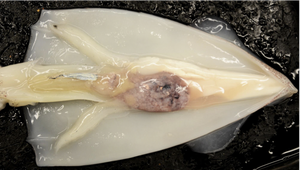
Squid Dissection: Male Anatomy
The male squid displays reproductive organs and internal structures relevant to cephalopod biology.
Key Structures: Mantle, siphon, gills, ink sac, funnel retractor muscle.
Summary Table: Major Animal Groups and Key Features
This table summarizes the main animal groups discussed and their distinguishing characteristics.
Group | Key Features | Representative Example |
|---|---|---|
Opisthokonta | Includes animals, fungi, choanoflagellates | Choanoflagellate, sponge |
Fungi | Basidiocarps, symbiosis, lichen | Mushroom, lichen |
Parazoa | No true tissues, specialized cells | Sponge |
Radiata | Radial symmetry, cnidocytes | Jellyfish |
Lophotrochozoa | Lophophore, trochophore larva | Earthworm, squid |
Ecdysozoa | Molting, segmented body | Crayfish, grasshopper |
Deuterostomia | Notochord, water vascular system | Sea star, mammal |
Key Terminology
Opisthokonta: Eukaryotic clade including animals and fungi.
Choanoflagellate: Protist closely related to animals.
Basidiomycota: Fungal phylum forming basidiocarps.
Lichen: Symbiotic association of fungus and photosynthetic partner.
Parazoa: Animals lacking true tissues.
Radiata: Animals with radial symmetry.
Lophotrochozoa: Protostome superphylum with lophophore/trochophore.
Ecdysozoa: Animals that molt exoskeleton.
Deuterostomia: Animals with deuterostome development.
Chordate: Animal with notochord, nerve cord, pharyngeal slits, tail.
Mammal: Animal with hair, mammary glands, endothermy, teeth.
Additional info:
Expanded explanations of anatomical features and evolutionary relationships were added for completeness.
Images included are directly relevant to the anatomical identification required for lab and exam preparation.
