 Back
Animal Diversity and Evolution: Structure, Development, and Classification
Study Guide - Smart Notes
 Tailored notes based on your materials, expanded with key definitions, examples, and context.
Animal Diversity Review and Adaptations
General Characteristics of Animals
Animals are a diverse group of multicellular, heterotrophic eukaryotes distinguished by unique structural and developmental features. They possess tissues that arise from embryonic layers and are regulated by developmental genes, notably Hox genes.
Heterotrophic eukaryotes: Animals obtain energy by consuming other organisms.
Multicellularity: Their bodies are composed of multiple cells organized into tissues.
Developmental genes: All animals have genes that regulate the expression of other genes, especially Hox genes.
Sexual reproduction: Most animals reproduce sexually, with a dominant diploid stage.
A Kingdom of Consumers
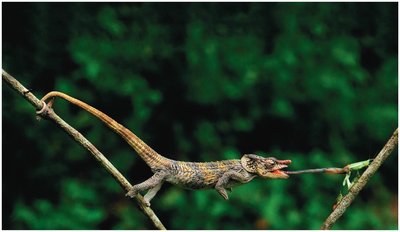
Animals are efficient consumers, equipped with adaptations for detecting, capturing, eating, and digesting prey. These adaptations are crucial for their survival and ecological roles.
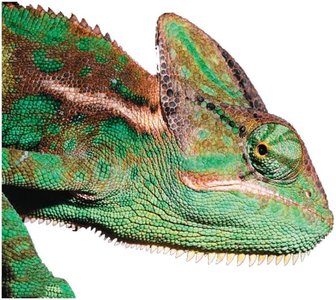
Adaptations: Examples include specialized structures like the chameleon's tongue for capturing insects.
Cell Structure and Specialization
Animal cells are supported by structural proteins such as collagen, rather than cell walls. Unique tissues, including nervous and muscle tissue, are defining features of animals.
Structural proteins: Collagen provides support.
Tissues: Groups of similar cells act as functional units.
Nervous and muscle tissue: Unique to animals, enabling movement and response to stimuli.
Reproduction and Development
Animal development begins with fertilization, followed by cleavage, blastula formation, and gastrulation. These processes establish the basic body plan and tissue layers.
Cleavage: Rapid cell division of the zygote.
Blastula: A multicellular, hollow stage.
Gastrulation: Formation of embryonic tissue layers.



Developmental Genes and Hox Genes
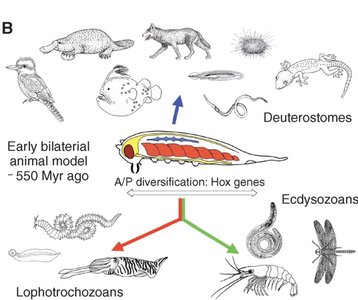
Hox genes are a unique family of developmental genes that regulate body form and are highly conserved across animal taxa, enabling diverse morphologies.
Hox genes: Control the development of body plans.
Conservation: Despite being conserved, they allow for morphological diversity.
History and Evolution of Animals
Common Ancestor and Animal Origins
The common ancestor of animals likely resembled modern choanoflagellates, a group of protists. The evolution of multicellularity required new mechanisms for cell adhesion and communication.
Choanoflagellates: Sequence similarities in genes for cell adherence and signaling.
Cadherin proteins: Key in cell attachment, found in both choanoflagellates and animals.


Major Eras in Animal Evolution
Animal evolution is divided into three major eras: Neoproterozoic, Paleozoic, Mesozoic, and Cenozoic. Each era is marked by significant diversification and extinction events.
Neoproterozoic Era: Early animal fossils, including Ediacaran biota.
Paleozoic Era: Cambrian explosion, rise of bilaterians, transition to land.
Mesozoic Era: Dominance of dinosaurs, emergence of mammals.
Cenozoic Era: Mammals diversify after mass extinctions.



Animal Body Plans and Classification
Body Plans and Symmetry
Animals are categorized by their body plans, which include symmetry and tissue organization. Symmetry can be radial or bilateral, influencing movement and nervous system development.
Radial symmetry: Top and bottom, no front/back or left/right (e.g., cnidarians).
Bilateral symmetry: Dorsal/ventral, anterior/posterior, right/left sides (e.g., annelids, arthropods).

Tissues and Germ Layers
Animal embryos develop distinct tissue layers: ectoderm, endoderm, and mesoderm. The presence and arrangement of these layers define diploblastic and triploblastic animals.
Ectoderm: Covers embryo surface, forms skin and nervous system.
Endoderm: Lines digestive tract.
Mesoderm: Intermediate layer in triploblastic animals, forms muscles and organs.
Diploblastic: Two layers (ectoderm, endoderm).
Triploblastic: Three layers (ectoderm, mesoderm, endoderm).


Body Cavities
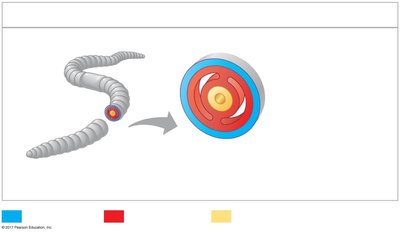
Most triploblastic animals possess a body cavity, or coelom, which is derived from mesoderm. The type of body cavity is a key classification feature.
Coelomate: True coelom, lined by mesoderm.
Pseudocoelomate: Body cavity not fully lined by mesoderm.
Acoelomate: No body cavity.

Functions of Body Cavities
Body cavities provide cushioning for organs, act as a hydrostatic skeleton, and allow internal organs to move independently of the body wall.
Fluid cushioning: Protects organs.
Hydrostatic skeleton: Muscles work against fluid-filled cavity.
Organ movement: Enables growth and movement of organs.

Protostome and Deuterostome Development
Animals are further classified by their embryonic development: protostome or deuterostome. These modes differ in cleavage, coelom formation, and the fate of the blastopore.
Protostome: Spiral, determinate cleavage; coelom forms by splitting mesoderm; blastopore becomes mouth.
Deuterostome: Radial, indeterminate cleavage; coelom forms from archenteron; blastopore becomes anus.
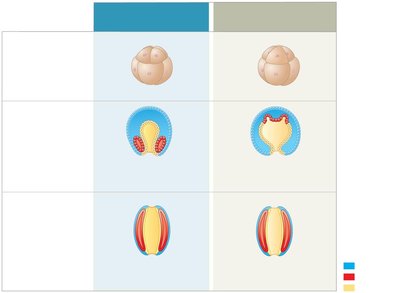

Blastopore Fate | Phyla |
|---|---|
Protostomy (P) | Platyhelminthes, Rotifera, Nematoda; most Mollusca, most Annelida; few Arthropoda |
Deuterostomy (D) | Echinodermata, Chordata; most Arthropoda; few Mollusca; few Annelida |
Neither (N) | Acoela |
Diversification and Classification of Animal Phyla
Phylogeny and Major Animal Clades
Modern phylogenies are based on genomic, morphological, and molecular data. Five key points summarize animal relationships:
All animals share a common ancestor.
Sponges are the sister group to all other animals.
Eumetazoa is a clade of animals with tissues.
Most animal phyla belong to Bilateria.
Three major clades of bilaterian animals: Lophotrochozoa, Ecdysozoa, Deuterostomia.


Summary of Key Animal Groups
Animal phyla are classified based on tissue structure, symmetry, body cavity, and developmental mode. The following table summarizes major groups:
Phylum | Description |
|---|---|
Porifera (sponges) | Lack true tissues; have choanocytes (collar cells) |
Cnidaria (hydras, jellies, corals) | Unique stinging structures (nematocytes); diploblastic; radial symmetry; gastrovascular cavity |
Platyhelminthes (flatworms) | Dorsoventrally flattened acoelomates; gastrovascular cavity or no digestive tract |
Rotifera (rotifers) | Pseudocoelomates with alimentary canal; jaws (trophi); ciliated crown |
Lophophorates (Ectoprocta, Brachiopoda) | Coelomates with lophophores (feeding structures) |
Mollusca (clams, snails, squids) | Coelomates with three main body parts; coelom reduced; hard shell |
Annelida (segmented worms) | Coelomates with segmented body wall and organs |
Nematoda (roundworms) | Cylindrical pseudocoelomates; no circulatory system; undergo ecdysis |
Arthropoda (insects, spiders, crustaceans) | Coelomates with segmented body, jointed appendages, exoskeleton |
Echinodermata (sea stars, sea urchins) | Coelomates with bilaterally symmetrical larvae, five-part adult body, water vascular system |
Chordata (vertebrates, tunicates) | Coelomates with notochord, dorsal nerve cord, pharyngeal slits, post-anal tail |
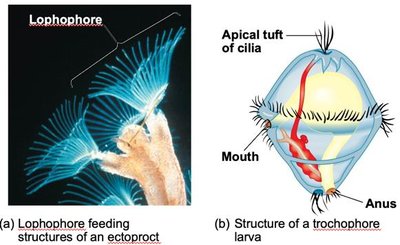
Examples of Lophotrochozoa and Ecdysozoa
Lophotrochozoa includes phyla with lophophores and trochophore larvae. Ecdysozoa includes phyla that undergo ecdysis (molting).
Conclusion
Animal diversity is shaped by evolutionary history, developmental processes, and structural adaptations. Understanding body plans, tissue organization, and phylogenetic relationships is fundamental to the study of animal biology.
