 Back
Animal Diversity, Body Plans, and Evolutionary Innovations: Step-by-Step Study Guidance
Study Guide - Smart Notes
 Tailored notes based on your materials, expanded with key definitions, examples, and context.
Q1. Approximately how many animal phyla are currently recognized by biologists?
Background
Topic: Animal Diversity
This question tests your knowledge of the classification and diversity of animal life, specifically the number of major groups (phyla) recognized in biology.
Key Terms:
Phylum: A major taxonomic group within the animal kingdom, representing a distinct body plan.
Animal Kingdom: The broadest classification of animals.
Step-by-Step Guidance
Recall that phyla are defined by unique body plans and developmental characteristics.
Think about the range of animal diversity—from simple sponges to complex vertebrates.
Consider the typical number cited in college biology textbooks for recognized animal phyla.
Try solving on your own before revealing the answer!
Final Answer: 30 to 35
Biologists currently recognize approximately 30 to 35 animal phyla, based on distinct body plans and evolutionary history.
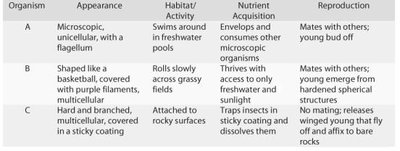
Q2. Which organism would you classify as an animal based on the table of observations?
Background
Topic: Animal Classification
This question tests your ability to use morphological and behavioral traits to distinguish animals from other life forms.
Key Terms:
Multicellularity: A trait common to most animals.
Motility: Movement, often associated with animals.
Reproduction: Sexual or asexual modes can help distinguish animals.
Step-by-Step Guidance
Examine each organism's appearance, habitat, nutrient acquisition, and reproduction.
Identify traits typical of animals, such as multicellularity, motility, and sexual reproduction.
Compare these traits to those of other kingdoms (plants, fungi, protists).
Focus on the organism that exhibits the most animal-like features.
Try solving on your own before revealing the answer!
Final Answer: Organism C
Organism C is multicellular, exhibits motility, and has animal-like feeding and reproduction traits, making it most likely an animal.
Q3. How can you distinguish a protostome from a deuterostome during embryonic development?
Background
Topic: Animal Development
This question tests your understanding of embryonic development patterns in major animal groups.
Key Terms and Concepts:
Protostome: Animals in which the mouth forms before the anus during development.
Deuterostome: Animals in which the anus forms before the mouth.
Embryonic development: The process by which animals form their basic body plan.
Step-by-Step Guidance
Recall the key difference: protostomes develop the mouth first, deuterostomes the anus first.
Look for evidence of the blastopore's fate in embryonic stages.
Consider other traits, such as symmetry and tissue layers, but focus on the mouth/anus development.
Try solving on your own before revealing the answer!
Final Answer: You see a mouth, but not an anus.
Protostomes are characterized by the mouth forming first during embryonic development.
Q4. What was an early selective advantage of a coelom in animals?
Background
Topic: Animal Body Plans
This question tests your understanding of the evolutionary significance of the coelom (body cavity).
Key Terms:
Coelom: A fluid-filled body cavity lined with mesoderm.
Hydrostatic skeleton: A structure that allows movement via fluid pressure.
Step-by-Step Guidance
Recall the functions of a coelom: space for organs, movement, and flexibility.
Consider how a hydrostatic skeleton works and its advantages for animal movement.
Think about evolutionary benefits for early animals.
Try solving on your own before revealing the answer!
Final Answer: Contributed to a hydrostatic skeleton, allowing a greater range of motion.
The coelom allowed animals to move more efficiently and flexibly, which was a major evolutionary advantage.
Q5. An organism that exhibits cephalization is probably also _____.
Background
Topic: Animal Body Plans and Evolution
This question tests your understanding of cephalization and its association with other body plan features.
Key Terms:
Cephalization: The concentration of sensory and neural structures at one end of the body.
Bilateral symmetry: Having a left and right side that are mirror images.
Step-by-Step Guidance
Recall that cephalization is linked to directional movement and sensory input.
Think about which body symmetry is associated with cephalization.
Consider other features that often co-occur with cephalization.
Try solving on your own before revealing the answer!
Final Answer: Is bilaterally symmetrical.
Cephalization is most commonly found in animals with bilateral symmetry.
Q6. Trichoplax adhaerens body symmetry seems to be most like that of _____.
Background
Topic: Animal Symmetry
This question tests your understanding of symmetry types in simple animals.
Key Terms:
Radial symmetry: Body parts arranged around a central axis.
Asymmetry: No symmetry.
Step-by-Step Guidance
Review the description of Trichoplax adhaerens: irregular shape, no clear head or tail.
Compare to sponges, cnidarians, tetrapods, and worms.
Identify which group has similar symmetry.
Try solving on your own before revealing the answer!
Final Answer: Most sponges.
Trichoplax adhaerens exhibits a symmetry most similar to sponges, which are generally asymmetrical.
Q7. What reproductive trait is associated with terrestrial environments?
Background
Topic: Animal Reproduction
This question tests your understanding of adaptations for reproduction on land.
Key Terms:
Internal fertilization: Fertilization occurs inside the body.
External fertilization: Fertilization occurs outside the body.
Step-by-Step Guidance
Consider the challenges of terrestrial environments (dryness, lack of water for gametes).
Recall which reproductive strategies help overcome these challenges.
Think about examples from land animals.
Try solving on your own before revealing the answer!
Final Answer: Internal fertilization.
Internal fertilization is an adaptation that allows successful reproduction in dry terrestrial environments.
Q8. The central nervous system is lacking in animals that have _____.
Background
Topic: Animal Nervous Systems
This question tests your understanding of the relationship between body symmetry and nervous system complexity.
Key Terms:
Central nervous system: A system of neurons concentrated in a central location.
Radial symmetry: Symmetry around a central axis, often associated with simpler nervous systems.
Step-by-Step Guidance
Recall which animals lack a central nervous system (e.g., cnidarians, echinoderms).
Consider the type of symmetry these animals have.
Think about the relationship between symmetry and nervous system organization.
Try solving on your own before revealing the answer!
Final Answer: Radial symmetry.
Animals with radial symmetry typically lack a central nervous system.
Q9. What feature of cnidarians most likely evolved simultaneously with the evolution of toxins?
Background
Topic: Cnidarian Biology
This question tests your understanding of evolutionary adaptations in cnidarians.
Key Terms:
Toxins: Chemicals used for defense or predation.
Medusa body form: Free-swimming stage in cnidarians.
Step-by-Step Guidance
Recall the lifestyle of cnidarians and the role of toxins.
Consider which body form is associated with active predation and toxin use.
Think about evolutionary pressures for toxin development.
Try solving on your own before revealing the answer!
Final Answer: The medusa body form.
The medusa form is associated with active predation and the evolution of potent toxins.
Q10. What synapomorphy distinguishes animals as a monophyletic group, distinct from choanoflagellates?
Background
Topic: Animal Evolution
This question tests your understanding of shared, derived traits (synapomorphies) in animal evolution.
Key Terms:
Synapomorphy: A shared, derived trait unique to a group.
Monophyletic group: A group consisting of a common ancestor and all its descendants.
Step-by-Step Guidance
Recall the traits that are unique to animals compared to their closest relatives.
Consider multicellularity, heterotrophy, coloniality, and cell wall absence.
Identify which trait is a synapomorphy for animals.
Try solving on your own before revealing the answer!
Final Answer: No cell walls.
The absence of cell walls is a synapomorphy that distinguishes animals from choanoflagellates.
Q11. TRUE or FALSE: Ringworm is a fungal infection of the skin.
Background
Topic: Fungal Diseases
This question tests your knowledge of common misconceptions about ringworm.
Key Terms:
Ringworm: A skin infection caused by fungi, not worms.
Step-by-Step Guidance
Recall the cause of ringworm and its symptoms.
Think about why the name might be misleading.
Try solving on your own before revealing the answer!
Final Answer: True
Ringworm is caused by a fungus, not a worm.
Q12. Match the correct adaptation and general feeding tactic for animals.
Background
Topic: Animal Feeding Strategies
This question tests your understanding of how animal morphology relates to feeding strategies.
Key Terms:
Filter feeding, fluid feeding, deposit feeding, mass feeding: Different ways animals acquire nutrients.
Step-by-Step Guidance
Review the adaptations listed (teeth, mouthparts, bills).
Match each adaptation to the feeding strategy it best supports.
Think about examples from nature for each feeding type.
Try solving on your own before revealing the answer!
Final Answer: C) i= d, ii = c, iii= b, iv =a, v=d
Each adaptation matches a specific feeding strategy based on morphology and function.
Q13. How are lichens and mycorrhizae similar?
Background
Topic: Symbiosis
This question tests your understanding of symbiotic relationships in biology.
Key Terms:
Lichen: A symbiotic association between a fungus and an alga or cyanobacterium.
Mycorrhizae: A symbiotic association between a fungus and plant roots.
Step-by-Step Guidance
Recall the ecological roles of lichens and mycorrhizae.
Consider how each benefits plants and their environment.
Identify the main similarity in their relationship with plants.
Try solving on your own before revealing the answer!
Final Answer: Both form symbiotic relationships with plants that benefit the plants.
Lichens and mycorrhizae both help plants by forming beneficial symbiotic relationships.
Q14. In which biome would you most likely find plants that exhibit C4 or CAM photosynthesis?
Background
Topic: Plant Adaptations
This question tests your understanding of plant adaptations to environmental conditions.
Key Terms:
C4 and CAM photosynthesis: Adaptations for water conservation and efficient carbon fixation.
Biome: A major ecological community type.
Step-by-Step Guidance
Recall the environmental conditions that favor C4 and CAM photosynthesis (hot, dry climates).
Identify which biome matches these conditions.
Think about examples of plants in these biomes.
Try solving on your own before revealing the answer!
Final Answer: Desert
C4 and CAM photosynthesis are adaptations for survival in arid environments like deserts.
Q15. Cnidarians are characterized by a _________ grade of organization.
Background
Topic: Animal Organization
This question tests your understanding of levels of biological organization in animals.
Key Terms:
Cell-tissue, tissue-organ, organ-system, cellular: Levels of organization in animals.
Step-by-Step Guidance
Recall the basic structure of cnidarians (jellyfish, corals).
Identify the highest level of organization present in cnidarians.
Compare to other animal groups.
Try solving on your own before revealing the answer!
Final Answer: Cell-tissue
Cnidarians have a cell-tissue grade of organization, lacking true organs.
Q16. Which of the following is (are) unique to animals?
Background
Topic: Animal Characteristics
This question tests your understanding of features unique to animals.
Key Terms:
Nervous and muscular tissue: Unique to animals.
Step-by-Step Guidance
Recall which features are found only in animals.
Compare to features found in other kingdoms (plants, fungi).
Identify the unique feature(s).
Try solving on your own before revealing the answer!
Final Answer: Nervous and muscular tissue
Only animals have both nervous and muscular tissue.
Q17. Lemon Sharks give birth to live young within specific marine habitats called nurseries. This species can be referred to as a __________ species.
Background
Topic: Animal Reproduction
This question tests your understanding of reproductive modes in animals.
Key Terms:
Viviparous: Giving birth to live young.
Oviparous: Laying eggs.
Ovoviviparous: Eggs hatch inside the body.
Step-by-Step Guidance
Recall the definitions of viviparous, oviparous, and ovoviviparous.
Identify which term applies to live birth in sharks.
Consider the role of nurseries in shark reproduction.
Try solving on your own before revealing the answer!
Final Answer: Viviparous
Lemon sharks are viviparous, giving birth to live young.
Q18. Match the correct fungal phylum to the distinguishing feature of morphology of their life cycle.
Background
Topic: Fungal Diversity
This question tests your knowledge of fungal phyla and their unique reproductive structures.
Key Terms:
Chytridiomycota: Flagellate spores.
Zygomycota: Zygosporangium.
Ascomycota: Ascospores.
Basidiomycota: Basidia.
Step-by-Step Guidance
Recall the distinguishing features of each fungal phylum.
Match each phylum to its unique reproductive structure.
Think about examples of each phylum.
Try solving on your own before revealing the answer!
Final Answer: A) i= a, ii= b, iii= c, iv= d
Each fungal phylum is matched to its unique reproductive structure.
Q19. Which difference distinguishes protostomes from deuterostomes?
Background
Topic: Animal Development
This question tests your understanding of major differences in animal embryonic development.
Key Terms:
Embryonic development: The process by which animals form their basic body plan.
Protostome vs. deuterostome: Mouth vs. anus formation.
Step-by-Step Guidance
Recall the key developmental difference between protostomes and deuterostomes.
Consider other features, but focus on embryonic development.
Identify which answer choice best reflects this difference.
Try solving on your own before revealing the answer!
Final Answer: Embryonic development
The main difference is in the fate of the blastopore during embryonic development.
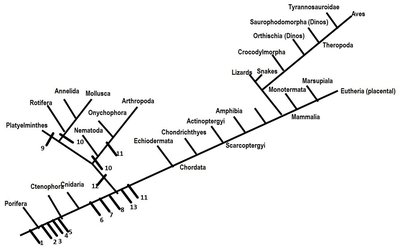
Q20. Which of the following are thought to be most closely related to chordates?
Background
Topic: Animal Phylogeny
This question tests your understanding of evolutionary relationships among animal phyla.
Key Terms:
Chordates: Animals with a notochord.
Echinoderms: Starfish and relatives, closely related to chordates.
Step-by-Step Guidance
Recall the evolutionary tree of animals.
Identify which phyla are deuterostomes like chordates.
Compare the options to the phylogenetic tree.
Try solving on your own before revealing the answer!
Final Answer: Echinoderms
Echinoderms are the closest relatives to chordates among the listed options.
