 Back
BackAnimal Diversity: Body Plans, Phylogeny, and Major Invertebrate Groups
Study Guide - Smart Notes
 Tailored notes based on your materials, expanded with key definitions, examples, and context.
Animal Diversity and Body Plans
Overview of Animal Diversity
Animal diversity encompasses a wide range of body plans, developmental patterns, and evolutionary relationships. Understanding these differences is fundamental to the study of zoology and evolutionary biology.
Tissue development: Animals can be classified based on the presence and organization of tissues.
Body symmetry: Symmetry types include radial and bilateral symmetry, which are key in animal classification.
Body cavities: The presence or absence of a coelom (body cavity) is a traditional classification trait.
Embryological development: Patterns such as protostome and deuterostome development are crucial for understanding animal evolution.
Segmentation: The repetition of body segments is associated with movement and specialization.
Embryological Development and Body Plans
Cleavage and Gastrulation
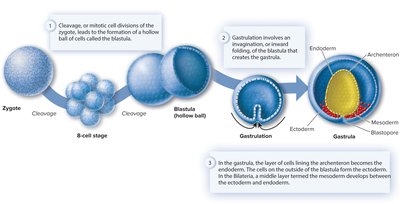
Animal development begins with fertilization, followed by a series of cell divisions (cleavage) and the formation of germ layers during gastrulation. These processes set the foundation for the animal's body plan.
Cleavage: Mitotic divisions of the zygote form a hollow ball of cells called the blastula.
Gastrulation: Involves the inward folding of the blastula, forming the gastrula with distinct germ layers (ectoderm, endoderm, and in some animals, mesoderm).
Germ layers: Ectoderm (outer), endoderm (inner), and mesoderm (middle, in bilaterians) give rise to all tissues and organs.
Protostomes vs. Deuterostomes
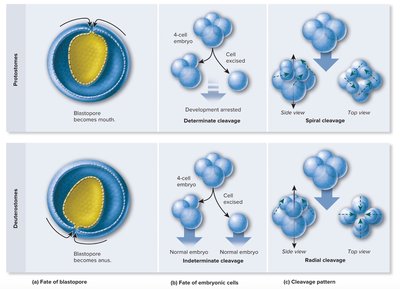
Animals are divided into two major developmental groups based on embryonic development: protostomes and deuterostomes.
Protostomes: The blastopore becomes the mouth; exhibit spiral and determinate cleavage.
Deuterostomes: The blastopore becomes the anus; exhibit radial and indeterminate cleavage.
Significance: These developmental differences are fundamental in animal phylogeny and classification.
Nervous System Organization
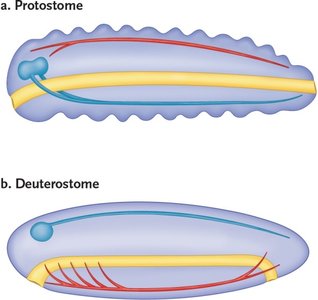
The arrangement of the nervous system differs between protostomes and deuterostomes, reflecting their evolutionary divergence.
Protostomes: Nervous system is ventral; brain surrounds the digestive tract opening.
Deuterostomes: Nervous system is dorsal; brain is located on the dorsal side.
Segmentation
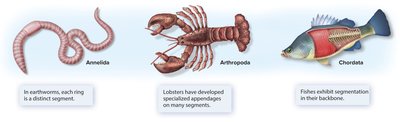
Segmentation refers to the repetition of body units along the anterior-posterior axis. It is a key feature in several animal phyla and is often associated with increased mobility and specialization.
Examples: Annelid worms, arthropods (e.g., lobsters), and chordates (e.g., vertebrates).
Function: Segmentation allows for more efficient and flexible movement.
Modern Animal Phylogeny
Molecular vs. Morphological Classification
Traditional classification relied on morphological traits such as body cavities and segmentation. However, molecular data (DNA, RNA, protein sequences) now provide a more accurate understanding of evolutionary relationships.
Molecular phylogenetics: Closely related species have fewer genetic differences.
Current classification: Integrates both molecular and morphological data for a comprehensive view.
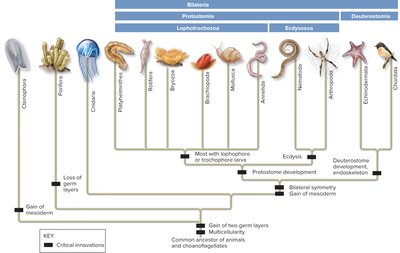
Major Animal Groups
Early-Diverging Animals
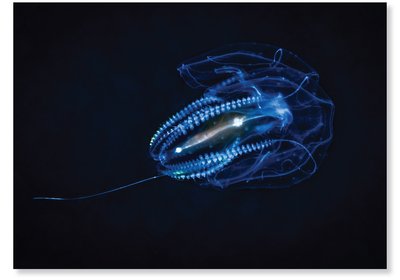
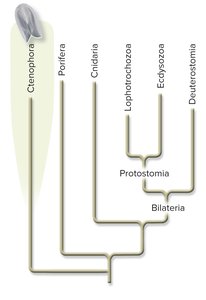
Ctenophores (Comb Jellies): Marine animals with eight rows of cilia for movement, two sticky tentacles, and a complete gut. They are hermaphroditic and bioluminescent.
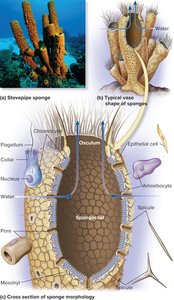
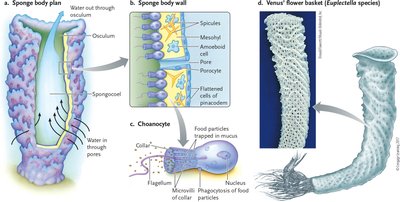
Porifera (Sponges): Simple, multicellular animals lacking true tissues and symmetry. Adults are sessile, and larvae are free-swimming. Sponges filter feed using specialized cells called choanocytes.
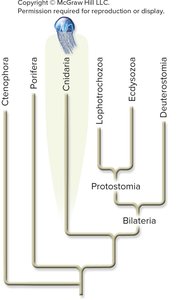
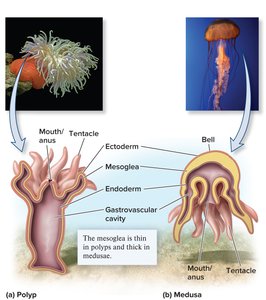
Radiata (Cnidaria): Includes jellyfish, hydroids, anemones, and corals. These animals have true tissues, radial symmetry, and a gastrovascular cavity. They capture prey with tentacles armed with stinging cells (nematocysts).
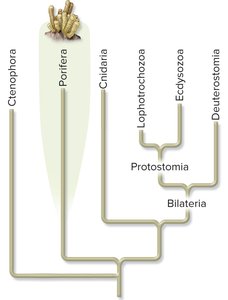
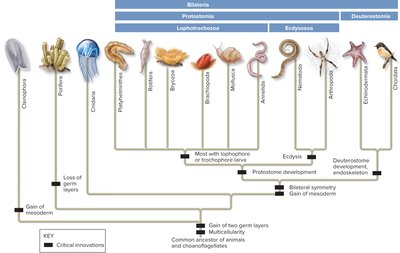
Bilateria: Lophotrochozoa, Ecdysozoa, and Deuterostomia
Bilaterians are animals with bilateral symmetry and three germ layers. They are divided into three major clades based on molecular and developmental data:
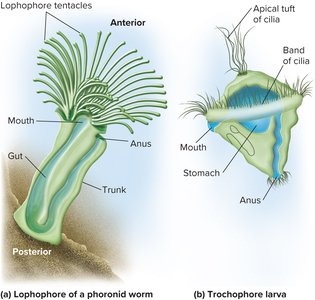
Lophotrochozoa: Includes flatworms, rotifers, bryozoans, brachiopods, mollusks, and annelids. Named for the lophophore (feeding structure) and trochophore larva, though not all members possess these features.
Ecdysozoa: Includes nematodes and arthropods. Characterized by ecdysis (molting of the exoskeleton).
Deuterostomia: Includes echinoderms and chordates. Defined by deuterostome development and other molecular traits.
Summary Table: Major Animal Clades and Key Features
Clade | Key Features | Examples |
|---|---|---|
Ctenophora | Eight rows of cilia, complete gut, bioluminescent | Comb jellies |
Porifera | No true tissues, filter feeders, asymmetrical | Sponges |
Cnidaria | Radial symmetry, stinging cells, gastrovascular cavity | Jellyfish, corals, anemones |
Lophotrochozoa | Lophophore/trochophore larva, bilateral symmetry | Mollusks, annelids |
Ecdysozoa | Molting (ecdysis), exoskeleton | Nematodes, arthropods |
Deuterostomia | Deuterostome development, dorsal nervous system | Echinoderms, chordates |
Additional info:
Modern phylogenies rely heavily on molecular data, which has led to the reclassification of several animal groups.
Some traditional morphological features, such as the presence of a coelom, are now considered less reliable for determining evolutionary relationships.
