 Back
BackAnimal Diversity I: Invertebrates – Classification and Major Phyla
Study Guide - Smart Notes
 Tailored notes based on your materials, expanded with key definitions, examples, and context.
Classification of Animals
Overview of Animal Classification
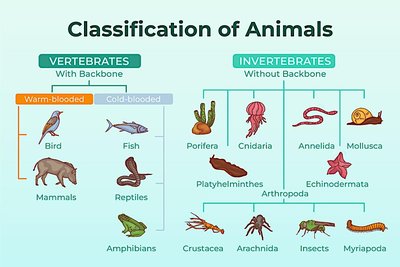
The animal kingdom is divided into two major groups: vertebrates (animals with a backbone) and invertebrates (animals without a backbone). Invertebrates comprise the vast majority of animal diversity and are classified into multiple phyla based on evolutionary relationships and body plans.
Vertebrates: Include mammals, birds, reptiles, amphibians, and fish.
Invertebrates: Include phyla such as Porifera, Cnidaria, Platyhelminthes, Annelida, Mollusca, Arthropoda, and Echinodermata.
Taxonomic Hierarchy and the Concept of a Phylum
Taxonomic Framework
Modern biological classification is hierarchical, with each category containing less inclusive groups. The main ranks are: Kingdom, Phylum, Class, Order, Family, Genus, and Species. The phylum is generally the highest taxonomic level discussed in introductory zoology.
Genus: A group of closely related species sharing a common ancestor.
Species: The basic unit of classification, theoretically reproductively isolated from other species.
Binomial Nomenclature: Scientific names are italicized (or underlined when handwritten), with the genus capitalized and the species epithet in lowercase (e.g., Cymbula oculus).
Phylum Porifera (Sponges)
General Characteristics
Sponges are simple, sessile aquatic animals lacking true tissues. Their bodies are organized as elaborate filtering systems, with water flowing through pores and channels maintained by the beating of flagella.
Body Plan: No organs or tissues; cells are loosely organized into functional groups.
Skeleton: Internal meshwork of spicules (calcium carbonate or silica) or spongin fibers.
Feeding: Filter feeders; choanocytes capture food particles and pass them to amoeboid cells.
Reproduction: Both sexual (hermaphroditic, with broadcast spawning) and asexual (budding, gemmules).
Body Types: Asconoid (simplest), Syconoid (folded canals), Leuconoid (most complex, with clusters of chambers).
Ecological and Evolutionary Importance: Sponges provide shelter for other animals and are important in understanding animal evolution.
Phylum Cnidaria
General Characteristics
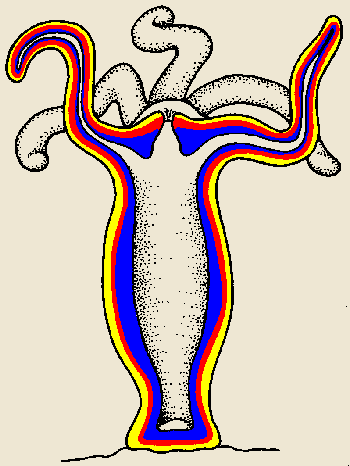
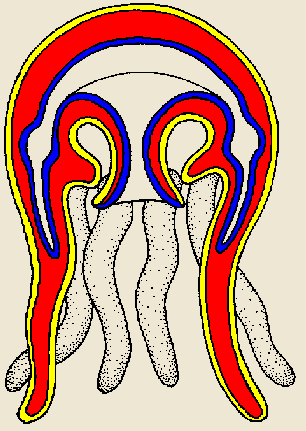
Cnidarians are radially symmetrical, aquatic invertebrates including jellyfish, corals, and sea anemones. They possess two main body forms: the sessile polyp and the free-swimming medusa.
Body Structure: Two cell layers (diploblastic), central gastrovascular cavity, no true organs.
Reproduction: Alternation between sexual and asexual phases; some species have only one form.
Specialized Cells: Cnidocytes containing nematocysts (stinging organelles) for prey capture and defense.
Toxins: Some cnidarians can be harmful or fatal to humans due to potent toxins.
Classification
Subphylum Medusozoa: Includes classes Staurozoa, Scyphozoa, Cubozoa, Polypodiozoa, Hydrozoa, and Myxozoa.
Subphylum Anthozoa: Includes subclasses Alcyonaria and Zooantharia (e.g., corals and sea anemones).
Phylum Platyhelminthes (Flatworms)
General Characteristics
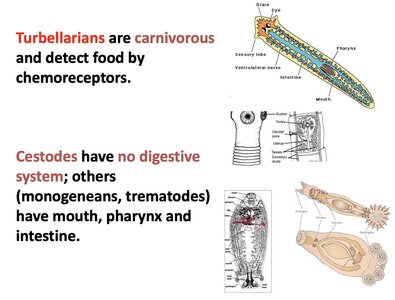
Flatworms are soft-bodied, bilaterally symmetrical animals with no circulatory system or body cavity. They have a simple, incomplete digestive system and are either free-living or parasitic.
Body Plan: Triploblastic (three germ layers), bilateral symmetry, definite anterior-posterior polarity.
Digestive System: Gastrovascular cavity with one opening; some parasitic forms lack a digestive system entirely.
Sensory Structures: Simple sense organs, such as eyespots in some species.
Reproduction: Most are monoecious (hermaphroditic) with complex reproductive systems; development may be direct or involve multiple hosts.
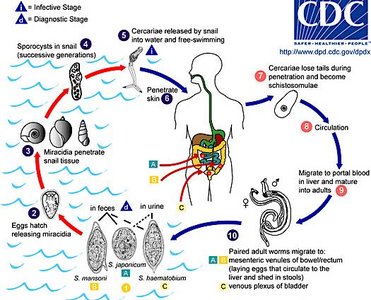
Parasitic Life Cycles: Many flatworms have complex life cycles involving multiple hosts (e.g., schistosomes).
Phylum Annelida (Segmented Worms)
General Characteristics
Annelids are segmented worms with a true coelom, closed circulatory system, and a complete digestive tract. They possess chitinous bristles (setae) and are found in marine, freshwater, and terrestrial environments.
Body Segmentation: Bodies consist of repeating segments, each with similar structures.
Excretion: Nephridia for excretion.
Reproduction: Both monoecious and dioecious forms exist.
Major Groups
Class Polychaeta: Mostly marine, with parapodia and many setae.
Class Clitellata: Includes oligochaetes (earthworms) and hirudineans (leeches).

Earthworms: Important for soil aeration and nutrient cycling; reproduce via cocoon formation.
Leeches: Many are predators or ectoparasites; some used medically for bloodletting and microsurgery.
Phylum Arthropoda
General Characteristics
Arthropods are the most diverse animal phylum, characterized by a segmented body, jointed appendages, and a chitinous exoskeleton. They have well-developed sensory organs and a complex nervous system.
Body Segmentation: Typically divided into head, thorax, and abdomen.
Exoskeleton: Provides protection and support; must be periodically molted for growth.
Respiration: Varies by group (gills, tracheae, or book lungs).
Reproduction: Sexes usually separate; internal fertilization is common.
Major Subphyla and Classes
Chelicerata: Includes arachnids (spiders, scorpions), horseshoe crabs, and sea spiders.
Mandibulata: Includes crustaceans (crabs, lobsters), myriapods (centipedes, millipedes), and hexapods (insects).
Insects: The most diverse group, with adaptations for nearly every terrestrial and freshwater habitat.
Phylum Hemichordata and Chordata (Lower Vertebrates)
Hemichordata
Hemichordates are marine, worm-like animals with a body divided into a proboscis, collar, and trunk. They possess gill slits and a true coelom, and are important for understanding the evolution of chordates.
Chordata
Chordates are defined by four key features at some stage in development: a notochord, a dorsal hollow nerve cord, pharyngeal gill slits, and a post-anal tail. The phylum includes three subphyla:
Cephalochordata: Lancelets, simple invertebrate chordates.
Urochordata (Tunicata): Tunicates, with tadpole larvae showing all chordate features.
Vertebrata: Animals with a vertebral column replacing the notochord during development.
