 Back
Animal Diversity I: Invertebrates – Structure, Evolution, and Major Phyla
Study Guide - Smart Notes
 Tailored notes based on your materials, expanded with key definitions, examples, and context.
Animal Diversity I: Invertebrates
Key Features of Animals
Animals are a diverse group of eukaryotic, multicellular organisms that are distinct from other kingdoms by several defining characteristics:
Eukaryotic and Multicellular: Animal cells contain a nucleus and other organelles, and animals are composed of multiple cells.
Lack of Cell Walls: Unlike plants and fungi, animal cells do not have rigid cell walls.
Heterotrophic Nutrition: Animals obtain energy by consuming other organisms.
Sexual Reproduction: Most animals reproduce sexually, producing genetically diverse offspring.
Motility: Animals are capable of movement at some stage of their life cycle.
Rapid Response to Stimuli: Most animals have nervous and muscular systems that allow quick responses to environmental changes.
Anatomical Features at Animal Evolutionary Branch Points
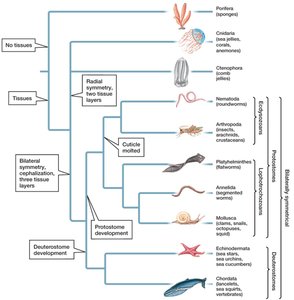
Animal evolution is marked by several key anatomical innovations that define major groups and evolutionary relationships.
1. Presence or Absence of Tissues
Tissues: Groups of similar cells organized to perform specific functions.
Sponges (Phylum Porifera): The only animals lacking true tissues; their cells act independently.
All Other Animals: Possess true tissues, indicating an early evolutionary split.
2. Body Symmetry
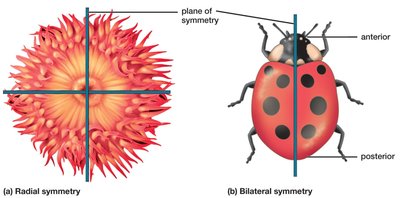
Radial Symmetry: Body parts arranged around a central axis; any plane through the axis divides the animal into similar halves (e.g., cnidarians, ctenophores).
Bilateral Symmetry: Only one plane divides the body into mirror-image halves; associated with cephalization (development of a head region).
3. Germ Layers
Diploblastic: Animals with two germ layers (ectoderm and endoderm), such as cnidarians and ctenophores.
Triploblastic: Animals with three germ layers (ectoderm, mesoderm, endoderm), including all bilaterally symmetrical animals.
Germ Layer Functions:
Ectoderm: Forms outer covering and nervous tissue.
Endoderm: Forms the lining of the gut and associated organs.
Mesoderm: Forms muscles, circulatory system, and, when present, skeletal systems.
4. Body Cavities
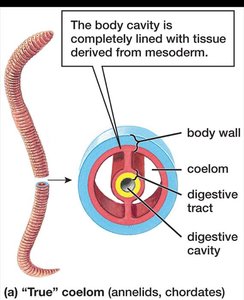
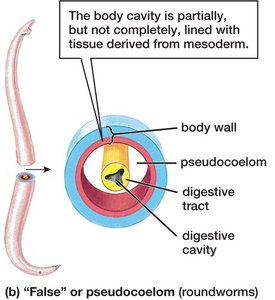
Body cavities are fluid-filled spaces between the digestive tract and body wall, providing support and space for organ development.
Coelomates: Animals with a true coelom, a body cavity completely lined with mesoderm (e.g., annelids, arthropods, mollusks, echinoderms, chordates).
Pseudocoelomates: Animals with a body cavity partially lined with mesoderm (e.g., roundworms).
Acoelomates: Animals lacking a body cavity (e.g., flatworms).
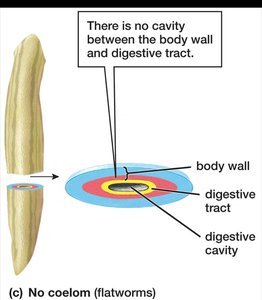
5. Protostome vs. Deuterostome Development
Protostomes: The body cavity forms within the space between the body wall and digestive cavity. Includes annelids, arthropods, mollusks, flatworms, and roundworms.
Deuterostomes: The body cavity forms as an outgrowth of the digestive cavity. Includes echinoderms and chordates.
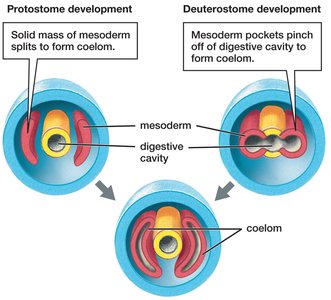
6. Major Protostome Groups
Ecdysozoans: Arthropods and roundworms that molt their outer covering.
Lophotrochozoans: Flatworms, annelids, and mollusks, characterized by a lophophore feeding structure or trochophore larva.
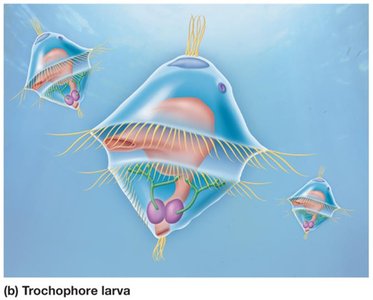
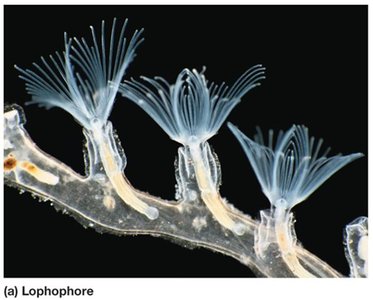
Major Animal Phyla: Invertebrates
Invertebrates are animals without a backbone and make up the vast majority of animal species. Major invertebrate phyla include:
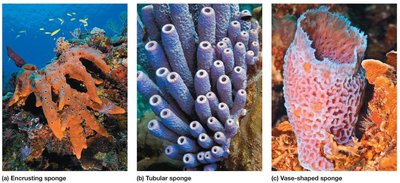
Phylum Porifera (Sponges)
Habitat: Mostly aquatic, sessile organisms.
Structure: Lack true tissues; body perforated with pores for water flow.
Reproduction: Mostly hermaphroditic; sexual and asexual reproduction.
Cell Types: Epithelial cells, collar cells (with flagella), and amoeboid cells.
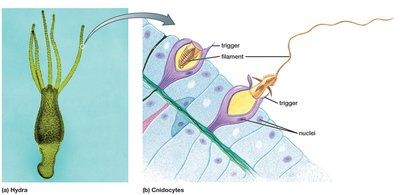
Phylum Cnidaria (Cnidarians)
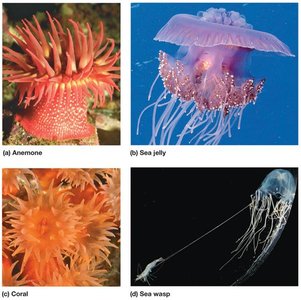
Examples: Sea jellies, corals, sea anemones, hydrozoans.
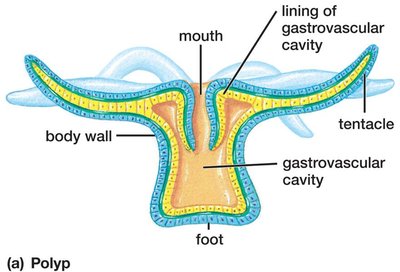
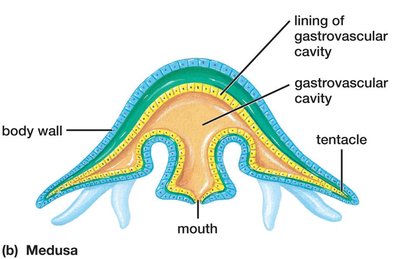
Body Forms: Polyp (sessile) and medusa (free-swimming).
Tissues: Two germ layers; organized into tissues but lack organs.
Symmetry: Radial symmetry.
Specialized Cells: Cnidocytes (stinging cells) for prey capture.
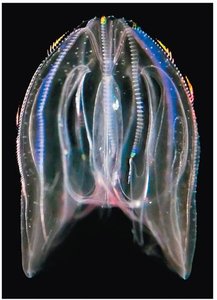
Phylum Ctenophora (Comb Jellies)
Movement: Use rows of cilia (combs) for locomotion.
Symmetry: Radial symmetry.
Feeding: Carnivorous, mostly hermaphroditic.
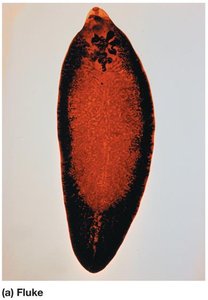
Phylum Platyhelminthes (Flatworms)
Body Plan: Bilateral symmetry, acoelomate (no body cavity).
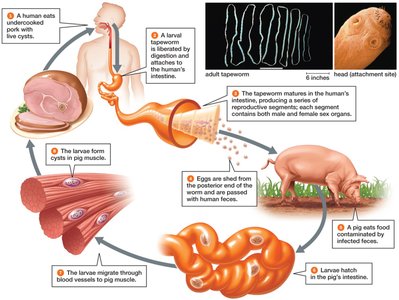
Habitat: Free-living or parasitic (e.g., flukes, tapeworms).
Reproduction: Sexual (hermaphroditic) and asexual.
Systems: Simple nervous system, lack circulatory and respiratory systems.
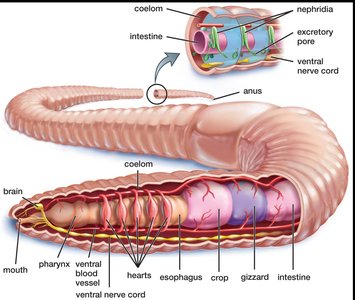
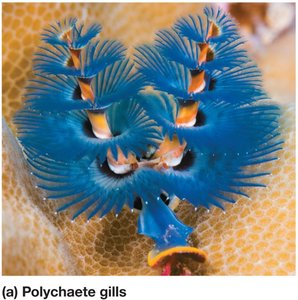
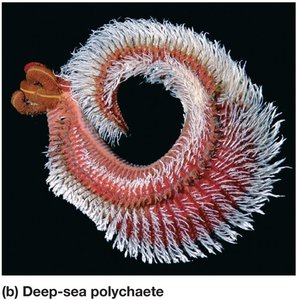
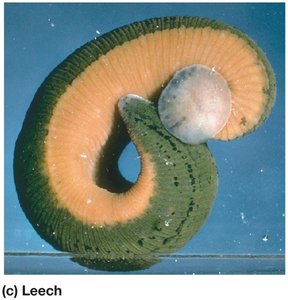
Phylum Annelida (Segmented Worms)
Body Plan: Segmented, coelomate worms (e.g., earthworms, leeches, polychaetes).
Systems: Closed circulatory system, well-developed organ systems, hydrostatic skeleton.
Reproduction: Sexual (hermaphroditic or separate sexes), some asexual reproduction.
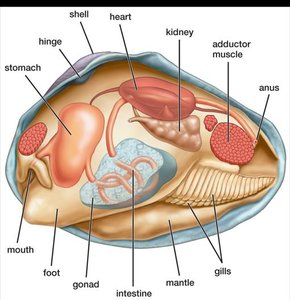
Phylum Mollusca (Mollusks)
Examples: Snails, slugs, clams, oysters, octopuses, squids.
Body Plan: Soft-bodied, often with a shell; open or closed circulatory system.
Subgroups: Gastropods (snails, slugs), bivalves (clams, oysters), cephalopods (octopuses, squids).
Phylum Arthropoda (Arthropods)
Examples: Insects, arachnids, myriapods, crustaceans.
Key Features: Segmented bodies, jointed appendages, exoskeleton made of chitin, open circulatory system.
Respiration: Gills (aquatic), tracheae or lungs (terrestrial).
Development: Many undergo metamorphosis.
Additional info: Arthropods are the most diverse animal phylum, with over a million described species.
Phylum Nematoda (Roundworms)
Body Plan: Pseudocoelomate, unsegmented, covered by a cuticle that is periodically molted.
Systems: Lack circulatory and respiratory systems; rely on diffusion.
Reproduction: Mostly sexual, with separate sexes.
Phylum Echinodermata (Echinoderms)
Examples: Sea stars, sea urchins, sand dollars, sea cucumbers.
Symmetry: Bilateral as larvae, radial as adults.
Key Features: Endoskeleton of calcium carbonate, water-vascular system for movement and feeding, deuterostome development.
Regeneration: Many can regenerate lost body parts.
Phylum Chordata (Chordates)
Includes: All vertebrates and some invertebrates (e.g., sea squirts, lancelets).
Key Features: Notochord, dorsal nerve cord, pharyngeal slits, post-anal tail (at some stage of development).
Summary Table: Major Invertebrate Phyla and Key Features
Phylum | Symmetry | Body Cavity | Key Features | Examples |
|---|---|---|---|---|
Porifera | Asymmetrical | None | No tissues, filter feeders | Sponges |
Cnidaria | Radial | None | Stinging cells, polyp/medusa forms | Jellyfish, corals |
Ctenophora | Radial | None | Comb rows, cilia for movement | Comb jellies |
Platyhelminthes | Bilateral | Acoelomate | Flat body, simple organs | Flatworms |
Annelida | Bilateral | Coelomate | Segmented body, closed circulatory system | Earthworms, leeches |
Mollusca | Bilateral | Coelomate | Soft body, often with shell | Snails, clams, octopuses |
Arthropoda | Bilateral | Coelomate | Exoskeleton, jointed appendages | Insects, spiders, crustaceans |
Nematoda | Bilateral | Pseudocoelomate | Unsegmented, molting cuticle | Roundworms |
Echinodermata | Radial (adult) | Coelomate | Endoskeleton, water-vascular system | Sea stars, sea urchins |
