 Back
BackAnimal Diversity II: Vertebrates – Mammals
Study Guide - Smart Notes
 Tailored notes based on your materials, expanded with key definitions, examples, and context.
Animal Diversity II: Vertebrates – Mammals
Overview of Vertebrate Groups
Mammals are a major group of vertebrates distinguished by several unique characteristics, including the presence of hair and mammary glands. This section explores the evolutionary origins, physiological traits, and diversity of mammals, as well as their comparison with other vertebrate groups such as birds and reptiles.
Endothermy: Both birds and mammals are endothermic (warm-blooded), meaning they maintain a constant internal body temperature that is typically higher than the surrounding environment. This trait allows for high metabolic rates and efficient muscle and organ function.
Ectothermy: In contrast, ectothermic animals (such as invertebrates, fish, and amphibians) have body temperatures that fluctuate with the environment.
Circulatory and Respiratory Adaptations: Endothermic animals possess advanced circulatory and respiratory systems, including a four-chambered heart that prevents mixing of oxygenated and deoxygenated blood, and specialized structures (e.g., air sacs in birds) for efficient oxygen delivery.
Evolution and Characteristics of Mammals
Mammals first appeared approximately 250 million years ago, but only became dominant after the extinction of dinosaurs about 66 million years ago. They are named for their milk-producing mammary glands, which females use to nourish their young. Hair is another defining feature, providing insulation and protection.
Four-chambered heart: Like birds and crocodilians, mammals have a four-chambered heart for efficient oxygen transport.
Major lineages: The 4,600 species of mammals are divided into three main groups: monotremes, marsupials, and placental mammals.
Major Groups of Mammals
Monotremes
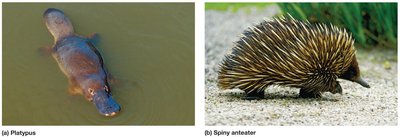
Monotremes are the only egg-laying mammals, a primitive trait among mammals. This group includes the platypus and four species of spiny anteaters (echidnas), found only in New Guinea and Australia. Monotremes have unique reproductive and feeding adaptations.
Egg-laying: Monotremes lay eggs with leathery shells, which are incubated by the mother for 10–12 days.
Incubation: Echidnas use a pouch for incubating eggs, while platypuses hold eggs between their tail and belly.
Milk secretion: Monotremes lack nipples; milk oozes through ducts and soaks the hair around them for the young to feed.
Diet: Echidnas eat insects and worms; platypuses forage in water for small animals.
Example: The platypus is well-adapted for aquatic life, while echidnas are terrestrial insectivores.
Marsupials
Marsupials are mammals whose young are born at a very immature stage and complete development outside the uterus, typically in a pouch. Marsupial diversity is greatest in Australia, with only one species (Virginia opossum) native to North America.
Reproduction: Marsupial embryos develop briefly in the uterus, then crawl to a nipple and continue development in the pouch.
Placenta: Marsupials have a placenta, but it is less complex than that of placental mammals.
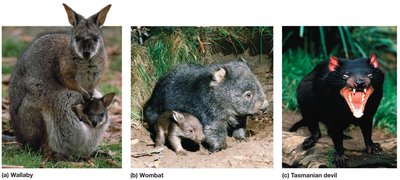
Diversity: Includes kangaroos, wallabies, wombats, and the Tasmanian devil.
Conservation: Some marsupials, such as the Tasmanian devil, are at risk of extinction due to disease and past hunting.
Example: Kangaroos are emblematic of Australia and are the largest marsupials.
Placental Mammals
Placental mammals are the most diverse group, inhabiting land, air, and sea. Their placentas are highly complex, allowing for prolonged development of the embryo within the uterus, resulting in more mature offspring at birth.
Diversity: Most mammal species are placental, including rodents, bats, primates, carnivores, and marine mammals.
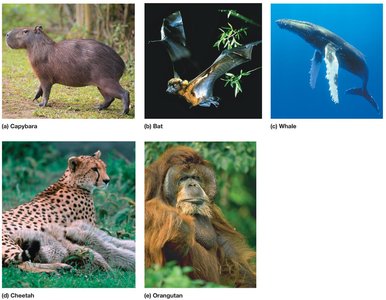
Rodents: Account for nearly 40% of all mammal species; includes rats, mice, squirrels, and the capybara (largest rodent).
Bats: Make up about 20% of mammalian species; only mammals capable of powered flight, with adaptations for nocturnal life and echolocation.
Other groups: Includes whales, cheetahs, orangutans, and many more.
Example: Bats use echolocation to hunt insects, emitting high-pitched sounds and interpreting the returning echoes.
Comparison of Mammalian Groups
The following table summarizes the key differences among the three main mammalian lineages:
Group | Reproduction | Geographic Distribution | Key Features | Examples |
|---|---|---|---|---|
Monotremes | Egg-laying | Australia, New Guinea | No nipples; milk oozes through skin | Platypus, Echidna |
Marsupials | Live birth; pouch development | Australia, Americas | Pouch for young; less complex placenta | Kangaroo, Wallaby, Tasmanian devil, Opossum |
Placental Mammals | Live birth; prolonged uterine development | Worldwide | Complex placenta; diverse forms | Rodents, Bats, Whales, Primates, Carnivores |
Key Terms and Concepts
Endothermic: Organisms that regulate and maintain a constant internal body temperature.
Ectothermic: Organisms whose body temperature varies with the environment.
Mammary glands: Specialized glands in female mammals that produce milk for offspring.
Placenta: An organ that facilitates nutrient and waste exchange between mother and embryo in placental mammals.
Echolocation: A sensory system used by bats to locate prey by emitting sound waves and interpreting the returning echoes.
Additional info:
Monotremes represent a basal branch of mammalian evolution, retaining reptilian traits such as egg-laying.
Marsupials and placental mammals share live birth, but differ in the complexity of their placentas and the developmental stage of their young at birth.
Placental mammals have radiated into a vast array of ecological niches, from aquatic environments (whales) to aerial habitats (bats).
